

How to Train Your Dragon 2

Updated: Aug 16
After How to Train Your Dragon came out in 2010, my family saw it shortly afterward, and it has since become one of our favorite movies. Its breathtaking animation, hefty dilemmas, memorable characters, and an eclectic array of dragon designs helped it stand out as one of the definitive animated films of the early 2010s.
Considering how devoted my family and I became to the movie, I was evidently excited to see How to Train Your Dragon 2 and what it would offer. What only added to my excitement over this movie was that DreamWorks Animation had a reputation for crafting genuinely strong, worthy sequels to some of its most celebrated films, with the most celebrated of them all being Shrek 2, Kung Fu Panda 2, and even the Madagascar sequels. And considering how each film either continued what made the first film so good or only made them even better, I was generally curious to see what How to Train Your Dragon 2 would have achieved.
As for what we ended up with from this follow-up? Much of the original film's magic had been maintained here, though this one seemed slightly less majestic, if only by a small margin.
Allow me to explain why that is, starting with the story.

Set five years after the first film, Hiccup was about to become the next Chief of Berk, which became a dragon-friendly community. It provided food stands for the dragons, water buckets in areas where they could catch fire, dragon races, and even dragon dentistry. And regarding their connections with the dragons, Hiccup, among other people, went even further with his technological innovations with his fellow dragon, Toothless, as best demonstrated when he went from flying on him to sometimes flying with him.
However, during their explorations, Hiccup and Toothless, along with Astrid and their friends, soon encountered unusual activities and locations nearby. This began when they came across a gang of dragon trappers led by the charismatic Eret, son of Eret. Their investigation also led them to some warped icy fortresses that initially appeared unnatural. But as evidenced by the wreckage of the ships intermingling with the structure of the ice formations, they resulted from coordinated attacks by an unknown creature lurking nearby. After stumbling into one of those ice fortresses by chance, Hiccup discovered all kinds of mysterious wonders from that cave, such as a whole horde of dragons, their leader and Alpha Dragon – a giant, regal dragon called the Bewilderbeast – and the last thing Hiccup anticipated: his mother, Valka, who had gone missing ever since Hiccup was born.
Shortly after, Hiccup started from the very beginning and tried to reconnect with Valka as he got to know her. One of the most astonishing talents Hiccup picked up from Valka was her ability to detect hidden talents in dragons, even Toothless. Meanwhile, fearing he was lost, Stoick and Gobber set out to find Hiccup, but once they reached the icy fortress and investigated further, it led Stoick back to his wife. This unexpected reunion was a blessing in disguise and helped heal some wounds that Stoick once believed could not be healed.
However, that was not the only discovery that caught them by surprise.
Just like Stoick, Astrid also set out with her friends to find Hiccup, but along the way, they ran into an enemy force on the horizon. The opponent was a dastardly dragon tamer named Drago Bludvist, who was known for capturing dragons and exploiting them. And by exploiting them, I mean that he figured out tricks to manipulate them and reduced them to their primitive states as they accomplished dangerous tasks under his command. And what’s worse, Drago had done that with many dragons and unleashed them on countless villages before, with Berk being among his former targets. Even Valka knew him from way back when and, just like Stoick when he was told about his return, knew better than to mess with him and his forces.
So, once Hiccup, Astrid, and all their friends and families caught on to the gravity of the situation regarding Drago and what he meant to do, including with their dragons, would Hiccup and his friends have had what it would take to stop Drago and his plans? What more could Hiccup and the others have learned about and from Valka? And what more would Hiccup and Toothless be capable of that they were not aware of before? And at what cost would the friends have seen to it to protect Berk?

For starters, let me talk about the animation and the atmosphere.
The animation had clearly developed significantly over the four years between the first film and this one. With the first film, I remember it capturing many distinct details about Nordic and Viking culture and being very imaginative with the dragons’ designs. But here, in addition to maintaining its imaginative hold, it went even further, extending its textures not just to clothing and customs but also to the characters’ bodily features. There were more noticeable features on the characters now, such as facial hair on Snotlout, Fishlegs, and especially Hiccup. While the designs of some characters, like Drago, were a little questionable, the animation improved to the point that the dragons and humans looked more realistic and detailed.
And regarding the atmosphere, what I remember loving so much about the first film was that it felt massive and all-encompassing, like you could easily fly anywhere you wanted and feel like you were part of a much bigger world.
In this film, the shift in atmosphere was evident. It adopted a murkier, more ominous tone than its predecessor. This darker approach felt intentional, since it reflected the characters’ progression into adulthood and more complex, morally ambiguous territory.
The atmosphere throughout the movie helped it feel much bigger for several reasons. This time, it introduced more elements into How to Train Your Dragon, raising the bar for what the characters had to face. Whenever new locations were explored, the atmosphere heightened their exoticism—like the ice fortress where Hiccup’s mother had lived for years. I’ll explain more about that shortly, too. It also made the movie's horrific acts more severe; the portrayal of Drago and his followers intensified the film’s sense of threat and made his villainy truly felt.
That’s all part of growing up, and to see Hiccup and even Astrid and all the other characters do the same thing was very engaging to see.
But let me explain a little more about the Bewilderbeast that lived with Valka and the other dragons. To start, this dragon fixed probably the biggest problem in the first movie.
And if you may recall, the dragons, including Toothless, had to pick up their prey so they could feed them to a ginormous dragon called Red Death. And while Hiccup and Astrid correctly deduced that they were basically serving as if their home was a hive, and the Red Death was their queen bee, I felt that this was a little flimsy and out of nowhere for a type of dragon functionality. However, in this movie, as Valka elaborated about the Bewilderbeast, it was…
(…) One of (the) very few that still exist. Every nest has its queen, but this is the king of all dragons.
And what was elaborated on the Beweilderbeast regarding the dragons’ servitude and their connections seemed more biologically sound. For example, the Bewilderbeast would have let out a calling cry that would have synced the dragons up with his line of thinking and ordered them to do his bidding. I don’t know if it’s because the dragons would have answered to the Bewilderbeast on a much deeper level compared to when they served the Red Death, but somehow, that kind of symbiotic connection all added up in this movie and made much more sense.

And as for how much Valka knew of the dragons outside of the Bewilderbeast?
Throughout the movie, there were hints dropped as to what Toothless was capable of and how he stood out compared to all the other dragons, and not just because he was the last Night Fury. And by the time Hiccup understood Toothless more, and even Valka had a hand in speaking with and getting to know Toothless more, it became more apparent that Toothless was capable of performing far swifter and more agile movements that unleashed his true potential, and even more that would demonstrate as such, even compared to the Bewilderbeast. As if to say, the size and strength wouldn’t matter as long as you knew exactly how to disperse your power and energy.
If the Bewilderbeast represented that in terms of their bulk, Toothless represented that in terms of his stealth and his general ‘huge things come in small packages’ stature. And from what he managed to unleash in this movie, it went to show just how much Toothless was maturing as well. And that was nothing short of remarkable.
John Powell returned to do the music from the first film, but by comparison, again, it wasn’t quite as majestic as in the first film. I still think the music in the first film was one of the strongest parts of what made it such a masterpiece. And while the music continued to show some muscle in this film, I think it showed more of that than its magical essence. But even I didn’t find that as a bad thing. I feel that the music didn’t quite match the mesmerizing quality of what John Powell achieved in the first film.
However, the one part of the music that stood out to me was the song, ‘For the Dancing and the Dreaming,’ performed by Stoick, Valka, and even Gobber. It started with soft, purely romantic essences seeping through as Stoick sang the tune to Valka. Soon, once it found its footing, partially thanks to Valka joining in, it went through a crescendo and flourished as a borderline folk dance, the likes of which may have tied back to whatever Nordic customs were practiced, probably when Stoick and Valka dated. This song was romantic, full of energy once it found its rhythm, and the vocals by Gerard Butler, Craig Ferguson, and Mary Jane Wells as Valka helped cement the song’s seemingly fitting essence for either a courtship or a family reunion.
As for the characters, both returning and new, they added a ton of juicy dynamics to this film.
Let’s start with Hiccup. In this film, he felt less scrawny or awkward than he had in the last one, which was to be expected after five years had passed. But what I found impressive about his growth in this movie was his willingness to seek out ways to reconcile, and I don’t mean just with Valka when he finally met her. He also attempted to demonstrate it as such with people like Drago, not realizing just how dangerous he and his horde of men were. This aspect of his character demonstrated the naiveté he still had, despite his budding urge to prove himself a true future leader of Berk. Hiccup was even doubtful about his capabilities as a future chief, as he was busier learning more about dragons than protecting his own people. But as Stoick, Astrid, and even Valka pointed out to him, his heart was in the right place, and that would’ve guaranteed that he had what it took to prove himself as a worthy chief. And despite his obstacles, Hiccup’s journey, with or without Toothless, would demonstrate why.
With the side characters, how were they like in the movie?

For as long as I’ve remembered her in this movie, I always thought Astrid would have been relegated to being Hiccup’s love interest and always being on his side. However, as I saw her in this film, while she did have moments of being on Hiccup’s side when the going got tough or when Hiccup struggled with something, there were plenty of other moments when she took matters into her own hands, especially when it came to looking for Hiccup. And when she and her friends stumbled into Drago and his horde of army ships, who hunted down dragons and enslaved them, that’s when Astrid expressed more of a fierceness in her that would have shown her true worth. Compared to the first film, she was still as reasonable as ever, but all the feistiness I remembered was replaced by a fierceness in loyalty and headstrongness. So, as I saw her in action, I became convinced that, as Hiccup would have made a great chief, so too would Astrid have made a great chieftess who could hold out on her own, and not just have Hiccup’s back.
The rest of the characters, including Fishlegs, Snoutlout, Ruffnut, Tuffnut, and Gobber, all made a comeback. And though they lacked much character, they still offered some genuine comedic banter that lent this movie a more lighthearted tone. It’s like it was the movie’s way of reminding us that what we would see would be much more drastic than what we’ve been used to in the first film, only we shouldn’t expect it not to have a sense of humor about it. As for how well it did? I’ll elaborate on that soon, also.
Speaking of comic relief, I like how Gobber was as a character. In the first film, I remember how much of a borderline second parent he was to Hiccup during his apprenticeship, on top of being a close friend to Stoick during his more uncertain moments. In this film, considering all that they had learned and gone through after their encounter with the Red Death, it seemed like Gobber still had his knack for his sense of humor while also feeling more like a second-in-command in terms of his relationships with Stoick and Hiccup, and not just as Stoick’s best friend.
And as for Stoick the Vast, I found it interesting how his character was portrayed in this movie compared to the first film. In the first film, I remember Stoick being a very proud leader of his people of Berk. But he also came across as a little too stubborn and unreasonable, especially when it came to Hiccup attempting to explain to Stoick that the dragons meant no harm, even though Stoick and the other Berkians were clearly living in fear of them.

But in this movie, all the stubbornness and lack of reason have melted away to display him as a much prouder chief of Berk than ever before. And as a father, he felt more understanding, for he wanted to do everything it took to prep Hiccup not only for the role of chief, but also for the trials and tribulations of the real world, like he should watch out for anyone who would dare intrude upon their tribe and town.
Now, some of the new characters introduced in this movie were very fascinating too.
Hiccup’s mother, Valka, was an exquisite character because, much like Hiccup, she learned the ways of the dragons, only she learned to live with them, especially at a time when her husband, her son, and the rest of Berk all lived in fear of the dragons and hunted them down in response to it. With Hiccup, he began to accumulate a general know-how of dragons, the different species, and what each one was capable of. And he’s been basically picking up on all of them the same way a student would pick up on certain things that no one else would have known before. Valka, however, was a borderline dragon whisperer. She not only knew everything there was to know about dragons, but she mastered certain techniques that would have allowed her to understand what the dragons were feeling, what they were protecting, who they were protecting, what they were looking for, and whatever else there was to understand about dragon psychology, dare I say it. What I liked about the relationship that bloomed between Hiccup and Valka was that Hiccup carried a lot of his mother in him, with her sense of understanding and her deepening of relationships with dragons. Whereas, from what I can see, Hiccup also inherited his inner drive, commitment, and negotiability from Stoick.
As for Eret, son of Eret, he, too, was interesting because he was initially introduced with his friends as a band of unscrupulous dragon trappers. I saw them as the Nordic equivalent of poachers who would have captured any dragon they found. Only in their case, they would have shipped them off to Drago Bloodlust in exchange for possible payment. But once Eret met up with Drago, the way their meeting went down felt like watching someone try or fail to pay a mafia boss their debt. That is to say, if they did not repay him with what he demanded, then they would have been as good as whacked. That is the exact kind of vibe I got from Eret in his movie whenever he did business with Drago.
But as for him turning over a new leaf and joining the Berkians, I did see some signs that led to him changing sides, such as when Stormfly, Astrid’s dragon, constantly protected him, especially when she wasn’t busy making a fool out of him or pressuring him into revealing someone’s plans or whereabouts. Abrupt as I found his decision to switch sides and join the Berkians to be, considering what he did concerning Drago before joining the Berkians, it conveyed some interesting character dynamics and how he went from snatching dragons to befriending them, not to mention getting in touch more with his humane side after getting along more with the Berkians.
Now, let’s hop over to the villain of the movie, Drago Bludvist. When you look at what he stood for, you’d see how he became one of the most menacing villains from How to Train Your Dragon.

Let me explain how that is. Whenever Drago’s mere name was mentioned, Stoick reminded Hiccup that he was a madman with no conscience or mercy. And as he explained, Drago once approached him and the other members of the board, at least when there were more chiefs like him, and I believe they were the closest in relations to the Vikings. Drago came to them as a stranger and told them that, if they bowed down to him, he could have the dragons leave them alone, but they laughed him off. But just as they did, Drago turned his back on them and sicced the dragons on them, showing just how much control he had over the dragons, with Stoick being the sole survivor of the onslaught.
And what also made it interesting, as he explained to Hiccup, was that he, too, lived in fear of dragons once. But whereas Hiccup learned to conquer that fear and turn his fear of the dragons into a better understanding of them by getting to know them more, Drago’s idea of conquering such fears was to weaponize the fear of dragons onto others, whether it be onto other dragons or especially onto other people. Hence, he was working his way onto other tribes and villages for dominion over all that he could reach. In a way, it made him feel more like the Vikings we know from history than the Vikings who made the village we know as Berk. It did make him a very compelling polar opposite of Hiccup, and when you look at his actions throughout the movie, he was far more intimidating than I might have expected.
He was pretty much like the Shan-Yu of Vikings. I found his characterization a little lightweight, but his reputation and ruthless nature made him all the more memorable. His background and how dark and twisted a reflection he was of Hiccup in his achievements and discoveries about dragons were interesting and gave this character a little more weight.
Of course, as fascinating as I found all the new characters to be, I want to shed light on the three voice performers who joined How to Train Your Dragon to lend their voices, because I personally believe what they lent were absolute knockouts.
Let’s start with Cate Blanchett as Valka. Every time I heard her speak through this character, she captured her character’s inner confidence and resolute nature as she explained her background and expertise among the dragons. But surprisingly, she also showed a more free-spirited, laid-back side of her voice as Valka took her much-needed chance to be Hiccup’s mother again. And that was a surprise because whenever I thought of Cate Blanchett, I always remembered her for how she captured the strength of a woman who’d gone through a lot, as well as the grace and inner tenderness of a woman who had grown in her wisdom.
Either that, or I might be thinking of Galadriel from The Lord of the Rings.
Speaking of epic fantasies, let’s go back to Eret.
What I remembered him the most for was who played him, and it was none other than Kit Harington, AKA Jon Snow from Game of Thrones. Now, if you remember my review of Game of Thrones, I thought the performances, epic fights, and political discussions were all very well established. Yet, I found some of the story choices and character executions – in more ways than one – to be too out of line for me. Yet, Kit Harington’s performance as Jon Snow was among the show’s highlights in terms of its acting.

As for what Harington conveyed of Eret in How to Train Your Dragon 2, he started by expressing the absolute opposite of what he usually conveyed. With Jon Snow, he played him with a more sensible, thoughtful approach. But with Eret, he started by portraying him as a more dubious type of character, the kind who meant serious business and was unwilling to let anyone stand in his way. But as soon as Eret began to soften toward the Berkians, Harington let himself go, as Eret leaned more into his humane side while still maintaining the sense that he had a ton of experience and was more serious about certain things than others.
It leaves me with probably the most surprising voice performance in the whole movie, Djimon Hounsou as Drago Bludvist.
Every time I saw Drago, I recalled just how fierce, intimidating, and dastardly he was whenever he was out doing his thing or controlling other dragons. But the fact that Djimon Hounsou did his voice completely blew me away. I had seen Djimon Hounsou play plenty of roles around the time the movie came out, especially as Korath in the Guardians of the Galaxy movies. But what he conveyed as Drago was just a home run. He captured Drago’s committed, intimidating qualities as he lunged out to conquer those who opposed him. But it was also interesting because that was more or less the human side of him when he sounded intimidating and dealt with other humans who opposed him. But whenever he got in touch with the dragons, he let out a more feral cry with characteristics that would have made him resemble more or less the uncivilized, savage side of the dragons, compared to Cate Blanchett’s more sensible and innocent side of the dragons.
Long story short, the three newcomers who came to join How to Train Your Dragon in this movie all played their roles to perfection.
As for the rest of the voice actors who returned from the first movie, they all continued to master each character’s cliques and establish them with the same energy, thoughtfulness, and buoyancy as in the first film. In doing so, they also highlighted the expertise and professionalism they mustered at this point in their characters’ lives, further demonstrating how much they’ve grown.
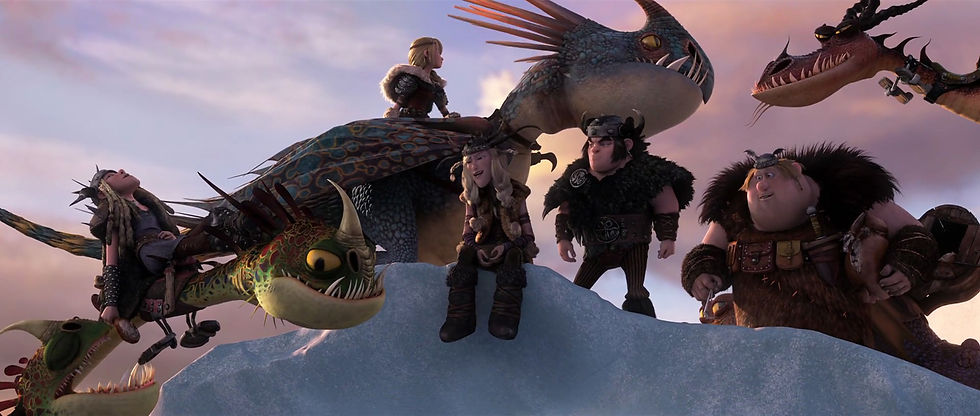
TJ Miller and Kristen Wiig continued to hone the typical brother-and-sister banter and butting of heads they mastered in the first film, Wiig as Ruffnut and Miller as Tuffnut. Only now that they’ve gotten the hang of piloting on their accompanying dragon, the Hideous Zippleback, there did appear to be more of a collaboration between them…when they weren’t busy fighting. I also have to give Kristen Wiig some credit in this film. I will explain why this is when I get to it, but she expressed far more character to Ruffnut than she might have in the first film.
Craig Ferguson, who played Gobber, continued to master his character’s little quirks. But while he conveyed a potentially more grounded and confident facade, he had never lost his giddy, lighthearted side, which highlighted which childish aspects had faded in this character and how much more expertise had begun to take their place in him.
Of course, by the time Valka came into the picture, it demonstrated just how distinct he was as a parental figure to Hiccup compared to either Volka or Stoick. In the first film, Stoick and Gobber were kind of like opposites as parental figures for Hiccup, Stoick being the harsh one and Gobber the lighthearted one. This time, with Stoic, Gobber, and Valka, these three still managed to remain distinct parental figures for Hiccup and thus excellent influences in Hiccup’s life.
Jonah Hill still managed to convey Snoutlout with just as much flamboyance as he had shown in the first film, and how willing he was to try to prove his worth, either to himself or to others.
And before I forget, let’s also talk about Gerard Butler.
Whereas most of the returning cast played their characters with the same lightheartedness as before, but with more seriousness, Gerard Butler almost went the opposite route with his character. In the last film, Gerard Butler played Stoic the Vast with sheer pride and viciousness to highlight how he was not the ruler of Berk for nothing. But he also maintained his general disinterest or excessive pride regarding Hiccup and just what capabilities he had as a Viking. What separated Butler’s performance in this movie from what he established in the last film was that he conveyed a more understanding side of himself, both as the leader of Berk and as a father to Hiccup, once he finally began to appreciate Hiccup for what he had accomplished and what he meant to do.
On top of that, by the time Stoick reunited with his long-lost wife, there was something about his voice that seemed to emulate how much of a long-lost part of himself had finally returned. It’s like we finally saw the Stoick that used to be very happy and proud of who he had in his life and what he had achieved before both Hiccup came along and his conflict with the dragons took hold. So, Gerard Butler went to town in maintaining what made the character so memorable from the first film while also throwing in new aspects to him, just like a good chunk of the returning cast in the movie.

America Ferrera still maintained Astrid’s sense of inner drive as she did in the first film, only this time she conveyed an intensified loyalty in her voice, like when she spoke to Hiccup. And by the time Astrid went out on a loop and either made some discoveries on her own or tried to reason with other people about what’s going on, you can still tell that she was still conveying Astrid with the same amount of resoluteness and firmness in her character that she did in the first film when she wasn’t busy horsing Hiccup around. For some reason, that told me just how capable Astrid was of being a future leader, especially of Berk.
And speaking of future leaders, that’s one of the biggest highlights of Jay Baruchel’s performance as Hiccup in the movie.
There was still a sense that Baruchel was playing a young man who still had a lot of things to learn, whether it’s about dragons, how to negotiate with other people, or how to prove himself as the future leader of Berk. And his awkward nature was still somewhat apparent in this movie, helping hone his more comedic moments, whether with Hiccup or in his conversations with Toothless.
This time, however, Baruchel honed more of a firmness in his voice to highlight just what Hiccup was still compelled to do, even when the odds seemed hopeless. No matter what other people said to Hiccup or how many times they tried to talk him out of something, there was an inner part of Hiccup that still tried to get to the bottom of what he knew had to be done and also done right, and that no matter what obstacles may have come his way, he would have continued to do what he knew in his heart had to be done, if things were going to be resolved somehow.
Jay Baruchel’s performance this time was nothing short of a hallmark, considering how often I associate Jay Baruchel with comedic roles and how much of his comedic antics he maintained with Hiccup in this movie.
The locations explored in the movie were as distinctive, mysterious, and eye-opening as can be, especially the ice fortress where Valka lived and was found. I found it most mesmerizing because of the cave’s icy, crystalline, warped formation. It just looked like one of the most mystical, exotic locations that dragons could’ve lived in and been found. And I can see this being the ideal hideout for Valka, since it reflected her more intrinsic, alluring, compelling, and dignified qualities, apparent when it came to familiarizing yourself with dragons and maintaining a worthwhile relationship with them, no matter how it would have turned out.
Now, there are other things to highlight about this movie that caught me by surprise. I’m pretty sure you know this by now, but this is where I’m about to venture into spoilers.

As the Battle against Drago began to intensify, he revealed that he had a Bewilderbeast of his own, which obviously put the characters in deep sludge, considering that, with another king of all dragons under his control, there’s no telling how far he was willing to go to achieve his goals.
And it culminated in, of all things, the death of Stoick, which I did not anticipate something like How to Train Your Dragon 2 to do. It was sudden, I wouldn’t have seen that coming, and because it came from a blow from a brainwashed Toothless, it only added to the collective tragedy of this outcome. And since Stoick was a regular character on the TV show as well, his death would have been even more shocking. While I remember Stoick’s death more for its shock factor than for its tragic angle, that doesn’t mean the emotional pain wasn’t there.
With all that said, is this movie as good as the first film?
Almost. And I mean with a capital A.
Looking at this film again, I noticed three things that kept it from being on par with the first film, but, again, only by a margin.
As I said, Snoutlout, Fishlegs, Ruffnut, and Tuffnut all came back to help the heroes on their journeys in this movie, but they felt more like extra faces in the crowd. They still provided the right comic relief in the right doses, but they all didn’t establish enough character to make any one of them more memorable, whether you’ve seen this movie on its own or if you’ve seen the first film beforehand.
There were two surprise exceptions, however, that seemed short but sweet and revealed some extra aspects of one’s character.
The first was Ruffnut. When she wasn’t bickering with her brother Tuffnut, watching her ogle Eret highlighted more of her girly nature than I recalled from the first film. And that was quite unexpected, considering how it made her a bit of a standout compared to Tuffnut. That, and I remember Snoutloud admitting that he had the hots for Ruffnut, though that was interesting, too, considering how, in the last movie, it was Astrid he had the hots for. So, I wonder if maybe Ruffnut’s aggressive side matched his own.
And as for the other exception, I’d point to Fishlegs. Because of his initial knowledge of the dragons from reading and almost memorizing the Book of Dragons, he went ahead and put together some note cards of all the dragons he and Berk had discovered thus far. And judging from how he introduced each of them, they almost looked like trading cards.
Is it just me, or was this habit of his a reference to what might have been a customary practice in the original book series by Cressida Cowell?
But regarding the second issue I have with the movie, I found Drago’s exit a little anticlimactic. In the climax, Hiccup and Toothless finally got the upper hand against Drago and his Bewilderbeast as Toothless and his fellow dragons unleashed their attacks all over the Bewilderbeast, not to mention firing Drago’s fake arm off. Suddenly, the Bewilderbeast retreated as he slunk back into the ocean, with Drago still on him. That made me wonder, did Drago drown? Was he eaten alive by the Bewilderbeast? Did he survive? Even watching Hiccup look down into the ocean seemed to imply that perhaps he was not quite dead. But considering all the horrible things that Drago had done throughout this movie, you would think that maybe there would have been a much more severe payback for him. That was nothing, though, compared to what was really in store for Drago, but that’s something I’ll have to save for the next film.
But how about the third part of the movie that I found a little underwhelming?
Well, at first, I couldn’t put my finger on it. When my family and I saw How to Train Your Dragon 2 together in theaters, we had no regrets in seeing it this way. But while I enjoyed it, I still found myself leaning towards the first film over this one, and I couldn’t figure out why. I knew the animation was still marvelous, and the storytelling had fully matured with the characters, which was clearly crucial for a sequel to a beloved family film. And while the situations dwelled on in this movie were weighty compared to what was dealt with in the first film, it was a satisfying kind of weighty, as they really helped hone in on the coming-of-age nature that Hiccup and the others went through.
But after watching it again, that’s when it hit me. I think the movie had a slight problem with struggling under the weight.
As I said, the atmosphere was lush in its emphasis on the tragedy or seriousness of the situations at hand. But because it did such a good job of making them such a big deal, it ironically got to the point where they sometimes outweighed the narrative and character development.
Think about it. You have Hiccup discovering that there’s another dragon master who would have conquered dragons through sheer force. Hiccup found out that his mother had been alive for 20 years, and he never knew it. Drago and his forces were corrupt nomads who would have set out to conquer anyone they ever came across, with the dragons on their side. Drago surprised others with his own Bewilderbeast, which impaled the other Bewilderbeast who had befriended Valka. Stoic the Vast took a hit for Hiccup and ended up being killed right away. And when you add that all up, suddenly you get a far more heavy-duty portrait of what the characters dealt with in this movie.
Look at The Lion King and Toy Story 3. Both those movies dealt with some very serious, heavy-duty themes. And in The Lion King’s case, it also dealt with the sudden death of a beloved father figure. But they both worked because they had enough lighthearted elements and whimsical scenarios to help balance it all out. With How to Train Your Dragon 2, it still maintained its sense of humor as the first film did. But when you pit it and the already-endearing characters against the travesties and earth-shattering discoveries at hand, that’s when it started to get a touch lost in the shuffle. And as a result, while I respect How to Train Your Dragon 2 for what it did compared to the first film, it made the situations feel a little too overwhelming.
SPOILERS END

But those three nitpicks did not, by any means, diminish the vast greatness and mature storytelling of How to Train Your Dragon 2. They felt more like a nitpick compared to the dragons serving the Red Death in the first film.
But complications aside, for what How to Train Your Dragon 2 had to show for it, it still proved its worth as a worthy follow-up to something as masterful as How to Train Your Dragon. And the fact that this was such a strong sequel to a movie based on a series of books, despite being seemingly unrelated to the books themselves, goes to show just how commendable this movie was as a cinematic achievement.
I have yet to see the TV show, but I can’t help but see it as the closest the film franchise has come to capturing Cressida Crowell’s writing style, sense of exploration, and sense of style.
But outside of that, How to Train Your Dragon 2 was a very strong sequel. It came super, super close to being as masterfully done as the first film, but that’s still a remarkable achievement. The animation carried enough weight to propel this franchise into new directions while jiving well with what the franchise held onto. Its explorations of dragon mentality and capabilities remained as engaging as ever. And the film’s coming-of-age themes felt strong and appropriate to the main characters’ struggles.
After being used to DreamWorks Animation’s techniques of sequel-making and how much my family and I adored the first film, I expected nothing less than what we had seen in the first film. While this was a tiny step below the first film, it was still a tremendous achievement for how it continued the story of How to Train Your Dragon. It took it to darker places than we’d seen in the first film, and because of what went down in this movie, the next steps the franchise took were genuinely monumental and worthy of recognition.
Be prepared to hop back on because this follow-up will send your spirit soaring.
My Rating
A high A


Comments