

Mulan (1998) - Chinese New Year Re-Review

Updated: Mar 4
Normally, I would’ve written a review in anticipation of Valentine’s Day on the designated holiday. But this year, in honor of the Chinese New Year, and henceforth the Year of the Horse, allow me to take this opportunity to retrace my steps with a familiar classic.
As we probably know, the era retrospectively known as the Disney Renaissance was a prestigious time for Disney and its fans, as Disney kept churning out one animated gem after another, all of which still resonated with fans who grew up with them. After exploring many different avenues throughout these films, including France, Africa, Greece, and even our own American history once upon a time, the Disney film I will focus on in this review ventured into the depths and wondrous beauties of ancient China.
And that film is Mulan.
When anyone thinks of the name Mulan, it’s easy to know what they think of: a young woman who posed as a man so she could have snuck her way into the army in her father’s place. That’s true of the original legend, which had come forth over 1500 years ago and, the way I see it, is to China what figures like Paul Bunyan and John Henry are to America. But while this movie’s sense of authenticity is up for debate, its artistic prowess in demonstrating why Mulan was such an important figure in Chinese mythology – or history – is most profoundly resonant here.

Let’s get into the story, or rather, the movie’s take on the story.
Fa Mulan initially lived her life as a humble yet inventive daughter of a proud Chinese soldier named Fa Zhou. One day, Mulan prepared to be the next bride and be granted the proper matching husband. But after some pratfalls, it left her disgraced as the next in line for potential marriage.
However, that kind of trouble was nothing compared to the news she was about to receive concerning her father when he was requested to join the Imperial Army and serve in a war against the invading Hun army, who, with their fierce leader Shan Yu – who had a beef for the Chinese Emperor – crossed the Great Wall and launched their way into China. However, Mulan was not on board with this, not just because she loved her father too much to let him join the army, but also because he was old and frail and thus unfit to serve. Ultimately, she decided to do the unthinkable and join the army in her father’s place. Her parents, however, were fearful of this, knowing that if she was discovered as a woman, especially one who took her father’s place in the army, she would’ve been in even deeper trouble. Because of this, the parents and the grandmother prayed to their ancestors to watch over Mulan. Upon listening, they decided to guide her in the form of an assigned guardian, only for the volunteer, much to their chagrin, to be a small dragon named Mushu.
Once he and Mulan met up and she finally made it into the Imperial Army, she started on the wrong foot with some of her male comrades before ultimately telling the Captain, Li Shang, that ‘he’ was actually a boy named ’Ping’, the untold son of Fa Zhou and hence taking ‘his’ father’s place in the army. From there, Mulan went on to learn all of the combat skills necessary to build up her stamina as a forthcoming warrior for China. And the farther she and her comrades went, the closer they were to being all set to fend off Shan Yu and the Hun army.
Would they have had what it took to stop Shan Yu and the Huns in their tracks before they got anywhere close to the Emperor? How long could Mulan have stayed undercover as ’Ping’ before her cover would have been blown?

Ever since I was young, I always looked back on this movie out of fondness for its mystical essence. I remembered being drawn into ancient China’s mere culture, mostly because of how rampant the sheer elegance, exotica, refinement, and delicacy were throughout the land. Of course, considering that this was in the Far East, that’s to be expected. You’re talking to someone who grew up in America and caught on to Chinese culture at a young age. But as far as introductory movies went, this could not have been one of the stronger movies to start us off on the right foot with.
And yes, I’m well aware of some of the liberties this film took with the Eastern customs. For example, the original ballad, while portraying China’s more genteel regulations regarding women, depicted their potential to participate in the war effort as being met with astonishment at most. But while the film maintained the more genteel regulations expected of women in China, the rest of the regulations concerning women and the likelihood of their role in the war effort were conveyed with more restrictive, if not misogynistic, levels. Also, the dress and makeup in which Mulan presented herself when she met the Matchmaker strongly resembled those of a geisha, which is a Japanese custom, not a Chinese one. But you know what? One: the ‘social norms’ shown in the film were conveyed for dramatic historical effect. And two, since the fortune cookies we enjoy all the time in Chinese restaurants actually originated in Japan themselves, and no one batted an eye over these cultural implementations, then perhaps none of this is worth making a fuss over anyway.
But the strongest facet of this movie, which helped lend it its long-standing legacy, is the animation. As expected from Disney’s lineup throughout the 1990s, the animation in this film still carried the sheer vibrancy, smoothness, and elegant touch that made some of Disney’s most successful animated films from the decade so worth celebrating. Every time I see the animation at work, I can feel the dedication behind the movements and poses, even among the movie’s more intimidating characters. Even Chen-Yi Chang’s animation of the characters was stylized enough to feel distinct, but never overtly stereotyped, which felt just right for this film’s more introductory aspects of Chinese culture.
Of course, that’s nothing compared to the animation’s own strongest facet, the backgrounds. Conveyed most stunningly by Hans Bacher, they lent themselves very closely to the cultural Chinese grounds, down to the formations of the mountains and the distinct styles of the Chinese architecture, whether in Mulan’s hometown or in the Forbidden City. They even embodied many key aspects and poses reminiscent of classic Chinese paintings, especially at the beginning of the movie and in the middle of ‘A Girl Worth Fighting For’.

Sometimes, the animation, when the slapstick took center stage, did provide the cartoony riots and humor you’d want in such circumstances. But when it’s hefty, serious, or quiet, it allowed the atmosphere, contemplations, and emotions concerning them to populate the screen until you’d finally feel the weight of what the characters dealt with in that moment.
I’m also impressed by the animation applied onto the entire Hun army as they barged down onto the Imperial Army from atop the snowy mountains. I’m convinced that they were animated by the same people who animated the wildebeests during their stampede in The Lion King. It helped expand the scope of this encounter and heightened the collective sense of danger when feeling outnumbered and overpowered by your enemy forces.
By the way, while I’m still on the topic, what do you say we hop over to the characters? Because, let’s face it, I still have a huge soft spot for a good chunk of them after all these years.
Starting with Mushu, I found him to be as zany a comic relief as ever. Besides the cutesy nature of his size, Mushu expressed himself with a ton of egotism to him and was mostly concerned about trying to maintain his reputation and position as a family guardian, despite him being asked the first time to summon the ‘great stone dragon’ to watch over Mulan because of how heavy-duty the conditions to which Mulan was about to subject herself was to become.
There’s one detail about Mushu I never caught on to before that helped make his character worthy of further evaluation. It was said that he was a collective outcast as a family guardian because the last time he attempted to assist one of the past members of the Fa family, named Fa Deng…well, looking at how he turned out, Mushu’s shenanigans left him beheaded. This background gave Mushu a little more depth and added to his humorous angles as a sidekick. So, to see Mushu go to great lengths to restore his reputation as a worthy guardian for the Fa family suddenly seemed understandable, even if his comedic antics and self-centered means overshadowed it.
However, as he spent more time with Mulan, he slowly began to reveal his more considerate side when it came to looking out for Mulan and her welfare, especially when she had to hide her identity as a soldier of the Imperial Army. So, when it got to the point where, outside of his comedic antics, he began to express more concern for Mulan as her bodyguard, that would have put him in a more sympathetic light, especially after being so used to him at his comedic or egotistical best.

One other part of the movie that kept slipping by me that deserves some attention was the Fa ancestors themselves.
Led by the first ancestor, voiced most astoundingly and with evident prowess by Star Trek veteran George Takei, the ancestors all felt like spiritual beings who once lived as relatives of the Fa family. Yet, for all their spirituality, their constant banters felt typical of how extended families would have debated among themselves about what right steps they could have guided their descendants with.
Cri-Kee, at first, seemed like just another cute sidekick to tag along with Mulan. But considering that, when he was first introduced, it was Grandma Fa who brought him along, thinking he was the lucky cricket, what I found so memorable about him was how overwhelmed he was by all the precarious, death-defying situations he ended up in, and how exhausted he was every time. Even if he grew devoted to Mulan as she settled in the Imperial Army, he sometimes had his doubts about how lucky he was, even for Mulan. It’s like he thought to himself – in the words of Linus from Peanuts and Charlie Brown here –

Speaking of comic relief, I still found Ling, Chien-Po, and Yao to be as delightful a trio of comrades as ever. It would have had more to do with how distinct each of them was, not just in their personalities but also in their looks, styles, and in how well they complemented each other on all counts.
Yao felt like a tough-as-nails guy willing to lunge into disaster headfirst, but was also short-tempered. I didn’t remember very much about Ling except that he was a bit of a modest wisecracker and felt like the borderline ‘older brother’ figure in the group. And that leaves us with Chien-Po. Surprisingly, despite his large size and nature, he was also the most level-headed and sensitive of the trio, speaking softly, and usually the likeliest to calm the waters before they got too intense.
I also liked how Chien-Po resembled the Buddha: big and round, yet gentle, peaceful, and a borderline embodiment of goodness. Even animator Chen-Yi Chang said so.
And by the time ‘Ping’ began to intermingle with them more, it made ‘him’ feel like she was one of them, despite them not knowing that ‘Ping’ was technically a woman in disguise, and they would even have felt conflicted about that once ‘Ping’s true identity was revealed.
And their contributions in the climax, where they dressed up as women? I considered that the most memorable part of their contributions against the Huns. After being used to Mulan pretending to be a man, it was cool to see the reverse occurring with Ling, Chien-Po, and Yao once they got back together with her, even after her identity was revealed.
Also, why do I get the feeling that Yao dressing up in drag felt fitting to his voice actor? I’ll elaborate on that very shortly, too.
Now, I will admit, I did have a like-hate relationship with Chi-Fu, the Emperor’s majordomo. Technically, he was like Mushu in that he was a bodyguard, only in this case, it was under the Emperor’s command. He was also in charge of Li Shang once General Li chose him to take his place as Captain, while he upheld another part of their mission for the Imperial Army. However, he was snotty at times, and yes, his views on women were the closest the Chinese customs ever came in this movie to feeling misogynistic. But here’s the thing: it wasn’t just him. It was said in this movie that it was a crime for women to partake in the battlefield. That was why Mulan decided to pretend to be a man, so she would be able to blend in with the rest of the Imperial Army. So, in a way, Chi-Fu was practically the embodiment of adherence to Chinese customs to a fault, but not without charming aspects of his own. I’ll explain more about that soon as well.
That leaves us with three major characters to address in the movie.
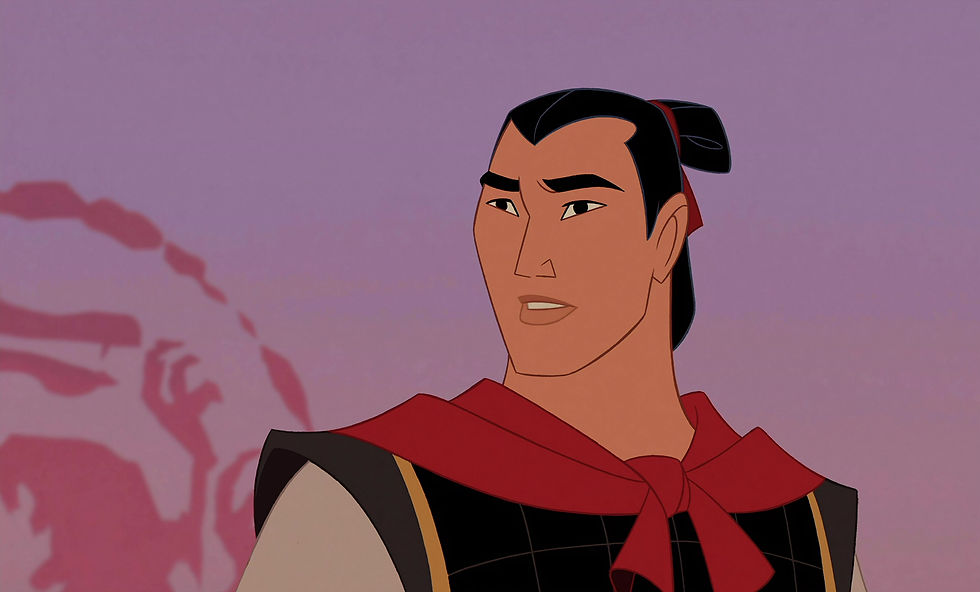
The first one is Li Shang. When we first see him in the movie – and much like what I caught with Mushu, this is one detail of his character that I kept forgetting about – he was promoted as the commander of the Imperial Army as his father, General Li, went off with his soldiers to protect a village on the Tung Shao Pass from Shan Yu and the Huns as they encroached into China and towards the Forbidden City. Judging from his sheer excitement and attempts to prove himself as a commander, it’s obvious that he was still a little young at heart and tried to do his father proud by being the best that he possibly could have. As soon as he stepped into the role, however, what I remembered of Shang was how effortlessly he performed his duties when he ordered his fellow soldiers around and prepped them for battle. He felt like a natural-born leader who was given the chance to prove himself when his father was away. Despite what his youth may have signified of his characteristics and position in power, the fact that Shang so effortlessly kept all of his fellow soldiers in line and gave them the right drills, instructions, and training necessary to prep themselves for battle against the Huns, especially Shan Yu, spoke volumes about Shang’s reputation and capabilities as an army captain.
The next character worth addressing is Shan Yu, the movie’s main villain. There may not have been very much to write home about with him – or the other Huns – just that he was the leader of the invading Hun army, had a vendetta against the Chinese Emperor, and was thus willing to do whatever it took to inch his way closer to the Emperor and strike him down for superiority over all of China.
But I almost don’t care. As debatable as it is on whether Shan Yu was one of the best Disney villains, he was easily one of the most menacing.
For starters, let’s look at the design. With the coat, boots, and animal hides, I can tell that Shan Yu had hunted his way into other people’s territories before. And never mind how turned off some people may feel about his black eyes and yellow irises – some found it a little silly – especially when you look at how every other character in the movie had regular eyes. To me, there’s just something about the colors of his eyes that only added to the creepiness of this character, on top of which it also made him look pretty otherworldly. And in my opinion, it’s just the right kind of otherworldly.
Even his pet falcon, who always scouted the farthest reaches of China to eavesdrop on who was doing what before the Huns made it first, added another threatening angle to Shan-Yu’s character, similar to what the crow did for Maleficent or what Iago did for Jafar.
And how about this line when Shan Yu was given the doll he and the Huns found?
The little girl will be missing her doll. We should return it to her.
I will admit, as a little kid, I thought of that as just a random but conscientious courtesy for Shan Yu to suggest to his fellow Huns. But it was not until much later that I finally caught on to that line’s context, or lack thereof. Considering how the next time we saw that doll, it was stranded in the Tung Shao Pass – I’ll delve more into that soon – suddenly it made this line sound much more dastardly and terrifying than it had any right to be!
And God, need we forget…
Actions like that reminded me of how dangerous Shan Yu and his Huns were without us even seeing them pull off whatever murderous stunts they did to move their way forward. We may not know very much about Shan Yu, and some people might think that’s a drawback to his character, but the fact that he put me on edge with so little is reason enough for me to still view Shan Yu as just the right type of villain for a movie like this.
And finally, we are left with the main heroine, Fa Mulan.
The last time I spoke about her, I thought of her as my absolute favorite among all the Disney princesses. And frankly, while she isn’t my #1 favorite, she is still one of my top favorites.
A good chunk of the other Disney princesses were very special in their own way, and there were aspects to characters like Cinderella, Princess Jasmine, and yes, even Princess Aurora, that I don’t think they’re given enough credit for. And other characters like Ariel, Belle, Anna, Elsa, Moana, Merida, Rapunzel, and so on, were all well-defined heroines worthy of the attention bestowed upon them. But Mulan was the most distinct of all those princesses and the one whom I considered the most special.
Let’s start from the beginning. Mulan just lived her everyday life as a regular young girl trying to make her own way for her family, while also doing her best to keep up appearances, abide by Chinese customs, and do her family proud, even if she ended up blowing it every time. But when imminent tragedy began to knock on her door in the form of her father being recruited to join the Imperial Army when the Huns invaded, that began to ignite an inner spark inside of her that would have cemented her reputation as a warrior-to-be who was willing to do whatever it took to not only prove her worth, but also still do her family proud. Even if she had ventured into dicey terrain because of her being a woman infiltrating the Imperial Army as a fellow soldier, and through all the training and hardships she had to endure, the mere desire to help her father out when he could not have volunteered to do China proud himself still came first. That is nobility at its finest.

And Mulan only continued from there in proving her worth as a fellow hero worthy of China, as well as a headstrong lady who had what it took to catch people with their pants down, help China in the long term, and keep the Hun army at bay. So, while I still love some of the other Disney princesses for what they achieved, I will never not have a soft spot for Mulan because of how much I can relate to her, her complexities, her home issues, and just how she perceived herself.
However much of it was true in the Chinese myth, I do not know for sure. But there was such an apparent weight to the characters throughout the movie that I could not help but abide by the movie’s interpretation of the tale because of the intrinsic values it imparted.
Now, let’s talk about the music.
Many of the songs in the movie were composed by Matthew Wilder and lyricist David Zippel, who came on board after nailing down the songs for Hercules with Alan Menken. And for what they both put together, they came about with as catchy and memorable a slew of songs as you would have hoped for.
‘Honor To Us All’ was soaked in the vibrant essences and sheer tranquility of the Chinese customs that defined what was expected of the up-and-coming women who would have made perfect brides to carry on their families’ honor and legacy. And we would have seen all the processes necessary to prep the women of China the right way, or at least what they believed was the right way. And while some of its moralistic instincts and expectations may raise some eyebrows, the sheer essence of the song alone was enough for me to acknowledge its merit and worth as a song meaning to convey a distinct, seemingly normal part of Chinese life, as if it were a regular thing.
The other song that I found cute, but mostly because of how boyish it was, was the song ‘A Girl Worth Fighting For.’ This song, besides being very cheerful, fantastical and romanticized, expressed what the soldiers’ ideas of ideal mates would’ve been and who they thought the perfect girl of their dreams would have been like. What did they see in their perfect matches? What would she have conveyed about herself that would have rocked their boats? What would the men have expected of them? How would that have validated their roles in the war? All those questions raised were like hearing all the men get into discussions about their ideas of perfect girls, and when expressed in song, it soaked in the more laid-back, comedic aspects of the song before the unthinkable would have literally cut the song off.
And despite not being familiar with the song as I am with the rest, I like ‘True to Your Heart’, performed by 98° and Stevie Wonder, just fine. Because of what a nice beat it carried with it, as well as what nice vocals all the artists conveyed in the song, it felt more appropriate in the end credits, because it would clearly have felt out of place if it were performed as a musical number for the climax, despite the movie literally ending on an imminent party blazing forth.

However, as I said the last time I spoke about this movie, the other two songs are the most valuable and famous of them all. These are the songs I still find myself listening to with instinctive anticipation.
The first one is ‘Reflection’. Now, this song was the deepest of the movie’s songs, and it’s probably one of the deepest songs from Disney at the time as well. Whereas most songs that were sung by the main character would have expressed their innermost longings desires, or conditions, despite ‘Reflection’ functioning the same way, there was a lot of self-doubt conveyed in the song, too. After her disastrous session with the Matchmaker, Mulan wondered whether she was cut out to be among the proper ladies fit to do China or even her family proud, and wondered, because of that, whether there was any worth in her at all, or if any, what it would have been. The version sung in the movie, as Mulan contemplated where she had gone wrong, was very eloquent, peaceful, and pensive.
And frankly, Christina Aguilera’s take on the song during the end credits was also very well done.
Only in her case, what Christina Aguilera conveyed in the tune would likely have resonated with many women who questioned their value as people worth roaming the world. But because what ‘Reflection’ tackled were such deep topics worth pondering, I still find that it served the song well in terms of what Mulan struggled with, or what other people like Mulan would have struggled with. Aguilera’s performance of ‘Reflection’ was so successful that she was brought back to sing it again for the live-action Mulan, where she conveyed more gravitas to her performance. However, I don’t know what Christina Aguilera’s track record with her music was like later in life, or how well her cover of ‘Reflection’ in the live-action Mulan matched it, and Christina Aguilera’s reputation as a musician in the late 90s and early 2000s is what I recognized her for the most. And for all the strength in maturity she expressed in ‘Reflection’ in the live-action Mulan, and despite her take of the song in the animated Mulan having a 90s pop vibe to it, there’s a level of purity in this take that I deeply admire.

And the second song that I still found the most memorable was ‘I’ll Make a Man Out of You’, performed effortlessly by Donny Osmond as the singing voice of Shang. True, this song also indulged a little bit in the values of masculinity in China, especially when war was on the horizon. But I still cannot help but get a kick out of this song, in a manner of speaking, because of how upbeat and energetic it was, which was fitting given that a good chunk of the song took place during Mulan and her comrades’ training. We’d even see them go from blowing it at their initial training to ultimately nailing their achievements for the soldiers that they were meant to be. From the crescendos that came with the elaborations on the most hectic situations and training imaginable to Donny Osmond’s fantastic vocals as Shang’s singing voice and the comedic pratfalls/inner determination bubbling forth, these helped make ‘I’ll Make a Man Out of You’ a most invigorating song worth listening to for enjoyment or in the background.
I also found this lyric from the song to be sneakily humorous.
Did they send me daughters when I asked for sons?
You’d be surprised, Shang.
That, and I found its reprise in the climax as awesome as the original. I have to admit, though, hearing it play over where Yao, Ling, and Chien-Po – all male soldiers – dressed up as women, it added a subtly humorous sense of irony, too, and that also worked.
Another factor in this movie that I may have taken for granted for too long was Jerry Goldsmith’s music. I went into great detail about how remarkable Goldsmith’s music in Rudy was, and as much as I wish Goldsmith had been given Oscar recognition for his work in that film, he was nominated for this film, and I personally found it well-earned. Some of the themes and motifs in Goldsmith’s music seemed to jibe nicely with Mulan‘s inner determination to prove her worth, especially as a fellow soldier for the Imperial Army, which was appropriate considering that Goldsmith’s music in Rudy worked in excellent harmony with Rudy Ruettiger’s rise as a football player for the Fighting Irish. But another reason his music was so astonishing in the film was that it jibed most efficiently with the Chinese ethics. With general wind music and empowering crescendos flourishing throughout the movie, they helped hone the more mystical, exotic aspects of Chinese culture and felt exquisite and surprisingly haunting. The music transported me to a distant place and time in China, which, like the animation, helped a great deal with the film’s introduction to the story of Mulan.
Even the movie’s opening notes, I still can’t hear them without feeling an ounce of euphoria from their cultural essence and beauty.
Of course, this also leaves us with a few other elements in the movie that left their mark for what they achieved.

Hopping back to the characters, one of the other strongest parts of the movie that helped them come alive was the voice acting. And for what Disney assembled for a project like this, parts of it were considerable breakthroughs in terms of what the actors were capable of. But the rest were selected for what valuable vibes each could bring to the table, and it shows.
Starting with the obvious choice, Ming-Na Wen, she mastered her tender portrayal of Mulan, blending her genteel, refined nature with her inner drive, which grew more prominent as she spent more time on the battlefield. Wen conveyed Mulan with all the aspects necessary to round her out as a seemingly normal girl who had what it took to prove her worth in the army and to her father, even if it would have put others on edge. And I will admit, I was also pretty impressed with how she conveyed Mulan when she pretended to be ‘Ping’ in the army. She conveyed her voice with such distinctness to Mulan’s voice while in this disguise that I would not have known that this was Mulan in disguise and training alongside her fellow soldiers.
Eddie Murphy…what can I say? He conveyed Mushu with almost the same energy Robin Williams did with the Genie. But while Eddie Murphy was nowhere close to matching the exuberant extravaganza that Robin Williams unleashed, what he brought forth to Mushu was still enough to elevate Mushu’s character into a comedic standout among the entire cast in the movie. With his constant wisecracks and outraged, observant deliveries, Eddie Murphy helped Mushu come forth as a trailblazing sidekick, with constant complaints, remarks, and observations that would have painted Mushu in a comedic yet multifaceted manner. Some of his deliveries were on point, comedically or even wholeheartedly, and he refined just enough of his voice to lend more of a personality to Mushu, outside of his cockiness and imminent considerations for the needs of others. Say what you will about Eddie Murphy, but I still thought that he was able to bring Mushu to life as expertly as he eventually would have done with Donkey in the Shrek movies.
BD Wong conveyed Shang with just the right amount of gravitas and determination in his voice to highlight just what a high standing he held in power, especially as the son of an army general, while also sneaking in just a nugget’s worth of youth and first-hand experience in his voice to demonstrate just how new he was to the position. However, I felt like most of the youth that was apparent in his voice melted away as Shang got more comfortable in his position as the Captain. The authoritative tone in his voice, as well as his borderline tenderness when he was direct to his fellow soldiers or about certain conditions at hand, still highlighted both his age and also his inner worth and determination to set his soldiers, and himself, too, on the right path.
Now, even though I did not have very much fondness with Chi-Fu, some things about his character made him tolerable. Some of his comedic antics, once he was subject to them, were undeniably humorous, and the voice performance by Asian veteran actor James Hong did wonders for his character. While he was a heavily recognizable voice actor all his own, I was still very awestruck by just how likable he made Chi-Fu sound, even though his viewpoints, as well as his attitude toward his fellow soldiers and especially towards women like Mulan, were a bit on the prickly side. There’s just something about the experienced aspects and comedic potential in his voice that lent Chi-Fu just the proper authority as Chi-Fu, despite his personality usually clashing with those of others.
Obviously, Chi-Fu was obnoxious and a pill, but even pills can be made easier to swallow. And for my money, the animation, his comedic antics, and James Hong’s voice performance did the trick.
And the voice actors who voiced Yao, Ling, and Chien-Po were all fantastic at conveying their personalities and working off one another with as much finesse, expertise, and zaniness as you’d want.
Gedde Watanabe conveyed Ling, as I said, with more of an ‘older brother’ figure to him, the kind who would have liked to indulge in practical jokes or antics that would have driven other people nuts. But when he was more modest and sensible, that’s when his inner tenderness began to sprout forth. Jerry Tondo conveyed Chien-Po with just the right attitude and personality necessary to mesh well with what Chien-Po himself expressed. His voice was generally soft-spoken, and there’s an inner awareness in his voice that highlighted just how Chien-Po felt about what he and his friends got into, or just what was going on around him. So, while it was not much, he still did wonders with Chien-Po’s character.

But among the three, the most memorable performance was Harvey Fierstein as Yao.
I’ll admit this was the first time I heard his voice, and I always remembered its gravelly nature and just how distinct he sounded whenever he played Yao, with his roughness heightening Yao’s more aggravated tone. It also helped that Harvey Fierstein was a comedian to boot, which helped hone Yao’s sassier antics whenever he was not pushed to his limits. I just relished his performance for achieving all that. And knowing that Fierstein is gay, his role somehow became more apropos once Yao dressed up as a woman with his comrades.
And I will admit, despite his not having done much in this movie beyond being the Huns’ target, I remembered the Emperor of China for just what a wise, contented, and overall enlightened performance Pat Morina lent him. The designs of the Emperor were distinct enough for me to feel his regality, but Morina’s performance was enough to clue me into just what the Emperor contemplated, considering the Huns’ invasion as they inched their way closer to the Imperial City. You can tell from the performance alone that the Emperor had extensive experience on the throne and thus knew what steps had to be taken to ensure the safety and longevity of his country. Having just recently seen Morina master his acting chops as Mr. Miyagi, what he conveyed as the Emperor still carried as much dignity and honor as his character deserved.
But the most intimidating performance in the movie came from Miguel Ferrer as Shan Yu. I still remember just how no-nonsense he made his character, Albert Rosenfield from Twin Peaks, and with that in mind, I can only appreciate just how similarly no-nonsense he made Shan Yu as the main villain. Regardless of his simplistic personality and his striking design, Ferrer’s voice performance was also heavy enough to hone more superiority to Shan Yu, as well as his experience in combat. Even though it was never said just what went on between Shan Yu and the Emperor, let alone what he went through from his home country, for him to have developed such a grudge against him, it didn’t matter because I was more astounded by what a terrifying performance Ferrer gave to his character here.
The voice actors who voiced Mulan’s family were also no slouches, either.
Soon-tek Oh, who played Fa Zhou, managed to convey him with just enough fatherly instincts for me to understand his concerns for his daughter. But he also conveyed enough awareness and confidence in his voice to remind me of just what he was in for when he was recruited to join the Imperial Army, and of how willing he was to get the job done, even when his body and other circumstances would have said otherwise.

It still blows my mind to think that Grandma Fa was voiced by none other than June Foray. June Foray was a master voice actress during her time and played multiple roles, including Cindy Lou Who in Chuck Jones’ take on the Grinch. Here, she managed to convey the grandmother with just a little bit of eccentricity to her, but also enough of a oddball wisdom to her to highlight what methods to the madness she knew of that would have guaranteed her a way forward, especially in the form of Cri-Kee, the ‘lucky cricket’ that she carried with her and would eventually have tagged along with Mulan even into the Imperial Army. So, I guess that did help hone the likelihood that, even if Mulan masqueraded as a man, she would have needed all the help she could get, whether from Cri-Kee or, especially, Mushu as her so-called family guardian.
But this leads me to address another aspect of the movie, which I still respect it for: its portrayals of war.
For starters, it did hone the basics of warfare just right by showing how a country would have promptly reacted if it had been threatened by outside forces like Shan Yu and his fellow Huns. And of course, the response would have been to rope in as many qualified men as they could find to help them in their battles against their enemies, and who would be willing to join them in their fight. And thus is just a random observation: part of the family dilemmas that ensued from Fa Zhou’s willingness to join the army did remind me a bit of how young men, or even families about their sons, would’ve reacted to them being drafted into the Vietnam War when the names were called out.
And of course, the movie delved a bit into war strategies, such as what we’ve seen from General Li as he plotted to map out his and his troops’ next advances against the Huns, and where they were to do it before the Huns advanced any further. And surprisingly, yes, even Mushu and Cri-Kee got in on the strategizing. After Mulan and her comrades had trained themselves to the nth degree, Mushu began to feel impatient and thought it was high time for Mulan to take to the battlefield, even though it was clearly meant to align with his desperation to promote himself as the family guardian Mulan needed. He achieved it with Cri-Kee in secret in the form of a mock letter saying that General Li needed Shang and his troops’ help to combat the Huns at the Tung Shao Pass.
The harebrained schemes and plots that he and Cri-Kee concocted to have Mulan and her troops ready to join up with the army in the battlefield may have been more simplified than how it would normally have played out in such circumstances, but it would still give audiences, especially children, a decent taste of how things would’ve been handled when it came to warfare strategies.
But this would have led to one of the movie’s most harrowing examples and one of its most powerful scenes.
Remember what I was saying about how ‘A Girl Worth Fighting For’ was literally cut off before it could have finished? Well, that was because Mulan and the troops were shocked by what they had seen next: a village on the Tung Shao Pass that was ravaged and burnt to the ground before they could have arrived.
Let me explain exactly why this scene stood out to me so much.

For the longest time, whenever I thought of this in conjunction with the song being sung earlier, I imagined the last note dragging on to a slow halt. But what I found very strong was how sudden its revelation was. That is to say, imagine yourself in a happy, imaginary place, only for reality to sneak up on you and take you by surprise.
Also, the movie showed another village going up in flames at the hands of the Huns before Mulan reached the Imperial Army earlier, but as this scene dwelt on another village that fell under the Huns’ hand the same way, it let the tragedy of the event truly sink in.
Then, for the next few minutes, Mulan and the soldiers wrapped their heads around what was left of the village, which was nothing more than burnt columns, posts, and skeletal remains of houses. And as they looked around to find what was left of the village, things took a turn for the worse when they also found General Li and the rest of his army lying dead in the snowy fields, which also revealed how their attempts to ward off Shan Yu and the Huns from invading the village were for nothing. Granted, there were no noticeable bloodstains, and it didn’t linger on the corpses in the battlefield for long. Nonetheless, the implications, including Shang being handed General Li’s helmet, were enough to hit home the sheer tragedy of the circumstances that they ran into too late.
None of which they would’ve discovered, I might add, if a little letter ‘sent’ by ‘General Li’ was never forged!
Wow! Good call, Mushu! And Cri-Kee, too!
And if that wasn’t enough, the doll that I spoke of, that Shan-Yu and his Huns found earlier? Mulan found it, and it clued me in that this village included not just adults, but children too, and that nobody was left alive in the village. That highlighted just what travesties would’ve come about with war and how much there was to be lost when innocent people would’ve been caught in the crossfire. Even the final shots – with Shane laying down his sword and his father’s helmet in honor of him, and Mulan placing the doll on the sword to honor him and those in the village who perished under Shan Yu and his Hun army’s invasion – reminded us not only of what the troops joined the army and prepped for battle for, but more importantly, for whom.
As I remember reading from one comment online, even something as simple as the doll and its significance in this circumstance brought a whole new meaning to the phrase ‘a girl worth fighting for’. For all the troops’ ideas of perfect soulmates, there would’ve been other ladies who’d need their help to set things right for their country, especially when it concerned something as vicious as Shan Yu and the Huns.
I still stand by that this is one of the most powerful moments in the entire movie, as well as one of my favorite movie scenes in general. I don’t think I recall seeing any moments like this, where the demonstration that ‘war is hell’ was conveyed so subduedly yet so effectively to families, nay, through animation. Frankly, this sequence alone might’ve been the closest Disney has ever come to having its own ‘Grave of the Fireflies’.
Looking this movie over, I still find it a very elegant, well-animated, and downright spirited animated film about the trials and tribulations one person could face to set things right and set a monumental example for those she held dear. The voice acting was spot-on, the characters were delightful, the themes of war were as digestible as they were cleverly and carefully handled, and the main heroine was just a shining example of modestly impactful altruism. Whether it would make a great introduction to China or to warfare, Mulan still managed to impress its audiences with its delicate handling of heavy-duty subjects introduced throughout the movie, while also displaying them as such with some appropriate comedy to match.
I said it before, and I’m gonna say it again. For all that this movie, and not just its main heroine, achieved, it undeniably brought honor to my childhood and to me.
My Rating
A strong A-

Additional Thoughts
Well, it turns out that I was mistaken. The dress and makeup in which Mulan presented herself to the Matchmaker actually had some cultural accuracy. The dress Mulan wore was called hanfu, the traditional Chinese dress worn during Mulan's time. And as for the makeup? That makeup was common during the Tang dynasty, especially in the Forbidden City, and was technically the ‘ancestor’, if you will, of the geisha makeup. I find it fascinating how the geishas, which we normally associate with Japan, technically originated in China, whereas the fortune cookies, which we usually associate with China, technically originated in Japan.
Works Cited
Kurtti, J. (2020). The Art of Mulan. Hyperion Books.
Schulz, Charles. Peanuts, Vol. 10, Fantagraphics, 2008. The Complete Peanuts, pp. 25.


Comments