

How to Train Your Dragon: The Hidden World

Updated: Aug 16
SPOILER ALERT
Here we are. We’re on the last chapter of How to Train Your Dragon, called The Hidden World.
Originally, having enjoyed the first two films of How to Train Your Dragon immensely, I heard The Hidden World was meant to serve as the grand finale of the film series and the franchise at large. That would include the TV show that chronologically took place between the first two films.
But what caught my interest about this film, particularly due to its inevitable nature, was how it would wrap up. It seemed like it would carry the same level of darkness as How to Train Your Dragon 2 did, only on a bittersweet scale. The idea was that this was where all the Dragon Riders of Berk would not only say goodbye to their dragon pets, but also never see them again after that. What was going to happen?
Since director Dean DeBlois mentioned this was the film’s intent, I was unsure how it would play out. I knew it would carry the same magic, beauty, comedy, and lyrical qualities that made the How to Train Your Dragon movies so spectacular. I knew that The Hidden World wouldn’t have dared kill off all the dragons, but what was to become of the Berkians and their dragons that would’ve sparked such anticipation of finality with this film?
After all that buildup, did this final chapter of How to Train Your Dragon deliver? Most of the time, yes. Let me explain.

Set a year after the events of How to Train Your Dragon 2, Hiccup settled into his role as the chief of Berk and set out with Toothless, Astrid, and their fellow Berkians to scavenge the farthest lands and seas for any lost dragons that needed a place to call home. However, they all faced three obstacles.
One, because of Hiccup’s humanitarian efforts, the dragon population of Berk had increased exponentially, to the point where any slight shenanigans by them would set off a chain reaction that would leave a good chunk of Berk in ruins. Plus, Berk’s gradual reputation as a dragon-friendly Viking community grew into public knowledge, which would inevitably attract potential enemies who could track down Berk and overtake or destroy it. Because of this, this left Hiccup at a crossroads as he had to decide what the best, most logical course of action would be to take for Berk’s welfare.
And this leads to the second major obstacle that came their way as a consequence of such publicity: a ruthless dragon hunter known as Grimmel the Grisly. Besides being drawn to Berk because of its reputation for rescuing whatever dragons it could find, what caught Grimmel’s interest was Toothless, since Grimmel had a most infamous reputation in Toothless’s eyes, which I’ll elaborate on very shortly.
And the third obstacle they had to deal with wasn’t an enemy, but a new face in town that would determine the fate of the Berkians and their fellow dragons: a dragon that strongly resembled the Night Fury, except this species was white and sleeker. Hiccup and Astrid called this species the ‘Light Fury’. What’s more, this particular dragon was female, and when Toothless saw her, she stole his heart.
Of course, because Grimmel and his forces were hot on all of their tails, it left Hiccup and his friends with only two solutions to consider. One, Hiccup remembered the stories Stoick told him about a legendary haven for dragons called the Hidden World, which could be found at the edge of the world. So, Hiccup and all the Berkians had to evacuate in the hopes of finding the Hidden World and seeking refuge there. After a while, however, the Berkains grew impatient and began to consider rebuilding their home on the next stretch of land they could find.
Meanwhile, as for the second solution, as Hiccup attempted to stay true to his word and find the Hidden World, Hiccup also tried to find the Light Fury again so he could arrange further dates on Toothless’s behalf. And the determining factors of Toothless and the Light Fury’s union would unveil Hiccup and the Berkians’ chances of finding the Hidden World and whether the humans would have belonged there.
Would they have succeeded in finding the Hidden World and settling there? Could the Berkians and their dragons have stayed out of harm’s way for long before Grimmel caught up to them? Would Toothless and the Light Fury ultimately be meant for each other? What was the Dragon Riders capable of without the dragons on their side? And of course, what would this determine about the Berkians and their dragons’ future together?

Considering what this film was meant to do in wrapping up How to Train Your Dragon as a franchise, I came in with a sickening sense of uncertainty about what this movie would have in store that would’ve spelled the end of what the franchise stood for. But that was when I anticipated my first viewing of the film. Upon this viewing, while I came into How to Train Your Dragon 2 knowing it was exactly as I remembered it, with it expressing a lot of muscle, but also not enough muscle to fully lift the heavy weights of the dilemmas it confronted, The Hidden World was barely like I remembered it; it felt even better upon rewatching it. For the most part, I mean.
To start things off, there are a few things I want to comment on about the characters that I thought were either tremendous or not quite what I anticipated out of this movie.
With Hiccup, the then-proud chief of Berk, his commitment to do right by his people and fellow dragons had clearly flourished in the time that had passed since the end of the last film. But for all his confidence as a chief, Hiccup still felt like he was unprepared for other factors that threw him for a loop, such as what Grimmel felt like to him, or what Toothless would have on his mind besides being his best friend. All the dilemmas that Hiccup faced challenged him from many angles, but his confidence and faith in his allies would lay his true worth as Berk’s newest chief. As for what hidden strengths he expressed? Well, I’ll tell more about that through the next character.
Astrid felt more like a shoulder to cry on for Hiccup, or just another partner to have his back whenever things started to go sideways or in ways that none of them anticipated. But even though it seemed like Astrid did not contribute much to this movie besides being on Hiccup’s side, there was something about her personality in this movie compared to the past two films that I thought felt very natural and appropriate for her character.
For example, just as Hiccup was trying to figure out how to reach Grimmel after he captured their dragons, Astrid admitted to Hiccup that she was not inspired to be a better person because of Hiccup’s friendship with Toothless, but rather because of what Hiccup was able to express about himself due to what he did for Toothless. It wasn’t so much what Toothless did for Hiccup; it was rather what Hiccup was able to do in response to Toothless that made a world of difference.
I know that for all of Astrid’s moments of feistiness and strength, this was probably her shining moment of fortitude right there. It goes to show just how far along she’s come from the feisty, almost bratty young girl she was a couple of movies ago. Here, while she was still a little bit prone to swing into action, she still had enough restraint in her temper to know when to keep a cool head and settle things down before it got too out of control. I remember seeing a general feistiness from her in the past two films, and she still had it here, but she expressed far more mellowness than I remember. And I didn’t see that as a sign of weakness. I saw it rather as a sign of maturity.
Speaking of which, I’m impressed by what this movie showed of Tuffnut and Ruffnut. For the past two movies, I remembered them both very well for their constant bickering and fighting over how to get the job done. But this movie might have shed a little more light on both of them than I anticipated. And this was monumental even compared to Ruffnut just having the hots for Eret – son of Eret – in the last film.
With Tuffnut, every time Hiccup got into his self-loathing phases about what to do with the dragons, Tuffnut would have basically given him a quote-unquote’ pep talk’ and some friendly advice on how to prove his worth as a chief, especially to Astrid, even though some of his ideas of advice came off as more counterproductive than he meant them to be. That told me he had some know-how for dealing with tough situations.
Compare that to Ruffnut, whose biggest moment in this movie was when she was captured. Well, not captured per se, but rather left behind to torment Grimmel about all the little things going on with her and her life back home, including how she moved on and wasn’t as much into Eret as she was before. But it wasn’t like she was pressured into it. She kept blabbering on and on until even Grimmel started to get tired of it. Unfortunately, Ruffnut made a quick little slip about the Berkians’ whereabouts. And while Grimmel did send her away unharmed, he actually arranged for himself to follow Ruffnut back to the new Berk and capture the dragons.
Considering what we’d seen of Tuffnut earlier in the film, this demonstrated what responsibilities he may have had as a brother, and it impressively added some new layers to Tuffnut and Ruffnut’s brother-and-sister dynamics in this film.

As for Eret, son of Eret, he felt he had assimilated deeply with the Berkians and had become one of them. At first, he did not have as big a role in this movie as he did in the last film. But what I did admire about this character was that, having once been a dragon trapper, he had greater exposure to societies with far more unscrupulous ways of dealing with dragons, whether it’s controlling them or continually hunting them down. And because of that, this kind of experience would have shaped Eret into being a source of intel on where to go and who to watch out for.
With regards to Snoutlout, as I’ve seen him over the past three films, I feel like he’s become a bit of a Casanova in that he was willing to hit on any woman that he would have drawn his fancy. A hopeless romantic, if you will. In the first movie, he hit on Astrid. In the last film, he hit on Ruffnut. And in this film, if you can believe it, he started hitting on Valka, which was actually pretty ewwy. But again, as much as he wanted to stick out and try to be the brains and brawn behind all of Berk, it still felt like it stemmed from a borderline superiority complex. Maybe that’s what I’m beginning to remember Snoutlout more for, the more I look back on him throughout these three movies. Most of the time, I would have thought of him as just a straight-up bully who would have picked on Hiccup and the others. But he seemed so hopeless in trying to prove himself as worthy, as well as being a potential romantic magnet, that I cannot help but feel sorry for him sometimes. And even that can be pretty admirable every once in a while.
Originally, I didn’t think much of Valka in this film. She just did her own thing with her fellow dragons after settling in Berk, as well as being a considerate, parental figure for Hiccup, and being the oblivious object of love fantasies. However, considering how Valka did not reunite with Hiccup until he was a young adult, the sagely, motherly advice she’d leave to Hiccup, and even Astrid, when it came to their relationship, demonstrated in all its simplicity how much she finally embraced her role as Hiccup’s mother, the mother whom Hiccup, Stoick, and all of Berk thought had been long gone. So, light as she felt in this film compared to the last one, I found her a pleasant character.
Speaking of which, I looked at Gobber the Belch a little differently than I had seen him over the past two films. In the first film, he felt like the more modest parent to Stoick’s tougher-as-nails approach. In the second film, he felt like a best friend with a comedic streak. In this film, with Valka back in Hiccup’s life and Stoick dead, this time, he served more of a role as Hiccup’s second father, the closest Hiccup had to a parent besides Valka. He still wasn’t without his comedic streak, however. Whenever he attempted to reason with Hiccup, especially after he had been promoted as chief, he still felt like an adequate source of humanity that Hiccup still had since even before he became chief.
Fishlegs may not have had as many groundbreaking revelations about his personality as the others, but I still admired what he did reveal. He was studious, he kept tabs on whatever dragon they found and studied with what looked like trading cards, and he had something of a “lover, not a fighter” demeanor. The fact that he cared for some baby dragons, even if they were the same species as Meatlug, would factor into what kind of dragon rider he grew up to be.
And this leads me to the film’s villain, Grimmel the Grisly.

For as long as I could remember this film, I initially thought of Grimmel as a weaker foe than Drago Bludvist, mostly because I thought he had a more animated personality, but a very awkward sense of humor. And not the giddy kind like with Hades in Hercules, but rather a very devious personality with a surprisingly laid-back aspect to him. But there were times when, even though it seemed in character, that side of him didn’t stick the landing to me. But upon rewatch, what won me over about him was his motivation.
As I elaborated to you about Drago in the last film, he was what Hiccup could’ve been if he conquered his fear of dragons and learned how to communicate with them for selfish means, since Drago used tricks to manipulate the dragons into abiding by his will, down to controlling the Bewilderbeast, the Alpha Dragon, into having all the dragons bow down to him and submit to his every whim.
Normally, I would’ve agreed with others that this would make Drago a much better villain than Grimmel. But I found Grimmel fascinating because he, too, served as a dark reflection of Hiccup, but from an entirely different angle.
Remember how Hiccup was about to kill Toothless, the first dragon he ever caught, only to have a change of heart and release him instead? When invading his home, Grimmel told Hiccup of how he, too, captured his first Night Fury, but he went through in killing it. And if that’s not scary enough, it turned out he was the reason the Night Fury became such an endangered species of dragon. That’s right, the Night Fury became the rarest and most feared dragon the Vikings have ever known because of the killing spree Grimmel unleashed in wiping them out, which made him a more terrifying adversary to Hiccup. While he may not have been as dangerous as Drago, the fact that he reflected what would have happened if Hiccup and the other Berkians had never stopped their old ways of hunting down the dragons demonstrated how far Berk and its residents have grown as a dragon-friendly society.
Another aspect of Grimmel’s character that I found eerie was his devotion to Stoick the Vast. Because of his reputation as a hunter, he always looked up to him, but only when he was the dragon-fearing leader of Berk. Even watching him stand beneath Stoic’s statue in Berk emphasized how much Berk had moved on, but not him.
Drago Bludvist may have expressed his dominion over dragonkind and other human civilizations with brute force, where he was all brawn and some brains. With Grimmel, he was all brain. He knew which dragons to kill and which dragons to use as his pets. And by pets, I mean he used his dragons’ own venom to drug others into abiding by his own doing. Watching him again, I believe Grimmel the Grisly would probably have given Drago a run for his money.
For these reasons, on top of how The Hidden World was supposed to serve as the final chapter of How to Train Your Dragon, it honed more of a bookending quality from Grimmel’s characteristics in conjunction with those of Hiccup.
Here’s one other thing I mean to highlight about Grimmel. The last film ended with Drago submerging into the sea as the Bewilderbeast slunk into the water in retreat from Toothless when he became the then-promoted Alpha Dragon. I found Drago’s exit anticlimactic for not delivering so much as a final blow to him, but why was that? Well, it may have been because the filmmakers contemplated bringing Drago back into The Hidden World.
On paper, this was a fascinating idea. The idea that this film could have expanded on Drago’s character, in contrast to Hiccup, would have made for an interesting evolution in their dynamics. But personally, Grimmel the Grisly felt adequate for how he was in The Hidden World. Besides, considering how Grimmel had perpetually hunted into near extinction what the Book of Dragons initially said was never worth researching or even encountering, it added as much of a fear factor in him as Drago’s dragon-motivated war background did in him.
If I were to choose between the two villains, dare I say it, it’d be a tough call.
The returning voice actors continued to bring what they had mastered throughout the franchise to the film, and most of the new actors who joined them did the same.
Jay Baruchel, just like his character, sounded like he truly embraced his role as a chief, especially of Berk. While he wasn’t without some hilarity to him – some of it sounded a touch nasal – it was simply maintained of Hiccup's character from what Baruchel mastered of his more awkward side while continuing to hone the hidden potential Hiccup had inside of him, and also his vulnerability as the situation became more dire or heartfelt.

Frankly, I’d say the same about Cate Blanchett as Valka. She still conveyed her character with an essence of inner strength and wisdom, as Valka had during her time with the dragons and away from Berk. And whenever she walked up to anyone and reassured them during their troubles, that’s when I thought her hidden innateness as a mother seeped through.
Craig Ferguson continued to expertly deliver his range of good-natured humor and occasional moments of thoughtfulness as Gobber the Belch. Considering what kind of role he filled in for Hiccup, I listened to him and thought that the way Ferguson played him would’ve felt different because of the circumstances that shaped Gobber into who he became.
The remaining voice actors who returned from the previous films never missed a beat in conveying their characters.
Kit Harrington continued to convey Eret, son of Eret, with enough thoughtfulness to convey how much of a fellow Berkian he grew to be, and also enough experience to alert his new friends to whatever new or familiar threats were around the corner. Jonah Hill continued to enliven Snoutlout with his bombastic deliveries and almost desperate urges to prove himself worthy to his fellow Berkians. Christopher Mintz-Plasse continued to add subtle touches to Fishlegs’ character, making him even more endearing. The level of concern he conveyed when he was looking out for his fellow baby dragons also helped. Kristen Wigg continued to master Ruffnut’s careless, almost playgirlish aspects to her character, only she knew how to make it sound snappy and humorous, just as she had throughout the franchise.
Of all the veteran voice actors who returned, Gerard Butler did, too, to do the voice of Stoick the Vast. Stoick was around only in Hiccup’s memories, but whenever Stoick spoke with him about the Hidden World or the pains of love, Butler conveyed Stoick with enough inner force to hint at his regality as the chief of Berk. But he also expressed enough care in his voice to highlight how much he loved Hiccup, despite him being rough around the edges, even at the time. Even after death, Stoick was still remembered fondly, and Gerard Butler still conveyed all the innate qualities of his character as if it were nothing.
I have somewhat mixed feelings about the actor who played Grimmel, F. Murray Abraham. Most of the time, he played him with enough intimidating factors and sneaky dispositions to boost his generally threatening image. Other times, whenever he played him at his most contented or relaxed, he did so with a somewhat confused sense of delivery, as if he didn’t know how to navigate comedic territory while keeping Grimmel threatening.
Because of the reports circulating about T.J. Miller’s sex and violence threats, a new actor replaced him to play Tuffnut, and that actor was Justin Rupple.
At first, I thought he sounded just a little off and weird compared to what I was so used to from T.J. Miller. But the longer Rupple went on, the more I found his performance admirable. Not only did it sound vocally in tune with how Tuffnut would have spoken, but the way he went on about his, Hiccup’s, or Ruffnut’s problems was such that they were appropriate with how Tuffnut would have spoken or complained about what went on.
So, as fond as I am of T.J. Miller for all he pulled off as Tuffnut, what Justin Rupple pulled off as Tuffnut felt equally as commendable in my book.
The animation continued to dazzle and improve on what already worked so well. Whether it’s with the mists, the substances from Grimmel’s pet dragons, or even the skies up above, it continued to push the envelope and make How to Train Your Dragon’s world feel more massive, believable, and immersive than ever before. I found it most evident in the closing shots, when Hiccup and Astrid married and, alongside their two kids, found Toothless and his family. I dare you to compare that to how Hiccup and Astrid were as kids, and tell me the animators didn’t keep stepping up their A-game with each film.

As was the norm for the How to Train Your Dragon movies, the newly introduced dragon species helped sustain the movie’s momentum by introducing new elements of undisclosed dragon lore that would have challenged the main characters and their development as fellow Vikings.
And the most unanticipated and game-changing of them all was clearly the Light Fury.
Considering how the Night Fury could easily have blended into the night sky and been stealthy where he flew, if the Night Fury was all about stealth, the Light Fury was more graceful. The design of this dragon was slightly simplistic compared to the Night Fury, but something about the smoothness of her skin only added to the elegance of this particular species of dragon. It made me wonder exactly how her species would have gone about their own business and what their capabilities were compared to the Night Fury.
Of course, some of the Light Fury’s functionalities were clearly different from the Night Fury’s. For example, while she too could have fired a propelling blast out of her mouth that blew up in the distance, she could have turned invisible once she passed through it. That gave her a sense of stealth, and it turned out she could do it not just in broad daylight, as I suspected she could, but also at night, which enabled her to blend in even then. So that only made her a little more multifaceted, even compared to the Night Furies as a species. And as soon as such capabilities began to be more prominent, that told me how much of a good fit this Light Fury was for Toothless.
As for Toothless, it’s true what Valka said in the last film: every dragon has its secrets. And it turned out that as soon as Toothless was able to propel the spikes on his back and gather up all the blue energy inside of him, he would have had an even better capability to perform such powers while in the middle of a thunderstorm. Because then, he would have summoned up all the lightning around him until he would have had enough to leave behind an explosion and become invisible himself. That’d show that, whereas the Light Fury could do it with so little, the Night Fury could with far more power at one’s disposal.
That convinced me that Toothless did not become the Alpha Dragon for nothing.
On a side note, I found Toothless’s attempts to woo the Light Fury on the first go hilariously awkward. If you know mating rituals, then you’d know that to win a soulmate over, the animals would have to perform whatever tasks they could to draw each other in. But because Toothless spent a good portion of his life with Hiccup, his ideas, as well as Hiccup’s, of mating calls made a fool out of Toothless instead. Who knows what the Night Furies’ ideas of actual mating rituals were like and whether they differed in any way from those of the Light Furies?
Besides the Light Fury, the dragons that Grimley and his people had on him were equally compelling. They were called Deathgrippers, and they had horns and poison-tipped tails, similar to the stingers scorpions use to defend themselves or attack others. Here’s what I found a little weird, though. Grimmel extracted the venom from his pet Deathgrippers to shoot other dragons and drug them into obeying his orders. But since the substance was literally called ‘dragon venom’, wouldn’t it have still killed whatever or whoever was inundated with it instead of paralyzing them, nay, drugging them? On top of that, unlike Barf and Belch, Ruffnut and Tuffnut’s Hideous Zippelback, where one head spitted out gas, and the other spitted out fire sparks, the Deathgrippers spitted out acid, and the corrosive kind.
So, even with the sequels, it did not slouch in expanding the universe of Berk and introducing us to new people, new dragons, new adversaries, and all kinds of stuff that went unexplored in the first two films. The more I think about it, now I’m looking forward to hopping over to the TV show and seeing what Hiccup and his friends had done before their run-in with Eret, Valka, and Drago Bludvist.
And this ties into what I admire about the movie’s atmosphere.

The lair in the Bewilderbeast’s ice cave was beautiful enough, where Valka lived for most of her life, but the Hidden World was nothing short of heaven beneath Earth. That looked like the real dragon haven for a reason, because every single dragon that ever lived could have gathered together and nestled to build their own communities and their own families, just as Toothless and the Light Fury, to whom he was smitten, were about to do.
Even the dragons - and I mean, many of them - conveyed a symbiotic reaction to The Hidden World. Look at how Stormfly’s skin glowed when she flew closer to the bioluminescent rocks from inside the cave. And looking closer at the Light Fury’s body, I recalled seeing some patterns from her that most likely would’ve reacted to the surroundings from within The Hidden World the same way. Whether that functionality was shared between every dragon alive or not, that’s why I found The Hidden World so beauteous and looked at it thinking this was the dragons’ real idea of home.
What also caught my attention about the characters were the clothing designs. They still retained enough Nordic elements to remain purely Northern, and demonstrate how their wearers developed a relationship with dragons while remaining Vikings first and foremost. But what stood out to me about the characters’ clothing choices in this movie was that they began to resemble the dragons they would have relied on and ridden. Remember what I said about how Hiccup was so close to Toothless that he embellished his outfit so it’d have wings to let him fly with Toothless, and not on him? It turned out that it extended to the rest of Berk, for Astrid and some of the others developed their suits also to have wings with which to fly either with their dragons or on their own.
That would show just how far along the Vikings and the dragons have come in building their relationship, Hiccup with Toothless, Astrid with Stormfly, Fishlegs with Meatlug, Snoutlout with Hookfang, and Ruffnut and Tuffnut with Barf and Belch.
However, the film’s consequential nature did contribute a fair deal to its handling of real-world issues. As I mentioned in the plot recap, in the last film, Berk was introduced as a more dragon-friendly environment with accommodations that benefited both dragons and humans. There was just one downside to that, and as the first shot of Berk revealed, Hiccup had gotten so committed to providing a refuge for the dragons that Berk began to be overpopulated with dragons. It’s gotten to the point where Gobber and Astrid wondered exactly what was to become of all the dragons; they knew they couldn’t live in Berk forever. Even Hiccup acknowledged that Berk’s reputation as a dragon-friendly community caught the attention of many other foreigners who grew suspicious of their means of advancement. So, this film dwelt on the consequences of Berk’s actions and what must be done to provide some safety either for the citizens or their dragons with a keen eye.
John Powell came back to do the musical score, and something about his music in this film felt much grander and more epic, like it began to get closer to the ancient Nordic music in this movie, and it took my breath away. It made me feel like I was part of something massive, huge, and cultural. For one thing, there was more choral music this time, such as when Hiccup and Astrid discovered the Hidden World, and also when they finally got married. Because it did so well in keeping up with the light-hearted elements and the severe circumstances that have been present with How to Train Your Dragon since the first movie, it's safe to say that John Powell knew how to keep the momentum going across all three films and whip up something monumental, whimsical, hectic, and in tune with the characters' dilemmas and traditions.
The musical score in this movie was clearly not as groundbreaking as the first film’s, but it was better than the already-good score from the last film, and that’s pretty impressive.
But let’s get to what’s probably the biggest element that brought this down for me: how it wrapped up.
The way The Hidden World handled the parting of the Berkians and their dragons was clearly emotional, and it excelled at it. But while the emotions and weight were still there, there was still a little twinge of whimsicality in there that kept it from being the grand finale that it should have been. And I think that was brought about more from when Hiccup and Astrid, who became parents of two kids, went all the way back to where they had last seen the waterfall at the very end of the world, where the Hidden World was. And wouldn’t you know it? They found Toothless and his family there.
It was a nice, hopeful ending for Hiccup and Astrid, since they have grown that close to their dragons, and it served as a welcome reunion to add some extra sweetness in the film’s bittersweet ending.
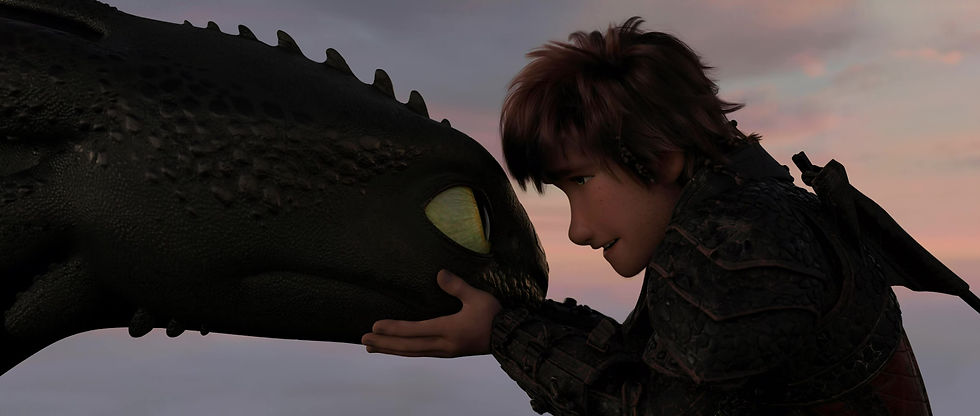
However, when I thought about what I was expecting from The Hidden World, I was honestly hoping for a more final parting, something more along the lines of Toy Story 3. That film not only acknowledged what was on the horizon but treated it with the weight and dignity that were entirely appropriate in such a scenario.
How to Train Your Dragon: The Hidden World didn’t quite go that far. In fact, you can say that whereas How to Train Your Dragon 2 went a touch too far, The Hidden World didn’t go far enough.
I even thought back to some of the animated shows I grew up with that took the idea of human masters letting their animal buddies go seriously, for they demonstrated how to convey it appropriately. Look at Digimon, for example. Several times throughout the show, mostly in the season finales, the characters and their Digimon buddies knew that they had to say goodbye and stay where they each belonged.
Even Pokémon got in on the act every once in a while. ‘Bye Bye Butterfree’ and ‘A Togepi Mirage’, anyone?
Maybe that’s why I didn’t always think as highly of The Hidden World as I did the first two films. I remembered the movie more for its lofty ideals than for the life- and game-changing elements it introduced. For that reason, The Hidden World was nowhere on the same level as the first two films, but not so much that it made it a dishonorable last chapter of something like How to Train Your Dragon. It was still a solid film overall.
While yes, all three movies resembled other films featuring a boy and his pet, they were very innovative with their plot elements, expanding them to apply onto other characters in the story and the extent of the threat they posed to others.
I remember falling in love with the first film for its perfect balance of childlike wonder, excitement, and adult dilemmas, and with the second film for confronting the morally gray adult dilemmas that threw Hiccup and his friends for a loop with grit and exotica.
With The Hidden World, it stumbled in its attempts, but it wasn’t one step forward and two steps backward. Unlike How to Train Your Dragon 2, which boldly confronted the far deadlier realities only to feel like it bit off more than it could chew, The Hidden World surprisingly had a much firmer grasp of the travesties the characters faced. It still acknowledged the devastations of the real world while maintaining enough of the light-heartedness from the first film to make the more hardcore situations easier to digest than in How to Train Your Dragon 2.
But a good chunk of it might have had to do with what Toothless and the Light Fury began to experience with each other. And at first, I didn’t know how the Light Fury was out and about, when I knew that Grimmel originally captured her. But then, as Hiccup and the Berkians departed, that’s when Grimley mentioned that he deliberately let the Light Fury go so that she would have attracted Toothless and thus bring him closer to Grimmel, which he would have arranged due to his drug-induced dragons. That also demonstrated just how dastardly Grimmer was.

After rewatching it, I still stand by that The Hidden World was the most romantic of all the How to Train Your Dragon movies on so many levels. But even that didn’t bring this film down as much as I thought it did.
While I still have a soft spot for How to Train Your Dragon 2, I still thought it had some problems that brought it down a peg from the first film. But what’s interesting is that while I still think How to Train Your Dragon: The Hidden World was clearly better than I remembered, there were still a few things about it that brought it down a peg or two, even compared to the second film. But considering how cohesive this movie was, I still thought it pulled out as many stops as it could, which was already remarkable for a threequel.
I can think of nothing to compare the How to Train Your Dragon movies with, except, of all films, the original Star Wars trilogy. The first film is wonderful, awe-inspiring, and an icon. The second film is darker, riveting, and a game-changer. And the third film may clearly be a step down from the first two, but it worked enough of its magic to stick the landing, especially as a concluding chapter.
In fact, that applies to the first three Kung Fu Panda movies, the more I think about it.
The characters were still as likable as ever. The new dragon species introduced in the movie helped convey the movie’s long-term stakes. The voice acting sounded like they had practically owned their roles, knowing them like the back of their hands. The animation was still as resounding and visually splendorous as ever. And the ending provided just the right amount of bittersweet angles to wrap the story up appropriately, without becoming too bleak or pessimistic. I suppose, after being used to the main heroes being separated from their pets, kind of like in Digimon, I was used to seeing more emotional rawness emerge from such bittersweet angles as the characters and their pets had to say goodbye. But while I still think it could have been a little better with How to Train Your Dragon, it still provided just the right amount of character, heart, and integrity to help The Hidden World flourish as a splendorous movie fit to wrap up How to Train Your Dragon.
Strap up for one last ride because, light as it is, this film wraps up the franchise with an exquisite finish.
Or so I thought it would. There’s one more chapter of How to Train Your Dragon to look over, and I’ll address that next week.
My Rating
A strong A-

Works Cited
Renfro, K. (2019, February 22). What the final moments of ‘How to Train Your Dragon: The Hidden World’ mean for Hiccup and Toothless. Business Insider. https://www.businessinsider.com/how-to-train-your-dragon-hidden-world-ending-explained-2019-2


Comments