

98th Oscars/Nominations Recap

A week has come and gone, and so has another glorious Oscar night. Like every other Oscar ceremony, there have been plenty of highlights and surprises galore.
Before I lunge into the turnout of the ceremony itself, allow me to start with my thoughts on the nominations. You may have noticed that I was quiet about it shortly after they were announced. Now, I wanted to share my thoughts on them, and not just the Oscars ceremony itself, in the same recap. In addition, what you’re about to read mostly concerns what I managed to see in theaters before the Oscars.
There were plenty of movies I saw throughout 2025 that were terrific and worthy of the awards recognition they’ve ever received.
Let’s start with Hamnet, which ended up with eight nominations. Anyone who thinks Hamnet felt too similar to Hamlet might be surprised to find out that this was technically a story about Shakespeare’s family. And yes, it did relate to Hamlet. As the beginning of the movie said, Hamnet and Hamlet were technically the same name when Shakespeare was alive, for ’n’ and ‘l’ were interchangeable.

Let’s not forget, one of the biggest aspects of William Shakespeare’s life that was probably not dwelt upon often was his family life, even though it was implied that the story concerning his wife was semi-fictional; there may have been nothing overly spiritual about her. But it may have been more because there was not enough documented about Shakespeare’s wife to give a full account of their family life. But I will confirm to you that what did happen, sadly, was the death of William and Agnes Shakespeare’s son, Hamnet, who died at the age of eleven years old. It was a harrowing film that was also truly profound and moving, and it shed light on how this traumatic event planted the seeds that would sprout into one of the most celebrated plays of all time. I would strongly recommend it to any Shakespeare fan.
Also honored with a ton of nominations at the Oscars was Marty Supreme.
At first, I expected it to be a simple underdog sports film about ping-pong. But that was just the tip of the iceberg compared to what I saw. Marty Supreme was simply a parade of the challenges he faced just to get a rematch with a fierce, world-class Japanese ping-pong competitor he had lost to. That’s it. It was a wild adventure, and my girlfriend and I agreed that Timothée Chalamet outdid himself as an actor in this movie. It also helped, in our opinion, that he helped produce this movie to boot. With nine nominations at the helm, including an earned nomination for Best Actor for Chalamet, it captured the feel of the 1950s to a T, as well as the trials and errors Marty endured, even though they were borne of sour grapes.

Another Oscar-studded film I found chaotic was One Battle After Another, which received thirteen nominations. This movie started like this.
It was about the antics of a band of revolutionaries called the French 75, who fought against the American government by setting illegal immigrants free in the US Southwest. However, things got heated when Leonardo DiCaprio’s character, Bob Ferguson, had sex with one of his compatriots, Perfidia, played by Teyana Taylor, and ended up bearing a daughter named Willa. Because of this, Perfidia had to leave him, partially due to being revealed as one of the revolutionaries. Then, the movie fast-forwarded sixteen years, with Bob ending up as a perpetual drunkard and Willa, now a teenager, having to be escorted by Bob’s forces by the French 75 as they asked Bob to meet up with them at a designated rendezvous point, only to struggle to make it there due to not remembering the passwords and the necessary information to reunite with them. Part of it was due to his constant drinking, which may have been the result of Perfidy leaving him. And who was their biggest adversary? An elite army official named Steven Lockjaw, played by Sean Penn, who had the hots for Perfidia and was also after Willa after learning of her familial ties to Bob, whom he had pursued for years. I don’t know if the way I’m describing it does the movie justice, but let’s say it carries a ton of intriguing aspects about the friction between the army and the revolutionaries. The results, because of that, were a little suspenseful, but also surprisingly humorous.
And that leaves us with the biggest dark horse among the nominees, Sinners.
I found this movie truly inventive because the story highlighted two brothers, Smoke and Stack, who returned home in the South during the early days of the Great Depression after spending time in Chicago. And from there, the rest of the story was about those two brothers, as well as their friends from the neighborhood, including Mary, played by Hailee Steinfeld, getting together in secret in an abandoned barn where they played music together, but were also hunted down by vampiric forces who had their own ideas of jovial celebrations. Put simply, this movie put the ‘gothic’ in Southern Gothic, and it excelled at its artistic spin on the classic Southern themes, mixed with unexpected horror elements. But what caught me entirely by surprise was the nominations that the Oscars bestowed upon this film.
Throughout history, only three films have tied for the most nominations: All About Eve, Titanic, and La La Land, each with fourteen. What did Sinners earn when it entered the Oscar race? Sixteen.
Yes, sixteen nominations for Sinners alone. I barely believed it when I first read it. I believed what Sinners was up for when I watched the nominations announcements, but not what it all added up to. This was an unanticipated, game-changing honor for Sinners.

And Sinner’s nominations also include what I’m about to highlight next.
For the first time since 2001, when the Oscars introduced the Oscar for Best Animated Feature, they would introduce a new category into the mix: Best Casting. I’ve noticed a lot of people say that this category was long overdue, and I can see why. If the Oscars for Best Actor, Best Actress, Best Supporting Actor, and Best Supporting Actress were to reward individual actors for their performances, Best Casting would reward whoever rounded up the right actors who would work well off each other. As we all know, filmmaking is a collaborative effort, not just for the artists, writers, directors, producers, and so on, but most importantly, for the actors. And as easy as it is to assemble an all-star cast to make something out of a movie you’re making, what would matter the most is to see how well the hired actors work off each other, how well they would support each other in their performances, and what they each could bring into a movie, either individually or as a group. We all know plenty of movies with superb casts; even the all-star casts of certain designated movies left enough of an impression to earn their reputation as the epitome of casting. But it’s nice to see the Oscars finally give the casting directors their proper due starting this year.
Hopping back to the nominations, one of the biggest surprise nominations to me was F1 for Best Picture.
When my girlfriend and I saw it, I remember liking it just fine as a cohesive and generally solid racing film about the F1 racers. Of course, seeing F1 recognized this way at the Oscars, with four nominations, especially one for Best Picture, was a pleasant surprise. F1 is a movie about an elite racer who tried to get his second shot by training a new F1 racer to the nth degree and pushing him to become his absolute best. I’m saying this because this is entirely fictional and not biographical. As far as racing films in general go, I can think of no other racing film that was bestowed with this many nominations outside of Ford v. Ferrari in 2019. In fact, the last film to focus on F1 racers, Grand Prix from 1966, won all three Oscars for which it was nominated. In addition, I remember reading that F1 was supposed to have a sequel in the works, and you know what? Considering what it just landed at the Oscars, they should just as well go for it.
However, if I had to pick my biggest complaint about the nominations, I was shocked to see that Wicked: For Good was nowhere to be seen among the Oscar nominees. The first Wicked film, or Part One of the movie, was nominated for ten Oscars, including Best Picture, and even the lead actresses, Ariana Grande and Cynthia Erivo, were nominated for their roles. Ultimately, Wicked won for Best Production Design and Best Costume Design. How is it possible for Wicked: For Good to not land one single nomination this year? Not even for the categories that the first film won last year? I don’t even understand what many people mean when they say this is below par compared to the first film, when clearly this was meant to be Act II of Wicked. It felt like Wicked: For Good should have been nominated for something at the Oscars, but I don’t know. Wicked: For Good didn’t deserve to be shut out this way.
Now that I’ve shared my two cents on the nominations, impressive as they were, let’s talk about the ceremony itself, as well as which films reigned supreme.
For starters, the Oscars for Best Production Design, Best Makeup, and Best Costume Design were all cleaned up by Guillermo del Toro’s Frankenstein. As I’m writing this, I’ve never seen this movie, but judging from what Frankenstein unleashed, I could tell it was a visual feast, with a compelling setting and makeup applications on the actors.

And after hearing K-Pop Demon Hunters get all the buzz, I was not surprised to see it win the Oscars for Best Animated Feature Film and Best Original Song for ‘Golden’. I’m ashamed to say that, as I’m writing this, I’ve yet to see that movie, too, but I want to. I understand this movie was animated by the same team behind the Spider-Verse movies. So that tells me there’s supposed to be a bit of vibrant energy in this movie, as well as a sense of ingenuity in its story, animation, and characters. Add to that the fact that the filmmakers behind the film and the songwriters, including EJAE, behind ‘Golden’ were among the first Korean artists to each have won an Oscar for their respective categories, and that’s sure to convince people like me to give this film a whirl.
But I should mention one other thing about K-Pop Demon Hunters winning Best Original Song that I found quite interesting. The artist who composed the song, EJAE, won a Grammy Award for creating this song, too. So, now, in the eyes of many who worshipped her, this puts her halfway through in joining a de facto pantheon of artists called EGOT. For those of you who wonder what this is, it is a group of artists who won an Emmy Award (for television), a Grammy Award (for music), an Oscar (for film), and a Tony Award (for stage). I won’t list them all, but among other famous artists recognized in this pantheon are Richard Rodgers, Mel Brooks, Alan Menken, and Elton John. What EJAE achieved so far with ‘Golden’ was impressive, especially for a victory as obvious as ‘Golden’ winning the Oscar for Best Original Song. All that’s left for EJAE to do now is to win an Emmy and a Tony. For what? We’ll have to see.
Furthermore, Zootopia 2 was nominated for the Oscar for Best Animated Feature alongside K-Pop Demon Hunters. Much like Inside Out 2 last year, Zootopia 2 earned its nomination for how well it continued the themes of the first film while adding plenty of new elements to keep it invigorating and worthy of the Zootopia name.
The nominees for Best Visual Effects were a neat lineup, though I did not expect Jurassic World Rebirth to make the list. I can’t help but notice some problems with Jurassic World Rebirth, especially when compared to the Jurassic Park trilogy and the previous Jurassic World films. But I can understand why it ended up at the forefront, because the visual effects applied to the dinosaurs were truly tremendous and helped bring them to life. But I ended up being surprised, yet not surprised, to see that the victor of this Oscar was Avatar: Fire and Ash. As I said in my review of that film, James Cameron had been nailing it in the franchise’s visual department, but somehow struggling with its substance. Be that as it may, the three Oscars the Avatar franchise won so far for Visual Effects were proof of James Cameron’s dedication to bringing Pandora and its inhabitants to life.
As for the Oscar victories that were completely unsurprising, the most obvious one was F1 for Best Sound. That may have been because the movie’s sound was impressive anyway when it came to race cars. And that’s ironic considering how surprised I was by F1 coming out on top the way it did at the Oscars.

But the biggest winners of the Oscars that night did have some surprise achievements that I was a little happy to see.
For starters, Best Casting. Except for The Secret Agent from Brazil, I have seen all the nominees for this category. When I looked at its lineup, I was happy that the results paid tribute to the casting directors for what they whipped up for each film, especially Sinners, One Man After Another, Marty Supreme, and Hamnet.
But to be honest with you, I expected the Oscar for Best Casting to be handed off to Sinners. There’s just something about its actors’ collaborative efforts that seemed so unified and vibrant that it felt like the first Oscar for Best Casting would’ve had Sinners’ name all over it. And I initially viewed that category as a demonstration of the strength of a unified whole through collaborations among the actors.
Besides, it’s very easy to think about all-star casts when it comes to Best Casting. And among the nominees, the closest one I can think of to an all-star cast was One Battle After Another. I mean, look at this. You have Leonardo DiCaprio, Benicio del Toro, Regina Hall, Sean Penn… Those are pretty big-name stars in a solid lineup for a movie like One Battle After Another.
Well, it just so happens that One Battle After Another ended up being the first winner of the Oscar for Best Casting, possibly for that reason.
Altogether, I’d wager that if the Oscar for Best Casting wasn’t established with the collaborative efforts, the big-name stars, or the all-star cast power in mind, maybe it would’ve been for the best selections of actors who we know would have made the most out of the roles they’re given individually. So, given how well the majority of the actors in One Battle After Another nailed their roles, this made sense. Of course, the actors of One Battle After Another were no slouches in collaborative acting either, so at the end of the day, it was pretty cool to see One Battle After Another come out on top like that.
But before I talk more about One Battle After Another, let me talk about the Oscars that Sinners ended up with. Given that Sinners surprised everyone with a whopping sixteen nominations, a record-breaking achievement, I was curious to see how well it would have done in terms of its wins.
Ultimately, it ended up with what’s technically a quarter’s worth of what it was up for, which was still a neat way to go. As for what it ended up with, it started with Best Cinematography and Best Original Score. And I thought, considering how dazzling the movie’s shots were of the American South, not to mention of the scenery when things started to get really suspicious, ugly, and murky when the vampires were around the corner, that was a sure thing. And Best Original Score? I can’t say I’m surprised, considering how focused the movie was on music.
But the other two Oscars were also expected and for the best. Best Original Screenplay for Ryan Coogler was definitely called for, since Sinners had a very vibrant original story to tell, courtesy of Ryan Coogler, who set it ablaze with riveting themes of togetherness and cultural identity.

But what I was pleasantly surprised to see was Michael B. Jordan winning his Oscar for Best Actor. To tell you the truth, I didn’t know until he won his Oscar that he played two different characters in the movie. I knew that the two main characters in the movie were brothers, but I would never have guessed that they were played by the same actor. So for that reason, it makes me more convinced that Michael B. Jordan deserved his Oscar for Best Actor for his performances in that film. Also, watching him go to In-N-Out after the Oscars felt like a funny yet ultimately humble way to celebrate his Oscar win. So, good for him.
Of course, it was a surprise that Sinners ended up winning so few Oscars compared to the previous record-holders: six each for All About Eve and La La Land, and a staggering eleven for Titanic. Regardless, what Sinners walked away with felt earned.
But now, let’s shift our attention back to One Battle After Another. Much like how Sinners won the Oscar for Best Original Screenplay, One Battle After Another won the Oscar for Best Adapted Screenplay, as it was inspired by the novel Vineland by Thomas Pynchon. I’m not familiar with the book, but I do remember glimpsing that it revolved around opposition to American customs in the wake of the drug wars and Richard Nixon’s presidency. One Battle After Another, on the other hand, felt like it was exploring the same issues, except in modern-day America, with the opposition aimed at more oppressive American customs rather than a specific individual. And judging from what the film had to say about the complications that revolutionaries, or ex-revolutionaries, would have gone through to get the job done or to evade the major forces who were hot on their tails, I can say that this movie did a remarkable job of diving headfirst into the chaotic events that resulted from these situations. So I could see why it landed that specific Oscar.
And as for the others, let’s see what One Battle After Another ended up with. It ended up winning Best Film Editing, which was nice since the shots in this movie were pretty well put together. As surprising as it was for the movie to win the Oscar for Best Casting, I agreed with Sean Penn winning the Oscar for Best Supporting Actor. From what I remember seeing of his performance in that film, he gave off a pretty committed and hard-edged performance as Steven Lockjaw, a general who was hell-bent on getting back at the ex-revolutionaries who had been a thorn on his side from many years back, even if part of it was fueled by his infatuation with Perfidia, one of the ex-revolutionaries, and also his complications and feelings concerning Willa, knowing that she was the daughter of the ex-reolutionary whom he chased down for years. Sean Penn conveyed all those conflicting aspects of his character, making them shine and glimmer with a roughness that reminded me of his background as a general, as well as of just how seriously he meant it.
And that ultimately leaves us with the ultimate two Oscars the film ended up with: Best Director and Best Picture.

I remember watching One Battle After Another in theaters and thinking that there were a lot of weird, complicated things going on in terms of what Bob had to go through and what he had to remember in terms of working his way back into the French 75, but also to get back together with Willa. And considering those two side-by-side issues beating on throughout the film, I guess it was little wonder that Paul Thomas Anderson ended up with his Oscar for making it so strongly felt throughout the movie, as did One Battle After Another with the Oscar for Best Picture for that kind of major achievement. I thought it was going to be Sinners, but it was nice to see that One Battle After Another came out victorious, too.
So, if Sinners was a dark horse among the nominations, One Battle After Another felt like the dark horse in terms of which film reached the finish line.
But I will say this: of all the movies I’ve seen that won this year, the one victory that I felt the most deeply happy about was Jessie Buckley winning her Oscar for Best Actress for Hamnet. I remember being spellbound by her performance as a struggling mother who was looked at suspiciously for supposedly possessing mystical qualities, even as she was also struggling as a mother. After all, Agnes Shakespeare’s husband, William, constantly went away on his trips to pen his plays, while she tended to their children, one of whom ended up becoming very sick. The raw emotion and anguish Buckley conveyed as Agnes were so vivid and on point that she helped carry the movie through and infused it with the strength of motherhood’s instincts. So, I’m very happy she won her Oscar for her role in that film.
And before I forget, one Oscar victory that I truly never saw coming was the winners of Best Live Action Short Film. As I watched the footage of the short films pass, I grew comfortable and expected the usual, “And the Oscar goes to...” phase, until the announcer said, “We have a tie.”
I did not expect that, because we had not had a tie at all at the Oscars since 2012, when Zero Dark Thirty and Skyfall shared the Oscar for Best Sound Editing. And in this case, the two short films that shared the Oscar were The Singers and Two People Exchanging Saliva (Isn’t that an off-putting title?). It was the seventh tie in Oscar history and, surprisingly, the second of such ties for the Oscar for Best Live Action Short Film. The last time this happened was in 1994, when Franz Kafka’s It’s a Wonderful Life, and Trevor shared this Oscar. It goes to show, I suppose, what happens when the voting yields unsuspecting results.
As for the ceremony itself and what happened during it, where do I start?
Conan O’Brien, just like last year, was on fire with his deliveries and comedic timing throughout the ceremony. But one of my favorite bits was when he thanked the orchestra for their contributions to the music, and as he was about to introduce the next set of presenters, he said, “Drum roll, please,” in Marty Supreme fashion. But it turns out it was ping pong paddles on a fake bottom. That was hilarious because, if you’ve seen Marty Supreme as I have, you’ll understand what the joke was.
The most astonishing highlight at the Oscars was the In Memoriam segment. For starters, Billy Crystal talked at great length about Rob Reiner and his wife, Michele Reiner, in terms of what accomplishments they achieved in their life, especially in terms of their films, which he listed off by name, and just what a great friend and great artist he was when he was alive. What’s more, many of the actors and actresses who collaborated with Rob Reiner in his movies, including Meg Ryan (When Harry Met Sally) and Kathy Bates (Misery), gathered on stage to pay their respects to Reiner and his wife in a similar fashion.
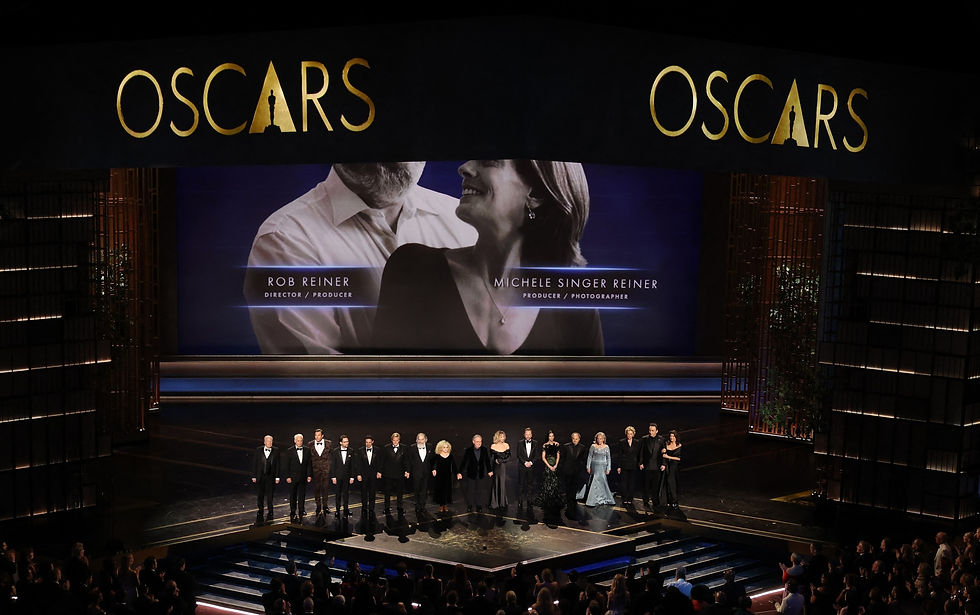
Rachel McAdams delivered a heartfelt tribute to Diane Keaton and Catherine O’Hara, sharing her experiences with Keaton and just how much of a woman of all talents she was when she was alive. And finally, Barbra Streisand concluded the In Memoriam segment with her memories of Robert Redford, down to acknowledging the cheeky nickname Redford gave her, Babs. In so doing, Barbara Streisand concluded her tribute to Redford and the In Memoriam segment on a most poignant note. She read aloud the last note she wrote to Robert Redford, using the nickname, before he passed away, and performed one of her hit singles, ‘The Way We Were’. You can feel how much the presenters missed the people who had passed on this past year, and we felt it too, for we lost more than just big-name stars. We lost people who sounded like really great people who left a mark in cinematic history. Even I teared up a bit at what was said about the stars who passed away in this segment. It’s like they always say, they are lost but never forgotten.
He was still recognized in the In Memoriam segment, don’t get me wrong, but the one actor who I was surprised wasn’t given a tribute all his own was Robert Duvall. I thought he was as much of a big-name star as the other four, especially Diane Keaton (after all, they both co-starred in the first two Godfather films), and that he, too, could have used a bigger spotlight.
However, as confused as I was by that, let’s take a look at how exactly it all went down. Rob Reiner, a mastermind behind a slew of iconic films, and his wife were both acknowledged by Billy Crystal in the first tribute. Robert Redford, a celebrated actor and filmmaker who played a long-term role in expanding filmmaking opportunities for the next generation with the founding of the Sundance Institute in 1981, received a tribute all his own from Barbara Streisand as the last one. And both Diane Keaton and Catherine O’Hara? Well, they were both acknowledged simultaneously in the middle tribute. The way I’m looking at it, as much as Robert Duvall deserved one, maybe there would really have been only so many tributes the Oscar ceremony could’ve squeezed in while making room for everything else.
As for how it started, however, that was fun. What happened was, it started with Conan O’Brien dressing up as Amy Madigan’s character from Weapons and protesting about coming out in this makeup, only to be hounded by a group of kids chasing him. Then, for the next five minutes, he ran all the way through Hollywood and even through a series of films that were up for Oscars this year, including Sentimental Value, K-Pop Demon Hunters, Hamnet, Marty Supreme, Sinners, and One Battle After Another, before finally making it to the Oscar stage. Watching him go through all the movie scenes just being chased by the group of kids who lunged their way through was definitely a laugh riot.
And as for the very first Oscar handed out that night, it just so happened that Amy Madigan ended up winning that Oscar for playing the aunt in Weapons. Is it just me, or have the Oscars been kinder to horror films this year than ever before? The last time I’ve seen the Oscars show some love to the horror genre was when The Silence of the Lambs won its Oscars, including for Best Picture, in 1991.
Simply put, this was one heck of a ceremony. And as always, there would have been some surprises and some not-surprises, as well as some highs, more highs than lows, really. But ultimately, it was a tremendous night at the Oscars, with some nice surprises along the way and a solid, heartfelt tribute to some of the people who passed away this past year, saddeningly numerous as they were. What are some of your favorite movies that ended up winning big at the Oscars? Any favorites that were at least recognized as nominees? Or did your favorite films of 2025 get the short end of the stick this year? Any surprises that you didn’t see coming?
I will see you next year, Oscar. And by then, we will see which next line of films reigns supreme with you.

Works Cited
Sanchez, C. (2025, December 1). The True Story Behind ‘Hamnet’ & William and Agnes Shakespeare’s Relationship. Harper’s Bazaar. https://www.harpersbazaar.com/culture/film-tv/a69593641/hamnet-william-agnes-shakespeare-true-story/


Comments