

Avatar: Fire and Ash

As I admitted from my reviews of Avatar and Avatar: The Way of Water, I had different responses to each film. With Avatar, I was blown away by the gargantuan visuals, the intriguing world-building concerning Pandora, and the sheer biology it introduced. However, what turned me off about this movie was how some of its story elements were recycled from other classic movies, not to mention the villainy, which was too over-the-top for my taste.
But then along came Avatar: The Way of Water, which came only three years ago and continued to introduce us to other aspects of the Pandoran wildlife we did not anticipate beforehand, such as marine life. I considered this film on the same level as the first film, but for different reasons. Avatar: The Way of Water undoubtedly excelled in its visuals, continuing the story forward, introducing us to other aspects of the Pandora wildlife, and, to my surprise, introducing further aspects of Quaritch’s character to make him feel more complex than how he started. It stemmed primarily from the fact that he had a biological son, Spider, and I considered that, along with the developmental dynamics of fatherhood shared between Jake Sully and Quaritch, the strongest parts of The Way of Water.
But that was nothing compared to what I heard of James Cameron’s long-term plan with Avatar. He meant for Avatar to span a whopping five films, which I’m convinced will cover a wide range of topics concerning Pandora and its inhabitants. Avatar served as the proper, if also flawed, introduction to that world, whereas The Way of Water continued its introductory phase with the marine wildlife.
It leads us to the next film on the list, Avatar: Fire and Ash.
I will admit, this is the one Avatar movie I was most interested in, and it wasn’t just because it was planned to continue Avatar’s story. What piqued my interest was that it was meant to introduce new aspects of Avatar that were arguably unexplored in the last two films: bad Na’vi and good humans. And considering how the first two films were looked down on for their generally simplistic moral lens, not to mention that I adored Princess Mononoke for exploring the blurs in moral lines concerning environmental welfare and warfare, it’s safe to say that I became beyond intrigued to see how Avatar: Fire and Ash would have pulled this off.
As for what we got? Well, I’d personally declare this on the same level as Avatar: The Way of Water. It did some things very well, but in others, it felt lacking.

Let’s start with what’s happening on Pandora next.
Picking up arguably where The Way of Water left off, it centered around Jake Sully, Neytiri, and their family as they huddled together with the Metkayina clan on their side and tried to make their own way. But suspicion began to brew around Spider, as well as toward their youngest son, Lo’ak. Because Quaritch knew that Jake was the adoptive father figure to Spider, his biological son, Jake knew that if he kept Spider around, then Quaritch would have gone after him no matter where he and his family roamed. So, during their next voyage across Pandora in a flock of Wingrays – I’ll explain more about them soon – they were ambushed by an enemy tribe called the Mangkwans, and their ruthless leader, Varang. What’s more, whereas the Omatikaya clan was land-based and the Metkayina clan was water-based, the Mangkwan clan specialized in fire. After recovering from the damages that they endured from this unexpected encounter, especially the wounded Neytiri after being shot in the shoulder, Jake Sully and his family ultimately decided to scurry while remaining undercover, not only from Quaritch, but also from the Mangkwan tribe.
Meanwhile, Quaritch eventually acknowledged that Varang was drawn to fire, especially his and his troops’ weaponry. Because of that, after a brief scuffle with Jake, Quaritch decided to seek out Varang herself, ask her to let him into her tribe, and reward her with how to use his and his fellow troops’ ammo to use against Jake, his family, and their affiliated tribes. Soon enough, Quaritch and Varang became close allies, doubling the danger factor for Jake, his family, and their friends as they all battened down the hatches and prepared for the next forthcoming attacks to set forth onto them all over again.
Would Jake have successfully warded off Quaritch and Varang? Would he have kept his family safe? Was Spider to be trusted by them for long? And what secrets did Kiri discover about Spider that would have changed the course of what relationships could’ve come forth between humans and Na’vi?
Altogether, Fire and Ash still carried enough weight to stand as a solid sequel to something like Avatar and Avatar: The Way of Water. But to start things off, while there were enough distinct moments in this movie to set it apart from The Way of Water, I walked away thinking that it felt more like Part Two of the sequel than the second sequel of Avatar. It continued where The Way of Water left off, with the Sully family grieving the death of their eldest child, Neteyam, with Jake obviously being the most impacted by it, and seemingly turning away from Lo’ak and treating him like he’s just the runt of the litter. It caused a lot of friction between them both, leading Lo’ak to launch into whatever dangerous situations were afoot, especially concerning Payakan, the Tulkun whom Lo’ak befriended, until such affairs began to trickle into Quaritch’s and his RDA troops’ crosshairs.
With the Metkayinas, they were going about their business as their own tribe while also having to tend to Jake’s family’s responsibilities the same way. I don’t remember them contributing much to the story beyond providing Jake and his family with shelter and the fact that Ronal was pregnant, just like in the last film. Now that I was curious about, knowing that she already had her daughter, Tsireya, who was growing quite fond of Lo’ak.
What would that have said about everything else that went on in the movie?
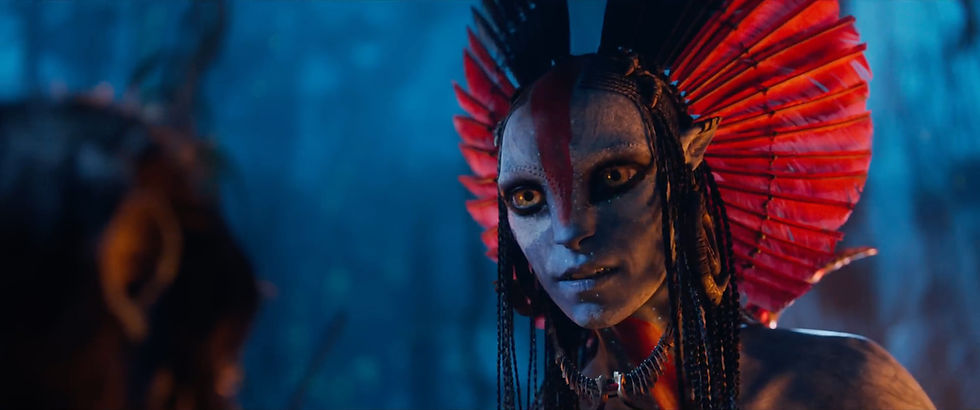
To start things off, I was legitimately impressed with the introduction of a villainous Na’vi tribe, that being the Mangkwans. Though they were separate from the Omatikayas and the Metkayinas, their tribe practically functioned as any Na’vi tribe would have done, albeit under different beliefs. As Varang made chillingly clear to a then-captive Kiri…
Your Goddess has no dominion here.
And when confronted by Quaritch in her village, Varang said the volcano near their village erupted and took away everything she and her tribe loved. But they eventually went from fearing the fire to embracing it once they knew of its destructive potential. Hence, Varang’s fascination with Quaritch’s weaponry and gear. Obviously, there were some things about that tribe that didn’t quite gel. For example, the movie dwelt on the nature of being an outcast, mostly in relation to Lo’ak. And soon, this extended to the Metkayinas and Payakan. So when I think back to that, what would that have said about the Mangkwans, since they were a villainous tribe after we’ve been acquainted with more peaceful Na’vi? Personally, a little more exposition about them as a tribe, especially in relation to the Omatikayas and the Metayinas, would have been most helpful. That way, we’d see just how much of an outcast they all were compared to Lo’ak or any of the Na’vi tribes with whom we’ve been acquainted.
We knew that outside of good Na’vi, there were also bad Na’vi, the ones that the tribes would have voluntarily gone to war against. But from what little Varang decided to explain to Quaritch about her background and fascination with fire, it did not seem sufficient enough to help introduce her or her tribe as a distinct or even a logistically unethical Na’vi tribe. Did the Na’vi tribe find their fascination with fire despite its capability of destroying everything, especially those that they loved, mostly out of discovering how they could have used it for their own gain?
That, and I hate to admit it, but there’s one character that felt like he had some potential, but was more of a plot device than an actual character. After Jake Sully surrendered himself to Quaritch to prevent further war and bloodshed, he was taken to the RDA base, called Bridgehead City. During his incarceration, there was one marine biologist, Ian Garvin, who became appalled by Mick Scoresby’s plot to overtake the natural resources and exploit the multi-million dollar liquid, Amrita, off the Tulkun herds. Thus, he decided to break off from the RDA and set Jake Sully free. But not only did he come into the story a little too quickly to be worth rooting for, but he also left as soon as he helped Jake out. So what good would that have done to the movie in the long run?
Either that, or, since Garvin happened to have been present in The Way of Water, too, maybe there was so much going on throughout both films that it was hard for me to keep track.
It compels me to talk more about the movie’s valiant attempts to shed light on the blurry lines between good and evil. And let me make one thing clear: the keyword is ‘attempts’.
When I heard about what Avatar: Fire and Ash planned to do as a continuation of the original Avatar films, I was already excited to see where it would have taken the story while also introducing new ideas that would have left us looking at the Na’vi and the humans in a more complex light than in the first two films. But the way it handled the differing dynamics between whose side was on whose, who was good, and who was bad was a little uneven.
Besides the suddenness of Ian Garvin’s role in the movie, there’s another factor that didn’t help. Once we got a closer look at Bridgehead City, it had its fair share of human visitors who came to look at what went down in Pandora ever since the RDA’s failed attempt to excavate the land of its unobtainium and the whales of its Amrita that would have guaranteed them billions at least. From the looks of it, many of the non-RDA members who came along seemed to be pro-RDA because they looked at Jake Sully as an automatic fugitive for what he had done to Quaritch and his fellow RDA troops, including Quaritch’s wife and Spider’s biological mother.

Two things came to mind as I saw this in action. One, the creators said that this movie would have explored more benevolence from the humans and more villainy from the Na’vi. We did get the villainy within the Na’vi from the Mangkwans, but when they mentioned the benevolence from the humans, I expected it to be more non-RDA or even anti-RDA crowds who acknowledged the plight of Jake Sully, his family, and the other Na’vi on Pandora and sympathized with them.
And two, for what we got out of the sympathetic side of the humans, that was conveyed more through Ian Garcia once he took matters into his own hands and smashed Jake Sully’s cell so he could’ve escaped. Outside of having shown up at the least expected time, the most problematic part of this guy was that his discoveries, reports, and protests about RDA’s findings on Pandora felt pretty much the same as what Jake, Grace, Max, Norm, Trudy, and the others made in the first film.
I feel like if this movie did want to own up to it and show the good guys from the human side supporting the Na’vi, it could have had it where there were some warring fractions of humanity on Pandora that would have continually fought over whether Jake Sully was a bad guy or if they knew that what RDA was doing to the Na’vi population was wrong. But their attempts to convey more moral grayness felt more cattywampus.
What made Princess Mononoke so strong was how it handled the gray areas between good and evil, and it did so like a pro. And frankly, Avatar: Fire and Ash handled it…like a rookie.
I could tell it got the general idea of where the blurriness could’ve occurred between good and evil, but I’m not convinced it approached that as fully as it could’ve, or what would have happened in such circumstances to make it so. Altogether, it portrayed the characters of Avatar: Fire and Ice similarly to how they were in the first two films: a peaceful Na’vi tribe fighting familiar human enemies, plus an enemy Na’vi tribe that clearly meant to harm others.
So, with that out in the open, does this collectively hinder Fire and Ash’s capability as a worthy sequel to Avatar?
Well, it would be a lie to say that it tampered with all the good qualities that it carried over from the first two films.

For starters, the visual effects were still as first-rate as you’d expect from Avatar or Pandora. Despite them being on the same level as The Way of Water, with very little to show for it compared to what The Way of Water achieved over the first film, they were basically the only thing the entire franchise never shorted out on, and it shows. The visuals helped convey the Na’vi, the Pandoran environment, the Pandoran fauna, the weaponry, and the futuristic technology as thoroughly and effectively as possible.
Regarding the new wildlife introduced in this movie, it surprisingly took a backseat to that. I guess that Fire and Ash had other fish to fry once it let the characters’ dilemmas take center stage. The most notable new alien species in this movie was the Wingrays. The design of these creatures captured the sheer exotica of the Pandoran wildlife, honing aspects that seemed both familiar and unfamiliar to humans. Outside of them carrying resemblances to jellyfish and other marine creatures, I looked at them feeling like they were similar to hot air balloons, only more sentient.
The rest of the wildlife that appeared, we’ve mostly seen in the first two films, as many of them made a comeback here, especially for the final – excuse me, next – showdown against the RDA.
But the one element of the Pandoran nature that came forth with very little explanation to them was the suction vacuum by the Metkayina clan’s home. All that was, according to Frances Ardmore, was just a void of aura and power that happened to have sucked up whatever came in close contact with it, like a vacuum, a tornado, or rather, a magnetic tornado, if you will.
There were some other elements brought back from the previous films to highlight the escalating nature of the conflict in this movie, but a part of me felt like they were literally repeated from the first film.
For example, as Jake Sully gathered his friends, fellow tribes, and everyone together for another battle against the RDA, who else would he have turned to for his aid than the Toruk Makto, whom he rode at the end of the last film? Considering I didn’t remember seeing him in the last film, it was a pleasant surprise to see him make a comeback, since it told me that what we’ve seen in the past two films was all coming together in this seemingly epic third chapter.
That, and I will admit, the music that Simon Franglen composed for this movie still felt about as second-rate as what he composed in the last film. I still cannot think of James Horner’s music from the first Avatar without thinking about how tremendous it was. I knew he was phenomenal already with his music in Titanic, but the music he unleashed in the first Avatar was truly spellbinding, exotic, and exciting. And as much as I don’t want to compare different artists for their work, Simon Franglen’s music still had a ways to go before it could resonate as strongly as James Horner’s music from the first film.
On the other hand, the whole dynamics between Lo’ak and Spider were probably the movie’s biggest highlights.

As I said, Lo’ak still felt guilty for Neteyam’s death and was more willing than ever to do whatever it took to help his family or steer them in the right path, even if it meant setting off in his own way and attempting to confront whatever sinister forces or unforeseen forces came his way with a cool head. As for Spider, the son of his adopted father’s enemy, he had no idea what to make of his place in the Sully family and whether he would have trusted them again, especially after Sully admitted his uncertainty about whether to keep Spider around for long. While Neytiri still harbored a grudge against Spider because of her awareness of his connection to the guy who killed half of her family, you could tell there was some friction as to how she was supposed to grapple with the humans after witnessing what destruction they were capable of. She was never ignorant towards her other son, Lo’ak, but it also showed a little conflict when it came to the values of their young, Jake with Lo’ak, and Neytiri with Spider. All the travesties that befell them since The Way of Water, the Sullies with losing Neteyam, and Spider from discovering that he, an adoptee of the Sully family, was the biological son of Jake’s biggest enemy, tested their resilience not only against their enemies, but also with each other. However, I hesitate to call them a dysfunctional family, even though there was a lot of emotional baggage they had to grapple with, because they clearly would’ve attempted to look closely at what was giving them so much grief and resolve it with as little clashing as possible.
But it only kept on going. What happened was that when Kiri noticed that Spider was running low on air in his oxygen mask, she quickly decided to lay Spider down on the Pandora ground, take off his mask when he began to run low on air, despite it likely killing him in the process, and perform the ritual of Eywa on Spider so he would come to life. In Kiri’s case, however, since she was the one practicing it, it left her to suffer from some seizures, which tampered with her ability to think things straight.
However, as soon as the process performed by Kiri on Spider was complete-ish, what at first seemed like a lost cause surprisingly did wonders for Spider, for he was able to blend into Pandora’s atmosphere and breathe in it. No need for masks for him anymore. But because Kiri relied on the roots of Eywa to help sustain him and allow him to breathe in Pandora, it did more than bring him to life. As Jake and Lo’ak soon discovered, it also made him grow a tiny tentacle-like particle on the back of his head. It turned out to be a queue, which was what the Na’vi grew as braids to communicate with each other and to whatever animal they rode.
Speaking of which, here’s one of the first signs of the Mangkwans being a bad tribe. Whenever they hunted down whatever Na’vi they ambushed, Varang used her queue to connect to those of others, paralyze them, and, most of all, cut them off afterwards. According to Lyle Winfleet, one of Quaritch’s men, this was supposedly a fate far worse than death to the Na’vi. And I can see why, because when I saw the Mangkwans and Varang perform this on their enemies, it felt like the Na’vi equivalent of Native tribes scalping enemy Natives or other intruders.

And I will say this about the alliance between Quaritch and Varang. By the time that Quaritch met up with Varang, we’ve already seen just how ruthless and vile she and her fellow Mangkwans could have been, especially to other Na’vi tribes. Slicing off the queue was bad enough, so what’s to say she and her tribe weren’t capable of committing far nastier evils against other N’avi than what we’ve seen her commit in the beginning of this movie alone? What more could Varang have pulled off that made her just as feared to the Na’vi as they were to the humans? That’s why, when Quaritch and Varang met up, and considering his motivations against Jake Sully and his determination to hunt him down by any means necessary, I was at a loss over what to assess of their meeting. That is to say, I couldn’t tell who should trust whom, or rather, who should not trust whom. Whether Quaritch should not have trusted Varang because of her ravaging disposition, or if Varang should not have trusted Quaritch because of his background and discrimination against the Na’vi, especially Jake Sully, I could not have told. That part of the relationship, in my opinion, was the most satisfying, even though it did take a few leans towards Varang deciding to join Quaritch and his allies out of fascination for the weaponry that he lent her in repayment for giving Quaritch the location of Jake Sully and his family, which the Mangkwan clan potentially knew was among the Metkayina clan.
However, one thing I appreciated about this movie was that it brought back some familiar faces we hadn’t seen since the first film, and not just Max and Norm. For starters, it brought Norm’s Avatar self back into focus, though temporarily. And it turned out, despite Jake’s initial reasons for wanting to get Spider out of the picture and his family, the original intent was to have them finally meet up with their grandmother: Neytiri’s mother, Mo’at, played again by CCH Pounder. It felt like the movie was finally accomplishing what The Way of Water did not: introducing elements and characters from the first movie to highlight the current conditions and where they stood in Jake Sully’s fight for his family. Even though it was a little helter-skelter how Jake Sully, Neytiri, and their family arranged this, it was still welcome to hear from the older characters in the first movie and see what they’ve been up to ever since RDA’s subsequent return trips on Pandora.
And this introduced us to another location that I found most staggering, the turnout of the original site of RDA’s landing site, now called Bridgehead City. As we’ve seen from the beginning of the last film, hasty as it was, it showed how RDA’s arrival ended up scorching what was left of Neytiri and her fellow Omatikaya clan’s home. And because of that, they had to relocate to the caves where they would have been safe from Quaritch and his forces. As we’ve seen on this site, it evolved into some human-operated factory, populated by war machines and humans in business suits wandering everywhere.
It was also nice to bring back Selfridge, played again by Giovanni Ribisi, who still felt committed to upholding RDA’s missions. Only this time, his focus was on capturing Spider alive, knowing that he was Quaritch’s biological son.
However, while some of the returning characters from the last film, including Quaritch’s superior officer, General Frances Ardmore, and Mick Scoresby – with his Amrita-hungry, Tulkun-hating spree – returned with very little personality to show for it outside of their domineering and thoughtless antics, what they did do well was stir up some debates among the RDA bases, especially with Selfridge and even with Quaritch. It demonstrated that even on the villains’ side of the story, there were some inconsistencies in how some people thought should be done with the Na’vi compared to how others would’ve done so, whether it concerned their pursuit of material wealth or designated persons of interest. I’d usually find it most fascinating when the villains all disagreed on how to pull off certain tasks, whether it’s for themselves or because of what they believed in. Even the butting of heads between Quaritch and Frances Ardmore about whether Varang and her fellow Mangkwans were allowed into Bridgehead City felt close enough to feeling like a demonstration of whether villains would actually have had other ideas in mind, considering Quaritch’s allegiance to the Na’vi or their umbrage against Jake Sully. What the movie lacked in compelling pro-Na’vi and/or anti-RDA humans, it almost made up for with the ideological friction between the villains. Almost.

And on several occasions throughout the movie, there were times when Jake and Quaritch actually let down their guard and dwelt for a minute about their past together as fellow Marines. Though they were mostly rushed in and lacked the right buildup, it was still interesting to think about whenever they came on, knowing not only their history together but also what they shared in common through Spider. So, I could tell just how much uncertainty and friction there was among the heroes, the villains, and even among themselves.
Speaking of which, regarding the rest of the characters, what they had to grapple with in this movie was still as engaging as ever, especially since, for better or for worse, they continued exploring what was set up for them since the first or previous film.
Jake Sully still felt like the troubled veteran-turned-Na’vi avatar that he was, since he still mourned Neteyam’s death while also seemingly holding it out against Lo’ak, as if he was to blame for Neteyam’s death. But the range of conflicts he underwent regarding how to either run from Quaritch or fight back against him, and also with his family on his side, did provide some engaging psychological avenues with which to explore Jake Sully. For example, seeing Jake internally debating whether to do Spider in if it meant warding Quaritch and his troops off and keeping them away from him and his family provided some suspenseful uncertainty as to what he would’ve pulled off on his family’s behalf. That, and the whole idea of Spider integrating into the Pandora atmosphere, down to its customs and biological standards, were intriguing enough to raise Jake’s eyebrows, as well as make other people curious as to what would have happened if humans could have integrated into Pandora’s atmosphere and possibly led to more human/Na’vi hybrids.
Neytiri seemed more like a broken warrior who tried to keep it together after her eldest son’s death, but also couldn’t have found it in herself to trust Spider due to his connections to Quaritch and how Quaritch was responsible for Neteyam’s death, plus that of her father and half of her tribe. But it was engaging to see her go into conflict with Varang, knowing that she was bad news. Though as for what connections they shared or how Neytiri knew of her, it could have used a little more exploration. And by the time that Lo’ak slowly showed more of his worth as a fellow member of the Sully family, only then did Neytiri begin to prove herself as the fierce warrior and mother that she always was. Part of that started, of course, with the possibility of her finally opening up to Spider and acknowledging him as much of a son to her as Neteyam was to her. On top of that, her feelings towards humans and even Spider began to shift a little after seeing the queue develop from the back of Spider’s head, and it helped that, despite his connections, he was still too much a part of the Sully family to let him go just like that. So, you could say that she was going through the same mental struggles as Jake did.

Miles Quaritch felt like the same as he was in the first movie, with him picking up on all the Na’vi antics and elements there were to pick up as he went along in his vendetta against Jake Sully. Now, the idea of having some Na’vi backup in his hunt against Jake Sully did seem to astound him, not just because of what innate and initial prejudices against the Na’vi he started with before, but also because of how much the Mangkwans despised Jake Sully, Neytiri, the Omatikaya clan, and the Metkayina clan. So, I was interested to see exactly how he would have reacted to the idea of the Na’vi living up to his and his fellow RDA troops’ initial perceptions of the Na’vi: as savage, bloodthirsty beasts. But when it dawned on him that he could have relied on Varang for her sharp wit, her knowledge of the land, and also, as a potential ally to back him up in his fight against Jake, it did highlight just how much of a connection he did not want to admit that he had with Pandora and its natives. It was most evident when he quarreled with Frances Ardmore about letting Varang and her tribe settle into Bridgehead City.
Again, there was some friction among the villains over how they were to carry out their tasks against Jake Sully, his family, and his friends. And the butting of heads that would have occurred between them concerning the Na’vi, how they were going to go forth on Jake Sully, should they capture him, as well as their general treatment of Spider, knowing that he was an ally of the Na’vi, all helped throw in more intriguing angles to them without making them feel like one-dimensional bad guys.
On top of that, while Miles Quaritch did go rough on some of the Na’vi to force information out of them about Jake Sully’s whereabouts with the threat of having Varang cut off their queues, he wasn’t kidding when he said that he was a man of his word. For example, when Jake Sully surrendered himself to Quaritch to stop him and his troops from slaughtering the Metkayina clan, Quaritch actually went through with it. So that did tell me that, underneath Quaritch’s hardened shell, a proud soldier still lurked, maintaining his code of honor. I still found that part of Quaritch the most compelling part of his character, especially given how much I couldn’t have stood him in the first film.
As for Mick Scoresby, who lost his arm in the last film and had it replaced with a (cool-looking) cybernetic arm, he unfortunately began to feel pretty much like how Selfridge and Quaritch was in the first movie, where he was determined to go after the Tulkun for the Amrita, only for his greed and pursuits for the material wealth to cloud his better judgment and ultimately be his undoing.
Admittedly, there wasn’t much for me to look back on regarding Kiri’s character. I could tell that she was getting pretty close to Spider, despite him being a de facto brother in the family. And let’s not forget her lineage; as I’m sure we remember from the last film, she had descended directly from Grace Augustine when she was alive. In this film, however, some hints were pointing to a potential connection she had with Eywa, which, as much of a stretch as it could be, may have stemmed from Grace’s then-connection to Eywa when she was on the brink of death. Kiri was even told about this by Norm and Mo’at, much to her disbelief. That particular lineage was a breakthrough for her character in this movie, but I’m still convinced that the Avatar series meant to take baby steps to solidify Kiri’s character. What I remembered the most about Kiri in this movie was how she tried her hardest to communicate with Eywa and rely on her for her powers and strength. But every time she did that, her connections through her tentacles with the vines of Eywa would have left her suffering some epileptic seizures that could potentially have killed her. The first time she tried to do that in the movie, it was presented as her working her way through the blustery elements of a Pandora forest, with the forces of Eywa behind the trees. Norm told her and Jake Sully that if Kiri went through another one of those communication rituals, like in the last film, she could potentially have risked succumbing to her seizure and dying from it.

And in Kiri’s last attempt to connect with Eywa and beg her for her help in having the backup necessary to help them in their fight against Quaritch and RDA, it started as just Kiri working her way in alone. Suddenly, she was helped there by Spider, who decided to put his queue to good use and reach out to Eywa with Kiri. And later, even the youngest sister, Tuk, who was concerned for Kiri’s safety, decided to chip in and play her part in helping Kiri speak with Eywa. And the closer they got, the more her face began to reveal itself. I always thought of Eywa as just an unseen goddess, the force of nature that you can describe as Mother Nature personified, but as a deity. Only in this case, we got to see her in her true, spiritual form. That was not what I would have seen coming, but while I found Eywa to feel much stronger as an unseen goddess of nature, seeing her up close was no less incredible.
Even then, though, parts of what had occurred with Ewya answering the heroes’ prayers in the form of the marine wildlife coming to their aid? Much like Ian Garvin, this felt like a repeat of what was established in the first film, only with the marine wildlife. It also tied into why I looked at Fire and Ash more as a direct continuation of The Way of Water than as a further continuation of the first Avatar.
But it did introduce another element that I found most intriguing. While this movie continued the subtitles that went along with what the animals communicated and said to the Na’vi who spoke with them, it went further by showing in greater detail what functionalities even the marine wildlife have would have had as their own species, or their own tribe, if you will. For example, when Sully was rallying all the tribes and even the local wildlife to help them in their battle against the RDA, the Tulkun elders expressed discomfort with participating in this war, believing that enacting voluntary violence against others would only breed more violence. They even did not hesitate to say that Payakan was an outcast. So it made me look at some of the Pandora wildlife and wonder whether every alien species on Pandora, whether in the jungles, the seas, or wherever, functioned as their own society, similarly to how the Na’vi and the Tulkun each functioned as their own.
Speaking of which, this led to one part of the mentality I found inconsistent, and it tied back into how the movie handled moral grayness. When Jake and Neytiri armed themselves with weapons to fight Quaritch and the RDA, they decided to experiment by embellishing some of their custom Na’vi weaponry with some of the RDA’s weapons. Jake Sully justified this, saying that there’s only so long that their natural weapons would have worked against the heavily advanced machinery of RDA’s weapons and gunfire. In contrast, there have been questions tossed back and forth about whether it would’ve been wise to retaliate against their oppressors with the same weapons they used against them. But considering how they also used RDA’s weapons to further their way in the war against the RDA forces before, such as in the battle at the end of the first film, it just felt a little thrown in at the last moment. It felt more like a random topic to discuss than a main drive propelling the movie forward. And by the time that they went to war against the RDA in this film, I might have recalled seeing the Na’vi use their RDA weapons against them. So, what was the point?
What made Princess Mononoke so special was that it stuck to its beliefs about the corrosive nature of hatred. And it did so seamlessly by having not only humans express it towards the animals, but also the native animals towards the humans. It demonstrated the futility of engaging in automatic warfare against such enemies by showing in extensive detail the consequences of giving in to your hatred, a lesson that, in Fire and Ash, Neytiri had to be reminded of by Jake when she was starting to get too in over her head about Spider or Quaritch.
While it’s nothing to write home about, I still have to give props to the actors who continued to help lend as much weight to the movie as possible with their performances.

Sam Worthington continued to portray Jake Sully with a sense of nobility. Still, as the stakes concerning his family grew much steeper, his mental struggles became more noticeable, whether they concerned his son, Lo’ak, or keeping Spider around for long, knowing that Quaritch would have continued to look for him and thus, by extension, Jake and his family. You can feel a lot of the background-borne nobility stemming from his performance, but also his sense of confusion and turmoil when it came to having to put up with all the forces that wanted him dead.
Zoe Saldaña, as in the past two films, continued to capture the fierceness of a local warrior determined to uphold her own principles and lunge at her enemies at the slightest provocation. But since this movie took place after Neteyam died in the last film, Zoe Saldaña continued to master Neytiri’s grief as a mother mourning the loss of her child. On top of that, as far as her thoughts on Spider were concerned, you can feel her inner distrust and borderline contempt for him as the implications surrounding Spider’s heritage clashing with those of her family dynamics became more apparent.
Personally, I found both Sam Worthington and Zoe Saldaña’s performances equally strong because of the anguish they each carried in response to the escalating situations surrounding them, as well as the cost it exacted on them since the last film.
Stephen Lang continued to capture the hard-edged notions and inner contempt of an officer who still had an evident vendetta against those he considered traitors to what he held so dear. And by the time his more strategic combatant aspects became more apparent, especially when he was about to collaborate with Varang – I’ll elaborate more on the actress shortly – he continued to highlight the more menacing factor in his character while also letting some of the more intricate human nature of his character be far from left out.
From the little time that he had in the movie, Giovanni Ribisi continued to master some of the smug and dastardly aspects of Selfridge’s character. But once other ideas were thrown about that he did not agree on, that’s when he began to reveal more of an uncertainty from his character as far as the plans of execution were concerned. For some reason, his performance in this movie felt like it didn’t convey as much cockiness as in the first film, and I personally welcomed that.
Some of the actors who reprised their roles from the last film played them nearly the same way, which, again, might explain why Fire and Ash felt like Part Two of the Avatar sequel.
Edie Falco continued to convey the tough-as-nails aspects of Francis, as well as her undying prejudices against the Na’vi, Jake Sully, his family, and anyone or anything she considered her enemies. Brendan Cowell continued to convey Mick Scoresby with his exaggerated whaler instincts and commitment to get what he wanted, even if, this time, there was more of a vendetta he conveyed against the Tulkun, just like what Quaritch conveyed against Jake Sully. I remember James Cameron saying that his character in the film series was supposed to be reminiscent of Captain Ahab from Moby Dick. And while I can understand his impressions, I can’t say it did him any wonders in this movie, outside of him slowly prioritizing his vendetta against the Tulkun over his still-present pursuits.

But now, let’s get on to what I consider the knockout of the entire acting ensemble: Oona Chaplin as Varang. She was very effective in capturing Varang’s distinct appearance as well as the smug, deceitful, and dangerous facade of a Na’vi who led and believed differently from all the other Na’vi tribes. Whenever she came on screen, you could feel just how slimy Varang turned out to have been and just how much of a different beast that she was compared to all the Na’vi that Jake Sully ever encountered thus far. Chaplin basically sizzled the screen, so to speak, every time she came forth.
Altogether, Avatar: Fire and Ash was a valiant attempt to introduce more complex topics into the world of Avatar, but it fell short of achieving that while continuing what the first two films established. The characters felt almost the same as before, but with less growth than in the first two films. Half of the elements explored in this movie were essentially recycled from the first two films, and it barely delved into the complexities felt among the Na’vi and the humans, thus not living up to its promises as much as it meant to. But it was all saved thanks to the gorgeous visual effects throughout the movie and the cinematography, which helped propel the action and kept us invested regardless of its execution.
Considering that James Cameron was on the brink of potentially completing the rest of what he planned to tell of this Avatar series as the director and not as the writer, there’s no telling exactly how he would pull off his vision of Avatar without it going off the rails. Only time will tell, because unlike the first two films, which were lucky enough to each gross $2 billion at the box office, Avatar: Fire and Ash only grossed over $1 billion. Compared to the first two Avatar films, there is a little something to be said about where Avatar could be heading, as the latest film had been somewhat underperforming.
I think the reason Avatar: The Way of Water made as much money as it did is that many people had been anticipating the sequel to Avatar for over a decade before it finally came and mostly met everyone’s expectations. This one came at a pretty fast pace and may not have had as much buildup as The Way of Water did. As a result, this movie struggled to make a lasting impression on general audiences and even Avatar fans. So who knows what the future holds for Pandora?
Even then, though, $1.3 billion at the box office, as of this writing? That doesn’t look unsuccessful to me. I still stand by that James Cameron should go ahead and get Avatars 4 and 5 off the ground if he felt like what these films would’ve revealed would’ve helped complete the story he meant to tell of Avatar. I just hope that by the time James Cameron gets to that point, he will make them less style-over-substance by comparison. The Avatar films got the style down to a tee. Now, they need to work on the substance.
Fire and Ash did delight with enough good sparks to start a small fire, but it wasn’t strong enough to set the franchise ablaze.
My Rating
A high B


Comments