

Toy Story 2

Updated: Aug 16
Last week, I talked to you about Toy Story and how much of a staple it was of my childhood. I was first acquainted with it through Disney’s Animated Storybook version of the film, where I was drawn into its delightful characters, colorful atmosphere, and the intriguing premise of toys coming to life when their owners were not around.
When the owners are away, the toys will play, as they’d say.
However, what blew my mind was the general reputation Toy Story had as a cinematic revelation. Toy Story was more than just a computer game like what I started with. It was also the first ever computer-animated movie ever made, developing a legacy on par with Snow White and the Seven Dwarfs for its revolutionary stance in animation.
Several years later, after Pixar gave it another whirl with A Bug’s Life, Pixar decided to give the story and characters that put Pixar on the map another go in the form of Toy Story 2.
Because the first Toy Story was a revolutionary movie, what possible chance would Toy Story 2 have in doing justice to the first film? What could it do to demonstrate Pixar’s growing prowess as an animation studio when Toy Story had already been hailed as a game-changing masterpiece?
First off, I innately recognized and appreciated Toy Story 2 as a feature-length movie. I would have been at least seven years old when this movie came out, compared to when I got used to the CD-ROM game and the animated version of the first film at around three or four years old.
But never mind that I was among the kids who went wild over Pokémon when it was all the rage or that Pokémon: The First Movie was among the movies I was most excited to see on the big screen at the time. I was just as excited to see Toy Story 2 because, let’s face it, my brother and I grew up on the first film.
I believe everybody knows this, but I can safely assure you that Toy Story 2 pushed the envelope not only in terms of what Pixar was capable of as an animation studio, but also what potential Toy Story had as a growing story. It took everything that it nailed about the first movie and not only continued it like a good sequel should, but also added new characters, new ideas, and new obstacles to make the sequel worthy of sharing the spotlight as the first film.

So, what is the story here?
Just like in the last film, Woody, Buzz, and their fellow toys spent their time together and anticipated their playtime with Andy whenever he was around and available. One day, however, at a garage sale that Andy’s mom put up, a fellow toy got prepped to be sold off, and in an otherwise successful attempt to rescue him, Woody got kidnapped – or should I say, toy-napped – by a greedy toy collector named Al McWhiggin. Because of this malicious act, Buzz and the other toys who witnessed this hatched a plan to track down Al McWhiggin and rescue Woody.
Talk about going from being the rescuer to needing to be rescued.
After doing some digging, Buzz discovered that Al McWhiggin, the man who stole Woody, was the owner of a local toy shop in the Tri-County area called Al’s Toy Barn, which Buzz recognized from a commercial he saw back at Sid’s house in the last film. Once he devised the plan to track down Al’s Toy Barn, Buzz, along with Rex, Slinky, Hamm, and Mr. Potato Head, joined forces to traverse neighborhoods and cross several hazardous roads to find Al’s Toy Barn and thus find Woody.
Meanwhile, back at Al’s apartment, which was across the street from Al’s Toy Barn, Woody wasn’t quite as imprisoned as he’d think, because while there, he ran into some new faces, including a toy horse named Bullseye, a portly prospector doll named Stinky Pete, and a cowgirl doll named Jessie. All three toys were beyond excited to have Woody in the same room, because it turned out that Woody was not just a favorite toy to Andy; he was also a collectible. As a toy, he was part of a franchise made off of a famous TV show from the 1950s, Woody’s Roundup, in which Woody was the star.
I will admit, every time I saw clips from this show, I looked at them thinking the show was the Pixar version of Howdy Doody, and that Woody was like the character himself.
Of course, once Woody caught on to his legacy and reputation among his new roommates, he found himself entranced by where he came from and how well he fit with his new friends now that they were part of a complete set. However, Woody also discovered that he, his new friends, and every other collected piece of Woody’s Roundup merchandise were about to be sold off to a toy museum in Tokyo, Japan. So, it left Woody conflicted as he contemplated whether it would be a good idea to join Jessie, Bullseye, and Stinky Pete and be put on exhibition forever at the toy museum, or if he should stick around so he could be rescued by his friends from back home when they arrive.
What would Woody have decided by then? And how would Buzz and the others have reacted once they find out that Woody was a collectible and also part of a classic franchise?

So, having already been familiar with the first Toy Story, I was within the ripe-enough stages of my childhood to have had an equally soft spot for Toy Story 2. But there was something about this movie that struck a chord with me on a much deeper level than the first film. Don’t get me wrong, Toy Story, the first one, was groundbreaking enough as it is with its revolutionary animation, good script, good banter between the characters, and excellent voice acting. But something about Toy Story 2 struck a nerve with me ever since I first saw it as a little kid. So what was it?
Well, let’s start with the colors.
In the first film, the colors felt very bright and energetic. Yet, the colors felt slightly basic, like they could have been just your everyday elementary-school-level colors. I think it makes sense, though, since that’s part of Toy Story’s rudimentary stages in terms of its computer animation.
With Toy Story 2, however, the colors felt more vibrant, like there’s a ton of different colors to complement each other throughout the movie and make this film feel more real and believable. It also helped that whereas the first film took place primarily in the suburbs, this film hopped over to the big city, where all kinds of different activities went on at once, as opposed to simply in the neighborhoods, where it’s bright and colorful in one house and dark and murky in another. So there’s a little more of a seamless blend of colors going on here and just what kind of vibrancy it gave off of the characters, the locales, or any of the objects in the movie.
On top of that? Let’s talk about the characters, because, man, do I love what this movie did with them, not just the returning characters but also the new ones.
Starting with Woody, he still felt like as righteous a toy as ever, especially after his misadventures with Buzz in the first film and how his jealousy got the best of him. Now, he became nobler than ever before, always looking out for the welfare of his fellow toys, and especially Buzz, who was on the verge of becoming his best friend. However, when he found himself in a pickle, he obviously did whatever he could to hightail it out of where he was held hostage, or so he thought before he met Jessie, Bullseye, and Prospector.
Since then, and partially because of his damaged arm – I’ll explain more about that soon – there was an inner part of him that wondered what he’s really cut out for. Once he was in permanent exhibition with his fellow toys, that meant he’d end up with his founding family, remain a permanent exhibition, and would be enjoyed by people forever. But because of his personal devotion to Andy, it left him unsure of what kind of devotion mattered the most to him, and which friends he should count on the most, whether it’s with Buzz and his friends from back home, or with Jessie and the others from Al’s collection. So, there was a bit of a challenge for Woody to take on, both personally and even physically.
Buzz Lightyear, after going through his ordeals of discovering that he’s a toy and not a space ranger, had grown substantially between the two films. Whereas Woody was more of a sensible type of leader, Buzz felt like the courageous type of leader, maintaining what he thought he had as a space ranger of Star Command while utilizing it in his leadership of Andy’s toys instead. Because of that, Buzz grew to feel as respected as Woody, and it was all for the best, considering what Woody told him of who and what he really was. And as we can see, his biggest moment of growth was most obvious when he rallied up his fellow toys to track down Woody after he was toy-napped. As Buzz told them directly,
Woody once risked his life to save me. I couldn’t call myself his friend if I weren’t willing to do the same.
So, that says a lot about Buzz as a character.

The rest of the returning characters all had their moments to shine and were very much the same as they were from the first film, mostly for the better.
Starting with Mr. Potato Head, I remember just how suspicious he was of Woody when it looked as if Woody tried to outsmart Buzz Lightyear to get back into his role as the leader of the toys. However, it did hint at a slight arrogance on his part because of how much he thought Woody really did mean harm. Here, Mr. Potato Head seemed to have mellowed down a bit and became more of a levelheaded guy, as well as a reasonable team player, while still engaging in physical hijinks because of his detachable body parts. The other likely reason for him having mellowed down, I will elaborate on when I get to that point.
Slinky was still as reliable and trustworthy as he was made out to be, because of his allegiance to Woody as well as his companionship with his other friends. His modest drive highlighted just how committed he was to sticking with his friend and tracking him down when he was in harm’s way.
Rex was still as neurotic and fearful as in the first film. But it’s obvious that despite his inner anxieties about undergoing such a potentially dangerous mission to rescue Woody, there’s an inner Cowardly Lion inside him who’s willing to undergo the tasks if it meant rescuing Woody and taking him back home. Plus, in this film, he was addicted to a Buzz Lightyear video game that he played back home. It showed a little bit of a geekiness that conveyed Rex in a slightly different light than I anticipated. Plus, since I played plenty of Nintendo 64 video games when this came out, I surprisingly related to that.
Ham was still as much of a smart aleck as I remember him from the first film and provided just the right amount of sass, either back home or during his and his friends’ trek into the big city to rescue Woody.
The rest of the characters who came back from the first film probably played their part in the movie in smaller doses than before, but they still maintained the best qualities that made them who they were in the first film.
Bo Peep was still as much of a sensible and conscientious lady whom Woody loved very much. Andy was still as excitable a kid as ever. Not to mention, he prepared to head out to summer camp before Al toy-napped Woody. So, that’d explain why a good chunk of the movie being told from his point of view was not as prevalent here as it was in the first film. And Andy’s mother still seemed as modest and knowledgeable as you’d expect from her.
But the biggest highlights of this movie were the new characters who came into the mix.
Get a load of this roundup. Jessie, Bullseye, Stinky Pete, Wheezy the Penguin, Evil Emperor Zurg, and Mrs. Potato Head, too. What each of them brought to the table left a deep impression on Toy Story fans everywhere and made them as iconic as the original batch, which was pretty remarkable for Toy Story 2 to achieve as a sequel.
To start with, this movie introduced another Buzz Lightyear…with a utility belt.
For the sake of differentiation, I will describe the Buzz we know as the original Buzz and this Buzz as the second Buzz.
The second Buzz felt more like the original Buzz in the first film, when he believed he was a legitimate space ranger from Star Command instead of a toy. It led to plenty of hilarious instances where this Buzz and the original Buzz quarreled over what the original Buzz was looking for and what the second Buzz believed. And let’s not forget what the original Buzz tried to tell him about what he really was. On its own, that showed just how much the original Buzz had grown when you see him engaging in a conversation with who was technically his past self. So, it was very engaging to think of the second Buzz when we evaluate him this way. While the trials and errors that the second Buzz went through were pretty much the same as what the original Buzz went through in the first film, it still wasn’t without its funny moments, including a climactic revelation to him that was an obvious reference to The Empire Strikes Back.
And this leads to one of the most memorable supporting characters in the movie: Evil Emperor Zurg.

He was talked about in hefty detail by Buzz Lightyear in the first film, but because we, as the audience, only heard of him and never saw him in the first film, it only painted him in a more mysterious light. So, when he finally showed up in Toy Story 2, that’s when his most intimidating presence and reputation were made well known.
To start, I strongly admire this character’s design. With his purple overlord suit, his intimidating mask – with the squinty eyes and teethy frown – his cape, and even his multiple-barrel bazooka, he seemed as dashing as he was evil, but also distinct enough to be easily separable from someone like Darth Vader.
His personality was generally overblown and vengeful, as you’d expect from an over-the-top bad guy. Still, the fact that he was Buzz Lightyear’s biggest foe, not to mention that their feud led to some cute Star Wars jokes between them, made the chemistry between them come alive.
The new characters extended to Andy’s toys as well.
Another character mentioned in the first movie before she appeared in this one was Mrs. Potato Head.
In the first movie, Mr. Potato Head chanted his desperation for a Mrs. Potato Head to come into his life as his wife, and he finally got his wish at the end of the first movie when she was given to Molly as a Christmas gift.
She was introduced in greater detail in this film, and much like Bo Peep, she was very sensible and obviously had Mr. Potato Head’s best interests at heart, just like a good supportive wife would. However, unlike Mr. Potato Head, she didn’t engage in as much physical comedy with her detachable body parts as Mr. Potato Head did. That made her feel like just the more sensible half to Mr. Potato Head’s supposedly agitated side.
I remember feeling very sorry for Wheezy, the squeaky penguin, because of how he was in a predicament without his squeaker to find his voice with. Because of that, Wheezy had been shelved for a long time, unsure of what worth he had of being played with for much longer before he had to be either discarded or sold off, just like what Andy’s mom meant to do with Wheezy. There may not be much to write home about with this character outside of his broken squeaker, but the fact that Wheezy bore such a simplistic, cutesy design and a low, down-hearted state of mind made him one of the most tragic and sympathetic characters in the movie.
And need we forget the Barbies in this film, voiced by Jodi Benson? After being acquainted with Jodi Benson as Ariel from The Little Mermaid, and long before Margot Robbie would have thrown her own spin on Barbie, Jodi Benson’s work as Barbie in this film, no matter which one it was, was the closest that Hollywood ever came to translating Barbie into a theatrical film. And the lengths Disney and Pixar went through to capture her likeness in this film were just remarkable. Whether it’s the tour guide Barbie, the painted Barbie, or the trio of showgirl Barbies, the animators did right by Barbie in her many manifestations in this film.
And then, there’s Al McWhiggin, the owner of Al’s Toy Barn.

Obviously, he must have been a rabid toy collector, judging from how committed he was to wanting to complete his Woody’s Roundup collection, particularly by stealing Woody after his attempts to pay Andy’s mother top dollar for him went nowhere. He also seemed quite egotistical because, on the side, he usually ran the toy store and did his advertisements while dressed up in a chicken outfit and making tons of chicken jokes and puns.
Come on, ‘making big buck-buck-bucks’ or ‘everything’s cheap-cheap-cheap’? I think that’s a clear giveaway.
However, I enjoy how giddy and almost finicky he could be when he tried to gather his collection of Woody’s Roundup memorabilia and have them all set for museum exhibition. I can tell that there’s a bit of a toy-loving man-child in him, which I found pretty fascinating since it was said that Al was modeled after John Lasseter, who was also a toy junkie himself.
Regardless, Al McWhiggin was a very conceited, selfish guy because of how desperate he was to make a quick buck. Judging from what he meant to do in collaboration with the toy museum’s owner, Mr. Konishi, his excitability told me he was about to sell off what seemed equivalent to a treasure trove.
Let’s hop over to the rest of Woody’s Roundup, shall we?
Starting with Bullseye, he acted very much like a regular horse, just like what any cowboy would have had. Whereas Slinky was sort of like a reliable friend to Woody and had speaking roles, Bullseye filled the same role except as a regular animal rather than with a speaking role. Regardless, much like Gromit from Wallace & Gromit, his facial expressions and body language did the talking.
On a sidenote, Bullseye originally was able to speak in the original draft of Toy Story 2, but having him act like a regular horse felt like the more proper way to go.
The one character who I believed was the biggest, most important newbie in the movie was Jessie, who clearly went through a whole lot of trauma and heartbreak to become the grounded, sympathetic toy she was.
On the outside, she’s a chipper cowgirl who’s ready to lunge into the slightest chance and take advantage of it like a natural-born cowgirl. But on the inside, what she struggled with as a toy painted her in a very sympathetic light, more so than Wheezy. What happened was, Jessie used to have an owner of her own named Emily, who was to her what Andy was to Woody. Unfortunately, as Emily grew up, she started to outgrow Jessie until she was older, had different interests of her own, and ultimately gave her away to charity.

It broke Jessie’s heart, and she knew what it was like to be abandoned because of it. Since her abandonment left her in storage for a good while, it impacted her so deeply that the mere idea of being in enclosed spaces was enough to leave her panicking and thus claustrophobic.
So, underneath her excitable attitude as a cowgirl, she’d surprise you with how broken she was, not physically, but rather emotionally. Because of that, the idea that she had to go through all of that made her one of the most dynamic and tragic characters introduced in Toy Story up to this point. Now, I see Jessie as being as much of an integral part of Toy Story as a franchise as the rest of the characters from the first movie.
And this leaves us with Stinky Pete, the prospector, who I thought was very interesting as a character.
Among other things, he seemed like a very wise, sympathetic character who would have made a great mentor figure and always tried to show his support for Woody, Jessie, and Bullseye as the Roundup gang they were. The Stinky Pete from the TV show was clearly the dim-witted of the trio. He always wondered where his pickaxe was when it was in his crack, and he lit what he thought was a candle when it was instead a stick of dynamite. That was in great contrast to Stinky Pete as a toy, who was very knowledgeable and was willing to give Woody and Jessie a helping hand.
SPOILER ALERT
However – and this is where spoilers will be blown wide open – underneath Pete’s wisdom emerged a committed, desperate toy who wanted to be sold off to the toy museum by any means necessary. And with it, he conveyed an ego and selfishness that’s almost on the same level as Al’s. Everything he did was all a ruse to keep Woody and Jessie in line and in one place, so he and the rest of them could be sold off together as a whole collection. Of course, judging from what he said…
I’ll tell you what’s not fair: spending a lifetime on a dime store shelf watching every other toy be sold!
…it almost made him look like he’s on the same page as Jessie and even Wheezy in terms of being shelved or put aside for way too long until he became desperate to want to be played with again. Only in this case, the prospector was a lot more selfish about it. Even if I disagreed with his motivations, I can see where he’s coming from. And while it threw the whole character dynamics with him for a loop, it still made him a fascinating character who’s willing to do anything to get his way, even through sheer manipulation.
And let me elaborate on one detail about this character and his reveal that I found beyond clever.
The first time he was seen, he was mint in the box and had never been opened, as Jessie told Woody, as he maintained his sympathetic side. But once his true colors were shown, he had been seen outside of his box since. That is to say, once he revealed the real him, there was no turning back. That was yet another level of ingenious writing that propelled this movie to further cinematic brilliance.
While we’re still on the topic of the characters, I ought to pay attention to the voice actors.

Throughout the time I talked about the characters, they either worked as well as they did because they maintained what made them so good in the first film, or were conveyed in a more engaging light even compared to what they started with in the first film. For me, a good chunk of it would be thanks to the voice performances.
Tom Hanks still honed the nobility apparent in Woody as the leader of the toys. Only in this case, while he still maintained his comedic essence from the first film, down to his angst-induced sarcasm, there was a lot less egotism and snarkiness in his performance than in the first film. As a result, it showed Woody’s growth between the two films. In some cases, there were hints of more thought-processing of his place in the world as a toy, which I’ll elaborate on very soon.
Tim Allen still gave off the noble instincts that he carried with him as Buzz Lightyear. And much like with Tom Hanks’ performance, I can see just how much Buzz Lightyear had grown when Tim Allen honed his vocals to demonstrate how much of the nobility and action-oriented persona Buzz carried from the first film, and how much of him grew more conscientious and savvy along the way.
When it came to voicing the second Buzz Lightyear, however, that’s when Tim Allen resumed what he mastered of his character in the first film with pride. This time, rather than looking at him as a funny, yet well-meaning toy, we looked at the second Buzz Lightyear as more delusional because of what he thought he believed as a space ranger of Star Command.
Tim Allen honed his voice enough that we could tell the difference between the Buzz Lightyear who caught on that he was not a space ranger and accepted his position as a toy, and the Buzz Lightyear who still believed he was a space ranger. Tim Allen was talented in flipping back and forth between these two modulations of his voice for Buzz Lightyear’s character…s, and they worked most seamlessly.
Joan Cusack might have found the role of a lifetime in her role as Jessie, down to her signature ‘yeehaw’.
With Jessie’s chipper personality, Cusack captured the most excitable and lovable aspects of Jessie as a cowgirl to the nth degree. But she was also no slouch when it came to highlighting the more troubled, insecure parts of Jessie as a toy. When you see Jessie either frustrated, disappointed, or in a really sad mood, Joan Cusack nailed that part of her personality to the point where she helped convey it with so little and with so few explanations necessary. Once you hear John Cusack play Jessie, you can almost know all that you need to know about her just from her performance. Joan Cusack was a pure natural when it came to playing Jessie, and she made the character for me.
Kelsey Grammer seemed tremendous when he played Stinky Pete. Knowing that he was off to a fantastic start as Frasier Crane, both in Cheers as well as in Frasier, meant he had a substantial background in maintaining his comedic personality while sneaking in moments of genuine, heartfelt conversations, and he was exceptional in delivering that through Stinky Pete’s character. Of course, considering what Stinky Pete really had in mind throughout the whole movie, it also goes to show you just how good a manipulator Stinky Pete was and how desperate he was to want to make himself a notable piece of toy history. So, when the rug was pulled from underneath us regarding Stinky Pete’s character, Kelsey Grammer reflected his inner arrogance and aggravated nature either out of what egotism he showed or when things started to go sideways for him.

Wayne Knight captured Al McWhiggin’s excitable nature, and you can easily say that Wayne Knight’s giddy personality fit Al McWhiggin like a glove because of how much more of a man-child it made Al look because of his devotion to his toys. Of course, beneath such an otherwise infectious attitude, he maintained the selfish part of his character when he collected those toys with the intention of selling them off for a fortune. Similar to what Kelsey Grammer brought with him from his time in Frasier, Wayne Knight brought everything he mastered in Seinfeld and especially concerning Dennis Nedry from Jurassic Park into his role as Al McWhiggin.
Andrew Stanton did the voice of Evil Emperor Zurg, and whenever he played this role, I thought he was completely unrecognizable. He went to town in amping his evil overtones through a dark overlord like Zurg. And because of the Star Wars references concerning Evil Emperor Zurg throughout the Toy Stories, Stanton was also exceptional in highlighting the part of Evil Emperor Zurg that honed his more menacing and domineering overtones, similar to what James Earl Jones provided to the voice of Darth Vader.
Joe Ranft indulged in his more helpless, sensible state of mind whenever he played Wheezy. Every time I heard him play his character, I remember looking back on Wheezy as a very tragic figure, and Joe Ranft’s sympathetic voice helped maintain that mood with Wheezy for me.
Estelle Harris, as Mrs. Potato Head, sounded as noble and knowledgeable as a better half as you’d want her to be. But beyond making her sound like a worthy soulmate for Mr. Potato Head, there’s something about her deliveries that demonstrated more of a comedic personality through her mannerisms. Whenever she was yelling or anything but in a quiet mood, the way she said Mrs. Potato Head’s lines suddenly heightened her character’s more comedic essence. That is to say, whenever Mrs. Potato Head was at her most comedic, it was with her voice rather than with her body, like with Mr. Potato Head. So, it made her look like a good character both as a romantic character and also as a comedic one.
Everyone else who came back to voice their characters from the first film, I am happier to report, did not skimp on their performances in this film.
Don Rickles still played Mr. Potato Head with as much of a no-nonsense personality as he did in the first film, only this time there’s less arrogance with him. Jim Varney, who unfortunately would have played Slinky for the last time in this movie, still played him with enough sensibility and sensitivity to highlight his faithful nature as Woody’s faithful dog, while still sneaking in enough of a comedic nature to highlight his comedic applicability in certain circumstances.
Wallace Shawn still captured Rex’s frantic nature, as Wallace Shawn would do best as a comedian. But sometimes, when it concerned other matters, like a video game, his excitability also captured just who else Rex turned out to be, since it made him feel almost like a child who was into other things outside of trying to prove himself as an apex predator.
Annie Potts also captured the sweet side of Bo Peep whenever she spoke with other toys. Of course, I found her to be the more grounded and conscientious half to Mrs. Potato Head’s more comedic and understanding side. John Morris continued to play Andy like a natural, for he sounded as excitable as I remember him being from the first film while also sneaking in enough maturity to highlight just how much Andy was growing up, or at least was in the beginning stages of growing up. And Laurie Metcalf still played his mother with as much tenderness and understanding as I remember from the first film, this time with a little more guardedness in her voice when she grappled with what went wrong.
Finally, there were three aspects to highlight that I thought made this movie.
For starters, the animation. It had clearly advanced in the four years since the first Toy Story came out.

I already talked about how more vibrant and varied the colors were in this movie, but the animation here also felt like it was taken to the next level.
In the first film, the animation felt very plasticky, which was a much better fit for the toys than it was for the humans. But in this film, there was a lot more texture to be found. The plasticky nature of the animation still fit the toys very naturally, while also showing a bit more of a difference between the different textures. The plasticky texture of Mr. Potato Head and Buzz Lightyear was now distinguishable, and the cloth on toys like Bo Peep, Woody, and the rest of the Woody’s Roundup gang was more defined and easily noticeable.
But I think the animation was most noticeable on the humans. Sure, the animation of some of the characters, like Andy’s mother, Molly, and even Emily, the girl who Jessie loved very much, was a little off, but they were conveyed more with human skin and textures. So now, they looked less awkward compared to in the first film.
And it wasn’t just because they had grown a little older. There’s more definition to the texture on the humans than in the first film. I remember seeing some freckles on Andy’s face. I remember seeing the facial hair on Al with evident detail. The animators were even nice enough to demonstrate that evolution with the toy cleaner, who came to help repair Woody after his arm had completely fallen off, and this character was clearly Geri from the short film Geri’s Game.
It was even easy for me to tell how far the animation has come along through the animals. Take, for example, the newest addition to Andy’s family, Buster. To describe him as simply as possible, he was the puppy that Andy got as a Christmas gift by the very end of the first film. Beyond being very energetic and a bundle of fun once you get to know him better, I love how he was conveyed in this film. Look at the fur and teeth from Scud from the last film, and now look at Buster’s. They both look very different from each other, don’t they? And Buster looked more natural by comparison.


Simply put, the animation felt like a talent show of animators doing their hardest to make this movie work.
And the more I think about it, one of the biggest factors in this movie that made me have a soft spot for it was its scope.
The first Toy Story was already off to a strong start by portraying the ideology of being played with by their owner from their point of view. So, what would look like just general playtime for children from our point of view suddenly felt more massive, expansive, and more anticipatory from the toys’ point of view, like being played with is equivalent to being played with by gods who trust and love you.
With Toy Story 2, however, the lengths Buzz and his friends went to rescue Woody made living inside the house, going into another house, or running through a neighborhood feel like a cakewalk. Sure, the toys also traveled to spots like the Dinoco gas station and Pizza Planet, but this film took it to a whole other level.
I was in more than just Andy’s bedroom. I also felt the characters crossing streets. I felt them going to a toy store. I felt them digging their way from the bottom of the hotel all the way to its tiptop. And I felt their drive, in a manner of speaking, as the toys drove in the middle of a city and reached an international airport to rescue Woody and the others before they’re carried off to Japan. That made the atmosphere overwhelming, and I mean that in a luscious, appetizing way. It outdid what the first film started with, and it made me feel like I partook in something huge, monumental, and almost life-changing.
Every time I went through where the toys went through, I always felt like I was part of something larger than life. Even right now, I tend to feel that way. In fact, don’t we all feel that way when it comes to us hopping between states, countries, continents, or even different planets like Buzz Aldrin and Neil Armstrong when they blasted off into outer space and landed on the Moon? It’s this kind of overwhelming atmosphere that was very much present in Toy Story 2, and it drew me in, hook, line, and sinker.
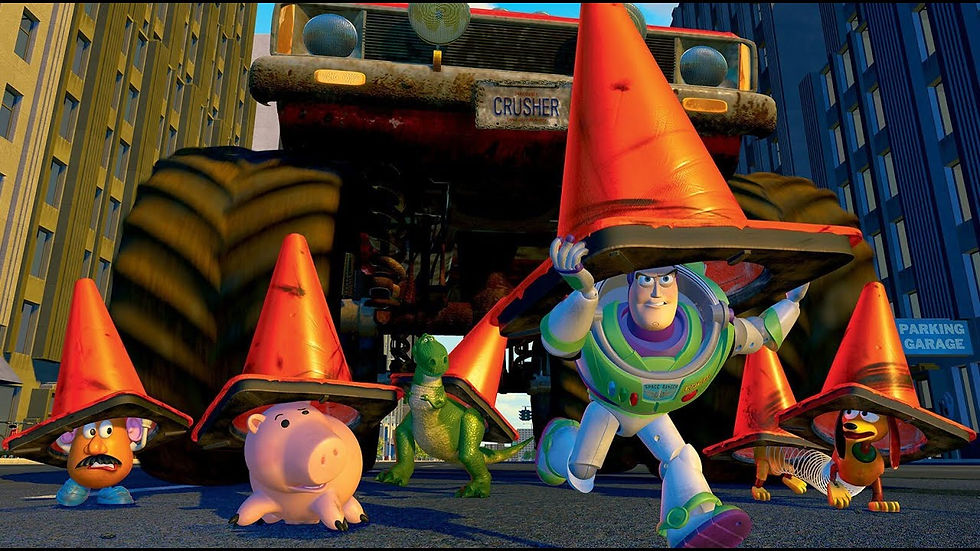
Before I forget, let’s talk about the traffic cone scene. That scene was remarkable because it heightened the tension as Buzz and the other toys tried to cross the street into Al’s Toy Barn as carefully and inconspicuously as possible so they would not be seen as living toys or smashed to pieces by incoming traffic. But for all the tension in the scene, it was also hilarious, because every time Buzz told his friends to drop and let their cones drop, it easily fooled the traffic into swerving sideways so they’d miss them, in which case it led to one accident after another for the drivers. And once Buzz and his friends successfully crossed the road, they left an utter traffic jam in their wake. It left me on the edge of my seat while also cracking me up because of what disasters Buzz and his friends unintentionally left behind.
On top of that, while I liked the songs from the first film just fine – ‘You’ve Got a Friend in Me’, ‘Strange Things’, and ‘I Will Go Sailing No More’ – the songs in this film were borderline masterclasses in music and lyrics. They were nearly as iconic as Toy Story’s theme song and still felt like the strongest array of songs in any Toy Story.
‘You’ve Got a Friend in Me’ made a comeback, but not as I anticipated. First off, it was played by Woody in ‘Woody’s Roundup’, and let’s say this was just the right cue to remind Woody of why he was so determined to make Andy’s idea of playtime worthwhile. And it was sung again in the finale by Wheezy, of all characters, as he suddenly sported a more masculine voice lent to Wheezy by Robert Goulet. Randy Newman went on record saying that he was not a fan of this cover because it threw in what he felt was an uncharacteristically romantic vibe to the song. But I don’t know, I found it such a snappy, well-done cover of an iconic song that I still like it just fine.
‘Woody’s Roundup’ was the most distinctive and flavorful of the songs penned for this film. With its fine-tuned violin work and Western-style vocals by Riders in the Sky, this song outdid itself in blazing forth as a fashionably old-fashioned song to set the mood for another rousing adventure in the Wild West, as it did splendidly as the opening theme song of ‘Woody’s Roundup’, the TV show.
And then, there’s ‘When She Loved Me’, looked at as one of arguably the most tragic songs in the whole franchise, and I can see how people would still look back on it this way. You have Jessie remembering her fun times with Emily, then she had to deal with being tossed aside, left under the bed, and collecting dust while Emily grew up and began to have a life of her own. And finally, Jessie ended up being donated away and out of Emily’s life forever.
There’s a lot of poignant stuff going on in this song that reminds me of what Woody went through in the last film, except Jessie had to bear the brunt of being outgrown. It took the most memorable parts of songs like ‘You’ve Got a Friend in Me’ and ‘Strange Things’ from the last film and painted them onto Jessie almost the same way that ‘I Will Go Sailing No More’ did onto Buzz Lightyear in the last film.
You know, I still stand by that, except for ‘You’ve Got a Friend in Me’, the songs in this film completely outdid the songs in the last film.
And above all, the themes surrounding this movie were also what gave it some weight.
In the first film, it was just a basic buddy comedy movie with Woody trying to grapple with his insecurities when Buzz came into the picture, followed by the trials and errors they went through together as they slowly let down their defenses and opened up as the best friends they would become.

In this movie, while the focus was still on Woody’s friendships, whether it’s with Buzz or with Jessie, their mere conditions as toys and what value they’d have as playmates have been brought to the forefront. With characters like Wheezy, Jessie, and even Stinky Pete, they have all had their experiences of being shelved, given away, or left to be ignored for way too long, and it left them feeling lovesick and desperate to want to have a kid play with them again.
Even Woody was on the same page as them during one of Andy’s last-minute playdates. Before he went to summer camp, Andy accidentally tore Woody’s arm halfway off, leaving him to be shelved while he went off to summer camp. Unfortunately, after undergoing a few misadventures, it ultimately led to Woody’s arm coming off, leaving Woody as the one-armed Woody before the toy cleaner came along to fix him up.
Of course, while it did result in some comedic scenarios in this movie, it touched upon just what value Woody would have left as a toy once he caught on to his legacy as a collectible as well as part of a franchise like Woody’s Roundup, whether he’s even meant to be played with by Andy for very long, and whether there might be some value to be gained out of being put on permanent exhibition for the rest of his natural life.
That’s why all the issues that he grappled with in this film were much more engaging than what was explored of them as toys in the first film. By the time Woody, Jessie, Buzz, and everyone else in the movie contemplated their natures as toys, it got to the point where it bordered on existentialism. As if to say, what was their true worth in life? What would happen when they become no longer useful? Would the world have been better off with or without them? What were they meant for in this world? What other worth would they have?
Those are deep topics to explore even among human beings, and seeing it applied the same way to toys felt like a huge step forward. This time, we’re looking at more than just toys who were inevitable playmates for children. We are talking about individual beings who were grappling with their worth in this world and what would have happened to them if they suddenly started to go downhill.
Even though I didn’t quite grasp it at the time, it did delve into the true values of not being played with by a little kid, which back then was equivalent to asking for simple appreciation. You know what I mean? The kind who is hoping for appreciation from someone, whether it’s through love, through a parental figure, through a close friend, and so on. Because I was at an age when, the first time I saw it, I began to feel a little bit of a need for appreciation, I began to feel their pain, too.
What I also found pretty remarkable about this movie is that it originally went by a completely different script, one that would actually have required that this movie be released in a direct-to-video release, much like the other sequels that Disney made and released straight to home video in the late 1990s up to the late 2000s. Take The Lion King II: Simba’s Pride, for example.
But then, at the last minute, the entire staff and crew had to work from scratch and start over to tell a new Toy Story 2 that’s fit to be released in theaters, not on home video. In hindsight, Aladdin went through the same creative existential crisis, and look how well that turned out.
It’s actually pretty remarkable. Two of my favorite animated films from my childhood, Aladdin and Toy Story 2, shared the same thing in common. They all had different stories to start with, went completely for broke and started over from scratch near the end of production, and both went on to be heavily acclaimed animated films of the 1990s. No wonder I fell in love with both of them so much. Either it’s a miraculous turn of events, a lucky break for the animators, writers, and voice actors, or it goes to show you just how supremely talented the cast and crew behind each film were.
So, after hearing me go on and on about this movie, you’d think, ‘Wow, there really is nothing wrong with this movie, is there?’
Well…yes. Except this scene always drove me nuts.
Son of a…seriously, who does that?
This occurred when Woody was trying to rescue Jessie from being boarded onto the plane bound for Tokyo. But, I don’t know, there’s just something about how careless this guy was with the fragile luggage that always rubbed me the wrong way.
Thankfully, however, it would take movies like Meet the Parents to bring this issue more to the forefront. Greg’s luggage troubles, anyone?
Everything else was so magnificent, so well done, so in-depth, and taken to the nth degree that it only makes this nitpick look like the puniest of all nitpicks.

Last, but not least, I want to address the most priceless part of the movie: the bloopers. They never get old.
Pixar was in a phase in the late 1990s and early 2000s when it animated bloopers to accompany its movies during its closing credits, including Toy Story 2. The only other films to have done so were A Bug’s Life and Monsters, Inc. I don’t know if they were scripted or if they were actual genuine bloopers set to Pixar animation, but man, they never ceased to leave me howling with laughter.
Everything else was just pure perfection. And because this was a follow-up to what was already a revolutionary film like Toy Story, that was an even more magnificent undertaking. Everything that has been brought back here from the first film has either remained as good as it was in the first film or gotten even better. The characters were still identifiable, the voice acting was still top-notch, the story was surprisingly deep, the scope was pleasantly overwhelming, the new characters went on to be as memorable and highly regarded as the original characters, and the bad guys all had intriguingly and delectably varied motivations.
In fact, Toy Story 2 got such a strong reputation that it was heralded as The Godfather Part II of animation. And who can blame them? I didn’t even think to make such comparisons with Toy Story 2 until I looked deeper into what it had done right and even what The Godfather Part II had done right. And I am happy to say that Toy Story 2 deserves to be on the same shelf as Toy Story in terms of its general value as a film, period, and not just my childhood allegiance and appreciation for it.
Watch out, Toy Story, because this follow-up has just joined you on your pedestal, as Buzz did with Woody.
My Rating
A low A+


Comments