

Toy Story

Updated: Aug 16
Toy Story.
As I’m sure you would understand from what I’m about to tell you, I remember being drawn into the film’s bright, colorful energy, its infectious sense of frivolity, and the fun activities the characters went through. There’s just a ton of pure fun going on in Toy Story that I got a thrill out of when I was younger.
And yes, I realize how I said that about plenty of other Disney films I grew up on, especially those that I’ve already looked at so far on The Screened Word, but I guess that came more from me having a ball with the bright energy that I was not old enough to have picked up on back then.
So, what’s the story? You may already know this by heart by now, but just to be safe, let’s hop into that first.
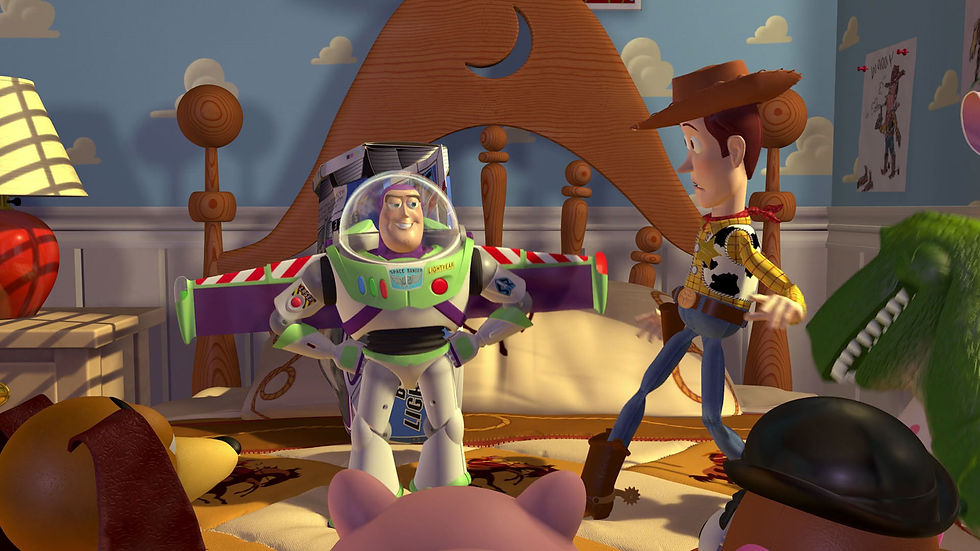
In this movie, Woody, a cowboy doll, was the favorite toy of a young boy named Andy Davis. Every time Andy or anyone else was away, he and all of Andy’s other toys came to life, talking and moving about like we all would in everyday life.
One day, they anticipated, with dread, an early birthday party as the toys listened in on what Andy could get that’d potentially replace any of them. One of the biggest highlights from Andy’s birthday party was the newest toy to enter Andy’s room: a fashionable action figure of a spaceman named Buzz Lightyear. Welcoming him in at first, Woody began to grow increasingly jealous when Buzz won the hearts of all of Andy’s toys and even Andy himself. Part of that wasn’t helped by how Buzz believed he was a legitimate space ranger who crash-landed on a distant planet. And I don’t mean for show; I mean for real, since Buzz was nothing more than a toy.
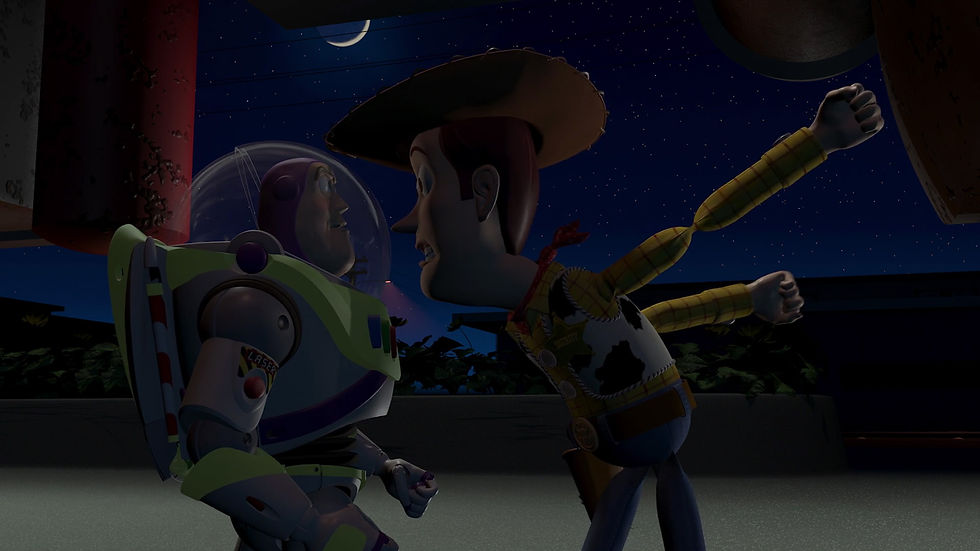
From then on, it became a butting of heads between Woody and Buzz as they tried to reign supreme as Andy’s favorite toy. However, after a freak accident, which started as a plot by Woody, knocked Buzz out the window, Woody soon ran into him as they tried to get back home, only to run into Andy’s neighbor, Sid Phillips, whom Woody and the toys feared because of his infamous reputation for mangling and destroying toys.
Would Woody and Buzz have a chance to escape Sid’s maniacal clutches? And most importantly, could they put aside their differences so they’d have a chance to make it home before Andy’s big move?
If you can believe it, the first time I ever became acquainted with Toy Story was through Disney’s original Animated Storybook CD-ROM games. Remember those? I remember admiring the game and going through the various mechanics and tactics necessary to progress my way through the story. The colors were nice, and the overall computer-generated imagery in the CD-ROM game was pretty good. Still, being the impressionable 3-4-year-old kid that I was, I was more drawn to what I saw in front of me than to what was being said.
Shortly after that, I finally watched Toy Story itself. And yes, I did recognize a good chunk of what I heard from the movie from the CD-ROM game, but beyond that, again, I was drawn more to the characters, their voices, and the animation.

But as time went on, the more I watched this movie, the more I picked up on things I hadn’t caught when I was younger. I felt the story’s cleverness. I felt the revolutionary techniques behind the animation. I felt the commitment behind the artistry throughout the movie. And of course, I discovered how it was genuinely hailed as one of the most groundbreaking movies in the past 50 years, so much so that the only movie to compare Toy Story with was Snow White and the Seven Dwarfs. As I watched this movie a few more times as an adult, I finally began to pick up on that legacy.
Every time I saw the characters’ movements and recognizable elements in the movie, I felt like I reconnected with my inner child. Or, in my case, I felt like I reconnected with the younger me because of what I recognized from Toy Story way back when, and also what I would catch on to and appreciate as an adult that the younger me would never have understood. There’s just enough light-hearted aspects in the film to catch the children’s attention as well as enough hefty material to appease the adults.
But it only kept getting more impressive. I will start with the cast, because that was just dead on. Every actor played their character like a violin.
With Tom Hanks, he fit into his role of Woody like a glove. Or rather, if Tom Hanks was a cowboy, he rode into the saddle and went through his first rodeo like it was absolutely nothing. He captured the sensible, concerned aspects of a toy who’s been loved for as long as he’s been around, while also expressing concern not only for those who feared being replaced, but also for himself if he was the one on the receiving end. But whenever he was agitated or indulged more in his jealous side, that’s when Hanks got more in touch with his comedic side, where he would let out some genuine wisecracks to highlight his agitation, and not just lighten the mood.
In the original cut of Toy Story that then-Disney CEO Jeffrey Katzenberg wanted, Tom Hanks nailed his voice role as Woody. However, he also went all out in the overindulgence of his crassness, which in turn made Woody a lot more unlikable. But in this cut, what Tom Hanks conveyed of Woody was just the right, more noticeable balance of sarcasm, nobility, and sensibility.

Tim Allen, already famous from Home Improvement, had displayed his utmost charisma and leadership as the alleged space ranger Buzz Lightyear. Allen highlighted not only his comedic side but also his bravura and borderline patriotism whenever he got into character as the famed space ranger of Star Command. Of course, because he had that mentality from the get-go without even knowing he was a toy, it inevitably led to quarrels between him and Woody about what’s what, who deserved to be what, and just who he really was when he wasn’t thinking he was what he thought he was. Nonetheless, whenever he let loose and got more in touch with his comedic side, Allen made sure it stayed in character for Buzz whenever he was let down or stuck in a sticky situation.
The late Jim Varney played Slinky Dog, and I remember being charmed by how reliable he made his character feel. There’s something in his voice that helped me understand how much of a long-time pal he was to Woody, and not just because Slinky was a dog. In all his lightheartedness, his deliveries also carried a twinge of comedy in both the expressions and their timing. Varney’s modesty and affability helped cement his performance as Slinky Dog, and it made me respect him as such.
Wallace Shawn. What can I say? He absolutely nailed it in his performance as Rex, with his neurotic display and scaredy-cat antics. Wallace Shawn went to town with his comedic urges as he emphasized the cowardly aspects of someone who was, in many ways, supposed to be one of the most terrifying predators ever to walk the face of the Earth. With Shawn’s performance, I could feel Rex’s insecurities lunging through and just how desperate he was to try to live up to his image as a dinosaur, whether to Woody, Buzz Lightyear, Andy, or anyone.
John Ratzenberger, who would eventually become a staple in most of Pixar’s films, nailed Hamm’s sometimes commonsensical, sometimes smart-alecky attitude, becoming the most memorable part of him outside of him just being a walking piggy bank. And whenever he spoke, his general sarcasm helped him deliver some witty retorts out of Hamm that were not too mean-spirited, but rather just laid back enough for me to get a solid chuckle out of it.
In addition, Don Rickles helped emphasize Mr. Potato Head’s comedic nature, especially when he had to grapple or complain about whatever body parts of him were gone or out of place. Even when he ventured into more accusatory territory when he suspected Woody of wrongdoing, Don Rickles still maintained his comedic nature even when he started to sound more agitated or suspicious.
Whenever I think of R. Lee Ermey, while others may recognize him from Full Metal Jacket, I always recognize him from his work here as Sarge. I find that funny, considering that his work in Full Metal Jacket possibly inspired his work in this film. Either way, he honed Sarge’s army commander instincts like a natural, talking and expressing himself as a full-fledged officer who treated every modest household activity, even a fun birthday party, like it was equivalent to entering a warzone that’d determine his and his troops’ long-term fate. He just owned it every step of the way.
Jeff Pidgeon was a master in conveying the otherworldly aspects of the little green aliens. As toys, either individually or as a group, they had a cutesy vibe, and they also expressed generally cultish mannerisms, the likes of which Pidgeon conveyed most memorably.
And the kids who played the kids in the movie basically felt like they played them by just being themselves.

Every time he played Andy Davis, John Morris conveyed him with childlike innocence and a sense of imagination. There’s a sense that he played every aspect of him just right, whether it was his imaginative side, his excitable side when he wasn’t playing with his toys, or as a respectable, responsible older brother figure every time he looked after Molly, his younger sister. Everything that Andy was, Morris conveyed with just enough flavoring to convince me that Andy’s a good kid.
Erik von Detten, on the other hand, played Sid Phillips with just enough of a nasty urge underneath his childish antics to convince me that he’s not a good kid. He also played him with an evident imaginative side, albeit one far more twisted and unusual, probably for a kid his age. And of course, the general undertones and antics he snuck into his voice highlighted how much of a bully he could be, especially to his sister Hannah. On top of that, much like how Zack Ward played Scut Farkus with such theatricality in A Christmas Story, so too did von Detten play Sid with a level of theatricality. I guess that he played him precisely as the toys would probably have looked at him, or as Sid envisioned himself - who knows? Either way, the amount of vocal ranges he played with Sid Phillips here was just mean-spirited enough, but also delightfully crazy enough, for me to be both amused by him and wary of him at the same time.
Even though she was not around for very long in the movie, Laurie Metcalf played Andy’s mother with just the right amount of motherly tendencies, enough for me to sense her personality even if the movie didn’t spend enough time with her.
Here’s what I did not realize until much later. And this is where I shall elaborate on its reputation as an animated film.
Ever since I was little, I’ve always recognized Toy Story as just a computer game. What I did not realize, however, was that the original movie was made entirely with computers. So, all the imagery I saw throughout the movie, polished as it was compared to what I was acquainted with from the computer game, was considerably revolutionary in its attempts to craft a full-length animated feature film with computer imagery as opposed to hand-drawn animation, as was the norm before then and at the time.
It was also revolutionary because computer animation was used only as a modifier, like a spice to emphasize certain aspects of whatever was shown in the movie. Among the pioneering movies to have achieved this were The Abyss, Terminator 2, and Jurassic Park. Even Disney used computer animation to enhance scenes in its own films since the mid-1980s. But here, the animators broke new ground by using only computer animation to make a movie. And the result was nothing short of a breakthrough in exploring the limitless avenues that animation can offer.
It was also a miracle that this had the benefit of good writing with which to tell the story, because if any other part of the movie were out of place, outside the animation, it would probably have knocked this movie down like a house of cards. Thankfully, everything about this movie was done with such careful attention to detail that even if the visual styles looked a little imperfect or awkward, it didn’t matter because everything else worked like clockwork.
It reminds me: I acknowledge that some bits of the animation did look rough around the edges, like with the human characters and Sid’s dog, Scud. Clearly, they were animated with less polish on the skin and hair than Pixar would perfect later. However, even I must admit that, much like Snow White and the Seven Dwarfs, for all the rudimentary aspects I caught on to in the film’s animation, it conveyed a slight old-fashioned quality that began to sprout from the movie’s facade as well. That is to say, even though it may look a little amateurish and like it just got started, there’s a certain quality it brought to the animation that made it surprisingly timeless. It was similar to how marvelous Snow White and the Seven Dwarfs still was to look at, not only for what kind of animation it brought to the forefront, but also for what animation it could bring as the first of its kind.
I felt the same way with the animation from Toy Story. Yes, some of the movements in the movie were a little jittery and unevenly paced. Yes, the textures on the human characters didn’t always look right. Regardless, the parts of the animation that did work really worked, and the parts of the animation that held up still blew me away as to how well it’d still hold up after over thirty years. That alone would indicate that it was made by a group of artists who knew the story they wanted to tell, which animation technique they wanted to use in this movie, and how to present it in the best possible way.

And I will say this.
One of my favorite parts of the animation in this movie centered around the atmosphere. Because this was shown from the toys’ perspective, look at how it would feel to see a child’s bedroom, a house, a neighbor’s house, or an entire neighborhood from the point of view of toys that are small enough for you to carry in your own hand. Something about it made the movie feel a lot more immersive, like suddenly, the world became much bigger than you’d possibly think it would look.
But what also helped the environment pop were the colors and the lighting.
Whenever it was bright or daytime outside, the colors were so vivid that they helped bring the movie to life; rather than just feeling like how a child would have imagined the most exciting idea of playtime, it tapped into the general childlike wonder of playtime for me. When it came to the toys being stuck in Sid’s house, it felt like a regular home yet ominous enough to hone the general dread and terror the toys felt as Sid prepared to torture them or rearrange them into freaky combinations and hybrids.
Heck, even Sid’s room, whether it was lit or not, highlighted the more unorthodox aspects of Sid Phillips’ character, from the punk rock posters across his room to the general craziness that came out when Sid was working on his toys. For example, when Sid played with Hannah’s toys and mutilated them to make his own experiments, the lighting as he got to work on them conveyed an unnerving atmosphere as he went to work on his next new experiment, which emphasized connections to Frankenstein as he mutilated the toys and rearranged their parts to make new ones.

Pizza Planet? Wowee, was this a hoot! With its intergalactic themes, rounds of fun games, and of course, some potentially mouth-watering pizza on the side, it looked like the kind of fun food and activity establishment that would put Chuck E. Cheese’s to shame. Even if a good chunk of the time the movie spent there was conveyed from the toys’ point of view, it looked so inviting that it would’ve been just as much of a blast to experience no matter who visited it. All those who say Pizza Planet ought to be brought to life as a new restaurant franchise, say aye.
And Randy Newman’s music? The general music he created in the movie, both the score and the songs, was fantastic.
Starting with his musical score, it conveyed the whimsy that provided the lifeblood of the movie’s tone. Sometimes, the music matched the toys’ general wit and humor, but other times, it jibbed nicely with the general childlike atmosphere. When it came to a kid playing with their toys, it was very elegant and excitable on Andy’s side. On Sid’s side, however, the music emphasized the unnerving energy and tactics that were expected with Sid’s generally crazy methods of playing with his toys. And every time things got serious or emotional for the characters, the music reflected either the urgency or the mellowness of the situation with the right types of softness it started with.
As for the songs he composed for the movie, they were surprisingly minimal compared to the other Disney movies around the time, which were full-on musicals. It still boggles my mind to think that, compared to all the other Pixar films to follow, this movie probably had the most songs so far, to the point where I mistook it for another musical, even though it did not have the characters singing and Randy Newman mostly sang the songs.
‘You’ve Got a Friend in Me’ was as wholesome as they come and conveyed the general lightheartedness and camaraderie to be expressed between two different people, whether they were far apart or close to each other. It was also very creative in that it did not emphasize the more lovey-dovey aspects of a friendship and rather conveyed it as a strong form of platonic bonding, if you know what I mean. However, while it’s obvious that this was supposed to highlight the relationship between Woody and Andy, the circumstances that Woody and Buzz went through together would hint that the song could be about them instead. Only, that’s if we’re talking about the song as it was in this film.
The song’s themes became so universal that it eventually expanded into the rest of the franchise with Toy Stories 2, 3, and 4. When you look at all the new toys and characters who came along throughout this journey, it made ‘You’ve Got a Friend in Me’ surprisingly applicable concerning who this could refer to. At first, it could refer to Woody and Andy, but in later cases, it could refer to Woody and Buzz, Woody and Jessie, Woody and Bo Peep, Buzz and Jessie, and so on. I remember relishing the song ‘Remember Me’ from Coco for being creative and vague enough in its relationships that I could see it easily applying to any genre. It could work as a romantic song, or it could work as a simple lullaby. What I did not catch on to with ‘You’ve Got A Friend in Me’ until later was that the appeal that made the song so iconic, especially as the theme song for Toy Story, potentially evolved, making it a classic for all the right reasons, as well as the closest thing to a masterpiece Randy Newman had ever created.
The other songs in the movie were not too shabby either.
‘Strange Things’ may have felt more standard, but it wasn’t without some noteworthy qualities of its own. It continued the whimsy that Newman mastered with ‘You’ve Got a Friend in Me’ and the score. In this case, though, he also emphasized the general uncertainties and anxieties Woody felt as his life slowly began to take a turn for the worse once Buzz Lightyear settled in. As Woody continually witnessed Andy favoring Buzz more than Woody, as well as Buzz proving his leadership skills with the rest of Andy’s toys’ community and allegedly showing Woody up, it only highlighted the collective frustrations Woody felt with the changes that came with his reputation and Andy’s room ever since Buzz’s arrival.

‘I Will Go Sailing No More’? Oof! I’m not going to pretend that this didn’t hit me like a ton of bricks. You can keep ‘When She Loved Me’, you can keep the ending of Toy Story 3. This is the one moment in the Toy Story films that always left me choked up. The song was all about what went through Buzz’s head as he finally discovered that he was a toy all along and not a space ranger as he thought. And the general sadness and dispiritedness present throughout the song as Buzz bemoaned his self-discovery of what and who he really was after all?
This song wrecked me because it felt like an existential crisis in song form. It always left me wondering what it would feel like if everything I had ever done was for nothing, if the people I thought were my friends or family were not, or if everything I had ever believed was a lie. How can you not feel such pain when you hear this song? What I found interesting about this song was that the last half of the song reflected what Buzz felt when he tried to talk himself out of believing that he was a toy and that he was still a space ranger like he thought he was, with the melody and lyrics matching the rising hopes. But by the time these hopes were dashed, it went back to the generally dispirited nature, but with a hint of acceptance this time. Regardless, I remember this song wearing me down every time I heard it, and it still does with the implications in mind.
Now, how about the characters themselves?
Woody was obviously a good-hearted, committed leader of the toy community, because he was simply the most favored of all the toys that Andy had with him. And as soon as all the other toys came along into Andy’s bedroom, Woody saw to it that they would all be given the love and attention that he believed they deserved, and not just himself, which was the sign of a righteous leader. Of course, with all those righteous qualities, you would think that he would have never thought about himself in any way, right?
Well, those aspects of Woody’s character were challenged when Buzz Lightyear came into the picture. He wanted to make sure he received the love and attention he thought he deserved. But when it came to his own need for attention, that’s when Woody’s character started to come alive. He started to have an internal tug-of-war between his needs for others and his needs for himself and Andy. So, when he felt shown up by Buzz Lightyear, he tried to figure out exactly where he fit in this whole scenario and whether Buzz was even worthy of Andy after all. But it did not take until his unfortunate journeys with Buzz in Sid’s house, where he began to feel increasingly challenged about what and who mattered most in his life and to him.
Buzz Lightyear was also a dignified toy who was under the delusion that he was a space ranger, specifically of Star Command. Even though he meant well and his heart was in the right place, he was technically living in his own fantasy world, thinking that he really did come from Star Command. Even though his expert craftsmanship and his skills swept all of Andy’s toys off their feet, it was never ill-intentioned or to replace Woody, but rather because that’s what he believed he was trained to do as a space ranger, and thus wanted to do right by his peers, just like Woody did, but for entirely different reasons and with different methods than how Woody had usually done so. That’s what drove a wedge between Woody and Buzz, and every time they bickered as to what mattered the most, which one of them mattered the most to Andy, and whether Andy even had anything to do with it, it helped drive the story forward.

All the supporting characters in the movie were memorable and left their mark in their own distinct fashion.
Rex, being a Tyrannosaurus Rex toy, felt like the exact opposite of threatening when I saw just how wimpish he could be, as well as how desperate he was to prove himself to be the terrifying reptile that he knew he could have been or that he was supposed to be. Because of this, he often responded to anything that seemed unnerving to him with frantic energy, which was not like what you’d expect from a Tyrannosaurus Rex, let alone a dinosaur.
Ham seemed like the generally commonsensical toy who just went about with his own commentary on certain goings-on or some of his fellow community members in his own – sorry, pun intended – hammy way.
Mr. Potato Head felt like he had more convictions than met the eye. While it was funny seeing him react to any scenario where he lost any body parts, since he was a toy with easily disfigurable body parts, there was a sense that he could be pretty suspicious about what he deemed unorthodox or unlike certain people he knew, especially when Woody started to act more out of line against Buzz. Even though his sarcasm often out-sarcasmed Woody, his general convictions when he started to blame Woody for all of Buzz’s shortcomings all started to paint him as a morally ambiguous character, but not so much where he was seen as a bad guy. If anything, I think it highlighted just how much he believed that Woody doing what he did, mostly because it was born out of jealousy, was not okay.
I will admit, regarding Bo Peep’s character, she generally didn’t have much going for her except for being a very nice, tender toy who had the hots for Woody. But as she was, she did seem like a more reasonable, level-headed toy in the group, especially when the toys were starting to frown down upon Woody for what they believed were treacherous moves against Buzz.
Also, I can’t help but look at what she suggested to Rocky in terms of lowering the ramp while the moving truck was in motion so Woody and Buzz would make it. That somewhat hinted at what she would eventually establish in the Toy Story films. But I will not get into that until I get around to it.
Plus, the animation of this character, as well as Annie Potts’ tender performance, helped her leave a distinct impression.
There’s something that I found commendable about the designs of the other toys. Look at the Troikas, the five-egg toy that always went in and out. I remember the toy robot. I remember the toy snake. I remember Mike, the toy with the microphone. I also remember the designs of the troll, Lenny the binoculars, and especially RC. Even Rocky, who looked like a simple bodybuilder, had enough distinctness to help him stand out. And who can forget the little green aliens, with their three eyes and singular antennas? I remember them all because of how distinct their designs and personalities were.

And of course, the designs of the mutant toys in Sid’s room were very freaky yet no less creative. I won’t go into more detail about what kinds of toys Sid had in his room, but take just one look at any of these toys, and I guarantee you that this would tell you exactly what kind of imagination Sid had when he played, or in this case, made, his toys. After all, a jack-in-the-box where a hand comes out instead? A one-eyed baby head with spider legs? Granted, some toys from Sid’s room were more modest and less weirdly put together than others, but that doesn’t change just what kinds of freaky creations Sid would’ve unleashed when he let his imagination run wild.
You know, I may as well throw this out: what I found morbidly humorous was Hannah’s toys, with which Buzz Lightyear had tea. They also all ended up the way they did after Sid messed with them: headless bodies. Yet Hannah still played with them like normal, so at least she wasn’t too perturbed by it. And who wouldn’t chuckle over Buzz referring to them as ‘Marie Antoinette and her little sister’?
Finally, I also found Woody and Buzz Lightyear’s designs very memorable for another reason. Because Woody was a cowboy, he sported a more old-fashioned, modest, historical look. In contrast, Buzz Lightyear, being a space ranger, had a more modern, high-tech, futuristic aspect to his character. And when you look at how much the Westerns-versus-Space quarrels lasted throughout time, it only added to the generally apt rivalry that developed between Woody and Buzz.
I also admire the movie’s sense of humor.
It does have its childlike humor, that’s for sure. This line by Bo Peep, for example, I always thought was cheeky.
Remember, I’m just a couple of blocks away.
Said she as she passed by a couple of literal blocks. Get it?
But I also admire what trademarks Pixar established with its humor by how subtle its adult humor could be.
It had never occurred to me until much later that the fishing rod with the lady legs from Sid’s house was supposed to be a visual resemblance of a hooker. And I especially like one of the games from Pizza Planet called ‘Whack-A-Alien’. I didn’t realize until I saw it again as an adult that it was a cute nod to the otherwise terrifying chest-bursting scene from Alien.
Bits like these only made me appreciate just how sly an adult sense of humor Pixar would sneak into films like this.
Now, getting back to Andy Davis and Sid Phillips, there’s not very much personality to each of them outside of them embodying the opposite aspects of an imaginative kid.
Andy Davis embodied the more wholesome, childlike essence of a little kid who loved playing with his toys. He’s good-natured, he’s social, he’s a bit of a partygoer, and he looked out for his little sister, Molly.
Sid Phillips, on the other hand, was definitely a bratty kid. Embodying a more twisted and unorthodox sense of imagination, he was very private, he concocted experiments, and of course, he bullied his little sister, Hannah. So, you can tell just how much they were complete opposites.

I especially loved how Sid Phillips was framed. In the eyes of others, such as his sister Hannah, Andy, his mother, and probably the other neighbors, he would have been looked down upon as a reckless kid who should not be allowed to play with toys the way he would. I mean, some of his ideas with his toys revolved around explosives. How did he get access to some of them unless he used his parents’ credit card? So to them, he would basically be just a bit of a troublemaker. But in the eyes of the toys, they looked at him like he was the absolute epitome of evil and a serial killer in terms of toys.
When I was a kid, I saw Sid as the main villain of the movie and therefore an inherently bad kid. Looking at him now, however, I would say he was more crazed than he was evil. If I thought of him as just a straight-up evil kid, it might’ve been because I was looking at and evaluating him the same way the toys did.
Of course, I’ve always wondered exactly whether Andy or Sid would have even known each other. But judging from how Sid Phillips was the reckless kind of kid, as we’ve seen with those firecrackers that he used to blow up his own toys with, I think it’s best that we not know exactly what kind of relationship Andy and his mother had with Sid and his family, if any.
In fact, why do I get the feeling that Sid Phillips had something to do with Andy and his family moving away?
Much like how the designs of Buzz and Woody worked off each other in opposite ways, but in ways that suggest a potential connection between the two, so too were there enough personality details and enough touches with both Andy and Sid’s personalities, down to their surroundings, to remind me of just how polar opposite these two were.
But what tickled me to think about Toy Story was what this movie would mean to all those who had the opportunity to grow up with this film, just as my brother and I did, and even as my nephew just did.
It was around late last year when my brother, my eldest nephew, and I went out together to catch Toy Story on the big screen, probably for the first time and also for what I’m pretty sure was my nephew’s first big-screen venture. There’s just something so riveting and deeply fulfilling about taking what we’ve grown up with as far as Toy Story was concerned and passing it on to the next generation so they could have a chance to experience it the same way we did. And obviously, even before he saw it on the big screen, my nephew was a huge Toy Story fan. So, because he was already acquainted with Toy Story at such a young age, he was basically getting the hang of it and loving it inside out, the same way my brother and I did and still do.
I think anyone who was only a few years old and experiencing Toy Story for the first time was guaranteed to have a very prosperous childhood ahead of them. Toy Story was like a borderline baptism of childhood trademarks. At least, that’s how children around my age group would have come to view Toy Story.

All in all, Toy Story was a truly remarkable motion picture that began with humble origins, and this was one of the defining aspects of my childhood. But as I grew older and discovered each new hidden layer of Toy Story, my appreciation for it only grew exponentially until I could finally see why it earned its legacy as a groundbreaking motion picture.
The characters were all charming and well-established, despite their varying degrees of complexity. The voice performances breathed pure life into the toys. The story was very simple but very effective. Randy Newman’s music might be some of his most iconic work yet. And the animation, for all its limitations, was just ahead of its time.
I always love it when you are acquainted with movies from your childhood that you appreciate on one level only to appreciate very well in another. And while I still hold a candle to Aladdin for achieving just that with me, as well as movies like Beauty and the Beast, The Lion King, and other such films for accomplishing such magnificent feats, I will forever hold a special place in my heart for Toy Story for leaving its mark on me from the most unexpected places and with the most unanticipated means necessary to pull off something magical.
To infinity and beyond shall this movie go.
My Rating
A high A


Comments