

Lincoln (2012)

As we sit here reveling in the United States of America’s major milestone, where it turned 250 years old on the Fourth of July, let’s take a look at some of the major movie moments that occurred throughout history.
Sorry. Couldn’t help it.
It goes without saying that many attempts were made to adapt the lives of some of the most famous U.S. presidents for film, television, and other media. Many documentary series and specials have been made about them, no doubt. But what about general biopics? The kind where they took an in-depth look into the presidents’ lives and revealed the personal motivations behind what they did to become the famous presidents they were? Plenty of movies have done that and become celebrated works of art in their own right, including those about Richard Nixon, John F. Kennedy (albeit via historical fiction), and so on. In some cases, like Founding Father Alexander Hamilton, they would have had the good fortune of having a highly successful musical made off of their life story.
For this month, after talking to you on the first Saturday of this month about where America had gone in the two hundred and fifty years it’s been around, I am dedicating the last Saturday of this month to highlight one movie centering on the U.S. presidency that reverberated within me long after I saw it.
I, of course, speak of Steven Spielberg’s take on the presidency of Abraham Lincoln.
Released in 2012, Lincoln became heralded as a shining figure in Steven Spielberg’s filmmaking career for establishing a more human exposure to Lincoln as he assumed the title as the President of the United States of America and tried to negotiate with various political figures in Washington, D.C. to get the Thirteenth Amendment passed, which would abolish slavery and, by extension, bring about the end of the Confederate States of America, which was on the brink of complete independent establishment from U.S. rule.
But what exactly went on in the White House that inspired Lincoln to make the decisions he made? What did he run into that caused him to batten down the hatches, bear the brunt of the situations unfolding around him, and try to steer America onto the right path, even if his decisions to do so were seen as controversial at a time when America was on the verge of splitting itself apart in the North and the South?

Let’s take a look at the story. Set in 1865, it highlighted Abraham Lincoln’s time as the POTUS while the Civil War raged down South. After having some issues to deal with, such as family struggles – among them the possibility of his eldest son, Robert, partaking in the war and the death of Willie, who had died only a few years prior – and the lessening effects of the long-term promises from the Emancipation Proclamation, which he delivered a year and a half before his re-election, Lincoln found it necessary to try to unite the United States of America as one whole country again by proposing the Thirteenth Amendment, which would help abolish slavery. Despite his intentions and long-term vision with the Amendment, the rest of his staff were conflicted. They either agreed with Abraham Lincoln in legitimizing the Thirteenth Amendment so America could be brought back together as one whole country, or went the other route and recommended that Lincoln pursue peaceful negotiations with the Confederate States of America. As you would expect, it resulted in a full-on battle over what the right decision would be, where Congress’ vote lay, and whether that would determine Lincoln’s fateful attempts to untangle America and free it from internal and political chaos. Would Abraham Lincoln have succeeded in his efforts to unite the United States as one? And what further causes did this result in before the fateful turn of events for both the Civil War and Abraham Lincoln himself?
Those of us who looked into history may know the answer, but that doesn’t mean that the hows behind it are not worth peeking into.
Whether Steven Spielberg and Tony Kushner took some liberties with Lincoln’s life story in this movie or not, if any, they still crafted an exquisite, poised, hefty, in-depth look into Abraham Lincoln’s time as the POTUS and what he meant to do to ensure everyone in the country was on the same boat in abolishing slavery with the Thirteenth Amendment. It was also interesting to listen to Lincoln and his subordinates, including Secretary of State William H. Seward and Vice President Ulysses S. Grant, argue about how to end the Civil War for the sake of further prosperity for both sides of the country rather than for one side or the other.

I also admire some of the shots throughout the movie, too. Everywhere I looked, they’d take me into a time and place in the United States of America where things were far more refined, sophisticated, and suave, not to mention pretty classy, all while the constant turmoil, aggression, and hellish urges of the Civil War were raging on nearby.
And let’s face it, I found myself completely transfixed upon the lavish set designs throughout the movie. The general layout captured the whole aesthetic and feel of 1860s USA, whether it be at the White House, the U.S. Capitol, or even some of the suburban houses. They all carried the distinct, long-gone-past feel that’d also help me feel like I had traveled back in time to witness history being about to be made, so to speak.
And while the set designs were truly something to behold, capturing the full aesthetic of mid-19th-century America, the same can be said of the outfits. Whether it’s the dresses, the presidential suits, the congressional outfits, or the costumes throughout this movie, they all captured the general feel and even the positioning of the troops and members of Congress in mid-19th-century USA. I could tell who served in the Union. I could tell who served in Congress. I could tell who was a mistress or the First Lady. In some cases, I could even tell who served the Confederacy. So, there’s practically a ton to be appreciated about the set and costume designs when they helped take me back to a time and place when America was risking a slip of its foothold on itself and needed some guidance to be put in the right place, as Abraham Lincoln would do with the Thirteenth Amendment.
It went all out to capture every minute detail and repaint how America functioned during what was then perceived as a chaotic time in history, when America was about to split in two because of the Civil War.
Now, what does this say about Steven Spielberg’s directing throughout the movie?
This film’s about the warfront, no doubt. But even then, it was more about the political goings-on that would guarantee an inherently dicey solution to end the war, and the tactics necessary to make it a reality. What I admired most about this movie is that it emphasized the human aspects behind such policies in Washington, D.C., as we witnessed history being made with the Thirteenth Amendment, which abolished slavery, and, by extension, its role in the end of the Civil War. When I think of Steven Spielberg and wars, I think back to what he had accomplished so well in films like Schindler’s List and Saving Private Ryan. With this film, even though it didn’t come close to being on the same level in terms of raw emotion, gore, and unflinching expositions of the cost of war, what I still believe Spielberg nailed with this film was the old-fashioned feel and the human drama that surrounded this otherwise tumultuous chapter of America’s growth as a country.

I remember looking at this movie and anticipating it because of how distinguished it looked. Part of it may have something to do with how it went back in time when the United States of America was trying to maintain its stronghold as a country and facing the likelihood of dividing against itself, hence the phrase, “A house divided against itself cannot stand.” But the whole idea of this movie taking a headfirst dive into the pains, struggles, and mental anguish of one of the most influential U.S. Presidents who ever lived was enough to clue me into wanting to know more about how this movie would have dwelled on the story of how he went from being a beloved figure to making history.
Sometimes, the directing even benefited the characters too, for while the actors were good enough in letting their body language and expressions do all the work, some of the shots and actors were positioned in ways where I could see them in their positions and truly get a better understanding of what was going through the characters’ heads depending on what they had to deal with, especially Abraham Lincoln.
That leads me to another highlight from the movie that left me enraptured: Tony Kushner’s writing.
I was entranced by how Abraham Lincoln and all his fellow politicians discussed the messy situations with such clarity, fluency, and as little backtracking as possible. The writing made it sound like they were natural-born Americans willing to confront the problems that stared them in the face or lay just around the corner. They even tried to keep a clear head about the situations at hand, especially when the dilemmas concerned whether to pass the Thirteenth Amendment or to forgo it and instead make peace with the Confederacy as a means to end the war.
Kushner’s writing was downright eloquent and made it possible for me to follow much of what the characters discussed throughout the movie and get a firm grasp of the complex political aspects without feeling lost amid the hurdles the characters faced. It also did wonders for the characters; the dialogue sounded distinguished and elaborate enough to reflect how it would have been spoken in the mid-nineteenth century, while also having just enough twinges of modernity to make it more easily digestible for a modern-day audience. It got to the point where it was very easy to follow what was being said while getting a firm enough understanding of the dilemmas so that I’d understand where each character was coming from and why they felt compelled to do what they did or act the way they did.

There’s even one scene I remember where Abraham Lincoln attempted to convince William Hutton to vote for the Thirteenth Amendment, and he refused, expressing his hatred for the African people and admitting he was ‘a prejudiced man’. Only, it likely wasn’t out of racist bigotry, but rather out of resentment for them having taken the life of his brother, who served in the Union. What I admired about this scene was that these two characters did not escalate into violence, conflict, finger-pointing, or anything like that. Abraham Lincoln held his peace, sent Hutton and his family his condolences, and set off on his way. Scenes like that, I thought, were a testament to how much of a good president Lincoln was, not just in his policymaking, but also in his personality.
It’s one of those moments where the movie didn’t paint characters like Hutton as straight-up bad guys, but rather as conflicted people whose lives were upended by the war. Even the Confederate officials who showed up in this film, like Confederate Vice President Alexander H. Stephens and even Robert E. Lee, had barely done much to leave a lasting imprint on the movie, but were portrayed more as regular people than straight-out bad guys willing to take down the United States of America in the name of the Confederacy. Even though a part of me wished that more time was devoted to them so that we’d understand why it was so urgent for Abraham Lincoln and his board members to have the Thirteenth Amendment passed, it was still addressed fluently enough, with these characters conveyed modestly enough, for the desperation behind the Amendment to be passed without any blatant black-and-white instincts to get in the way.
One of the most memorable scenes that always stuck with me about Abraham Lincoln was when he walked into the living room to check on his son, Tad, who slept by the fireplace. Lincoln noticed two pictures in Tad’s hand, both of young African-American boys. Then, he lowered himself down, lay down beside him, and picked him up to bring him off to bed. That scene always resonated with me because this was the first time I had ever seen a completely different side of Abraham Lincoln that we may not have noticed before. What I saw in that moment was more than just a revolutionary U.S. president. I saw the Abraham Lincoln who was a loving father, a committed husband, and someone who knew in his heart that the Thirteenth Amendment would be the gateway to freedom for all the African Americans who had been enslaved in the South. It became more important to him as he understood that even his sons shared his concern for them as fellow people, not as people lower than them.
So, whenever you look at the more humane aspects of Abraham Lincoln beyond just his time as POTUS, that would help emphasize the monumental decisions he made as President, down to rallying everyone behind the Thirteenth Amendment.

The music was composed by long-time Spielberg collaborator John Williams. If you look at his other collaborative projects with Steven Spielberg, they both masterfully captured the human tendencies in the characters while balancing the story’s dramatic, weighty aspects with its more lighthearted elements.
What I admired about Williams’ work in Lincoln was that, as easy as it would be for him to compose work that just screamed patriotism and fervent American pride, he instead captured the general anxieties of the battlefield and the inner turmoil that lurked beneath Abraham Lincoln and behind his decisions. His music helped bring to life the story of a revolutionary man whose motivations, deepest desires, and ambitions shaped the course of American progress for the better, while also exploring the humanity behind the icons who made the impossible possible for the United States of America.
I must admit, though, there were a few scenes that came across as a little too gimmicky, and the music with them.
To start, parts of the music had a borderline country vibe, as three of the politicians hired by William H. Seward to find the remaining votes, William Bilbo, Robert Latham, and Richard Schell, tried to reach out to other eligible voters and convince them to vote for the Thirteenth Amendment so it could pass. There was something about the scenes and music that made them look like they tried to concoct any hare-brained schemes necessary to secure the votes they needed for the Amendment to be ratified and properly processed, even though it could very well blow up in their faces.
I get that the movie tried to throw in a little lightheartedness to balance out something as weighty as the Civil War and the desperation to pass the Thirteenth Amendment, but something about it just felt a touch too corny. A little whimsy was to be expected in Steven Spielberg’s movies, but I remember looking at these and feeling like the whimsy could have been dialed back a bit.

Other times, however, the lightheartedness fit well. For example, I remember two scenes, both involving Abraham Lincoln, that felt like the movie’s humor was exactly how it would’ve occurred in those times.
In one scene, Abraham Lincoln publicly announced the raising of the flag by the U.S. Treasury. Then, less than a minute later, he concluded, “That’s my speech.” Considering how we’d think of large, patriotic speeches when we think of Abraham Lincoln, that kind of delivery on something so short and sweet just felt amicable and lighthearted enough to add to the humor behind such exchanges as that.
There’s another scene where everybody waited in the telegraph room in anticipation for the reports of the Northern activities down in the South, and Abraham Lincoln decided to tell them all a story he remembered to pass the time.
As he relayed it, shortly after the Revolutionary War concluded, American politician Ethan Allen went to Great Britain to arrange international negotiations. Then, in the middle of dinner as a guest, Allen decided to go to the ‘water closet’, and it just so happened that the bathroom had a portrait of George Washington looking back at whoever was using the john. What caught his eye about the painting was its awkward sense of, um, position. Allen left with the implication that any Englishman going to use it would have felt an intimidating presence from George Washington, as if they were spied on for more reasons than being looked down upon by those who crushed them in the Revolutionary War.
I remember this story getting a big laugh from the audience as much as it did from those who listened to Abraham Lincoln’s story in the telegraph room.
Moments like that did more than humanize Abraham Lincoln and his fellow compatriots. It also helped provide the general gaiety found in the more mundane moments when America was not losing sleep over the Civil War, such as what Steven Spielberg could do best under the right circumstances.
What I came to find a little off-kilter was the movie’s demonstration of the Amendment’s voting stages in the House of Representatives. It did not occur to me until recently that the movie showed the political debates over the Amendment only in the House of Representatives. For any new law or Amendment to pass, it’s supposed to get enough yeses not only in the House of Representatives, but in the Senate, too.
After doing some research, it turned out that the Senate already passed the Amendment on April 8, 1864. I get that the movie may have tried not to risk repeating the Amendment’s journey toward legitimization, and yes, the Amendment’s passing in the Senate was mentioned on a couple of occasions. But this is one of those subjects where you’d have to pay close attention to understand where the Amendment stood as Abraham Lincoln labored to get it through and embedded in the Constitution.

Last but not least, the one aspect of the film that helped give it its footing lay in the acting. Many of the actors in this film gave it their all and elevated this chapter of American history to cinematic brilliance without sacrificing any of the human drama and sensibilities that shaped this monumental discourse on American prosperity.
Three major actors evidently went above and beyond their call of duty to deliver their performances to the characters who benefited the most from such inflections. We may know who those three would be, especially when we look at their Oscar recognition, but I’ll get to them when I do.
I’ll start with the first of these actors, Tommy Lee Jones as Congressman Thaddeus Stevens.
As I could tell from the look on Jones’ face, Stevens looked as if he had gone through tons of hardships in his life that left him bitter and unsure of who to trust, even Abraham Lincoln, but with nary any signs of spite. But after repeated exposures to the arguments backing up the Thirteenth Amendment, an inner part of him began to ignite when he was confronted with differing propositions that aligned with what he truly believed in, and thus was willing to commit himself to that cause no matter what others would say about it, what others would tell him about it, or what he would even try to tell himself would be the case. And the more he began to get in touch with that inner part of himself, the more he had done so with remarkable precision as he pointed out all the Constitutional laws and ethics necessary to justify their alignment with the proposed legitimization of the Thirteenth Amendment.
I don’t want to give away what was revealed about Stevens at the end. But what I shall say is that it would give you a much clearer idea of why he did what he did throughout the movie and help you reevaluate his character in ways you wouldn’t otherwise. And it only lent more weight to Tommy Lee Jones’ performance because it’d make you understand where he’s coming from and why he was so compelled to stick by what even he initially agreed was too controversial a proposition.
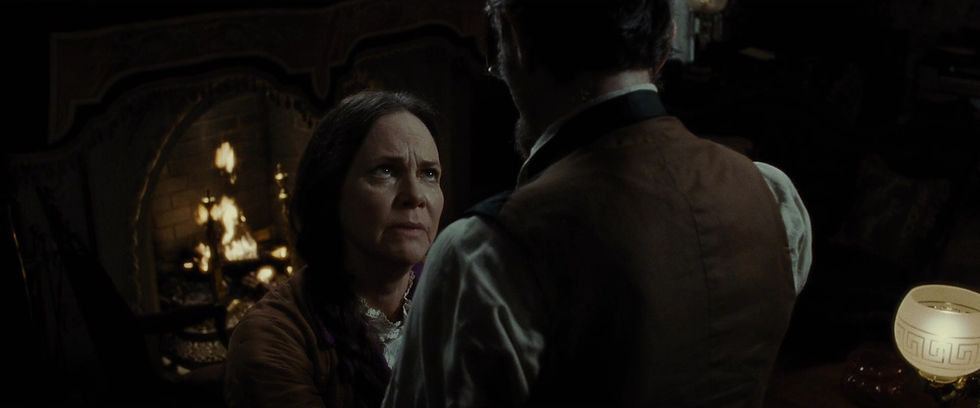
Sally Field, another of the actors who was bestowed Oscar recognition for her work in this film, was just a hoot as First Lady Mary Lincoln.
With Sally Field playing Mary Lincoln, she infused far more into her character than met the eye. She was more than just a nicely dressed First Lady. She carried all the grace and dignity expected of one, while also being a wisecracker, a terrified mother, and very mindful of the drastic effects the Civil War was having on her family and her husband. Because of this, she was unsure whether to stick by Abraham’s side during these challenges, or if she was ultimately at her wit’s end with such radical decisions. And nowhere was that more prominent than when she and Abraham Lincoln were confronted with the likelihood of their eldest son, Robert Lincoln, volunteering to serve in the Union. I could feel all the angst and conflicted emotions running rampant through Mary Lincoln as she tried to be there for Lincoln as he tried to be there for her.
But before I hop onto you-know-who, allow me to explain and say that plenty of other actors left a big impression on me throughout this picture because of what they managed to deliver into their characters.
For example, David Strathairn, who played William H. Seward, played him well because of how committed he helped his character feel and sound every time he spoke with Abraham Lincoln. Despite his clear allegiance to Lincoln and his ideals, he looked like he was on the verge of believing that making peace with the Confederacy was the most logical way forward, and that the Thirteenth Amendment was nothing more than a dicey proposition that could collapse on itself if not followed through accurately or under the right conditions. I could tell that he did his best to stay on Abraham Lincoln’s side despite surmounting odds, but at the same time tried to maintain where he stood in his beliefs, regardless of his commitment to Abraham Lincoln, as he tried to reason with him about what must be done, what should be done, and whether that would be good for Abraham Lincoln or, by extension, the rest of the United States of America.

One actress who won me over was Gloria Reuben, who was Mary Lincoln’s dressmaker, Elizabeth Keckley. Throughout the course of the movie, I just saw her standing by Mary Lincoln’s side as she watched in fear, anticipation, and through tears about the ongoing debates concerning the legibility of the Thirteenth Amendment and whether African Americans should be allowed to be free citizens and broken free from slavery. But it was not until she spoke with Abraham Lincoln that I was floored by why she stood by the Lincolns in their pursuit of the Thirteenth Amendment, why she was on board with it, and why it was so important to her, her family, and her people. She elaborated on how her son fought and died in the Union and how she, then a childless mother, believed that the Thirteenth Amendment could have granted her and her people what her son fought for. That part of her performance, I thought, was the most memorable in the whole movie, as it was of her character.
Let’s also talk about the actors who played Abraham Lincoln’s sons.
Joseph Gordon-Lovett gave a most convincing performance as Robert Lincoln. While it was obvious that Robert was visiting to catch up with his younger brother, Tad, and their parents, he made it clear that he did not mean to visit for very long, for he felt like he had far more important things to do, the aspirations of which his family found too alarming. The reason was that Robert decided to serve in the Union to do himself, his family, and his country proud, which led to a heated argument between him and Abraham Lincoln over whether he was making the right choice to join the war.
In one particularly harrowing scene, Robert waited for his father when he noticed a cart with what looked like blood coming from underneath it. And after following it, his stomach clearly turned at the sight of severed limbs, arms and legs alike, being dumped into a hole, possibly to be buried. Yet, despite his inexperience and unwillingness to stomach the nauseating sights in front of him, it did not deter him from wanting to launch himself into the battlefield for his fellow country, much to his father’s objections.
And it all led to one of the family struggles between Abraham and Mary, who were conflicted about whether to let Robert join the war because they had already lost one of their other sons, Willie, several years earlier and didn’t need to lose another. That’s why the Civil War tied into the Lincolns’ struggles as a family: it left them uncertain about whether what they were doing was the right choice for their country or for them.

And even though he may not have done much throughout the movie, I still remember what an innocent and wholesome performance Gulliver McGrath gave as Abraham’s younger son, Tad. For most of the movie, he basically remained his innocent self while assuming the more adult, mature positions of the American elite, as children normally do.
But one of his biggest highlights occurred near the end, and I will elaborate on that when I do.
And it wasn’t just them. There were even a few celebrities I wouldn’t have recognized until much later who made an early appearance in this movie. For example, one of the African Americans who worked as Lincoln’s valet and was also enslaved in the Confederacy himself was William Slade. He was played by Stephen McKinley Henderson, whom I would have recognized from the Dune movies, as well as Fences and Civil War. And whenever Lincoln corresponded with Samuel Beckwith, who oversaw sending Morse code telegrams in the telegraph room when it concerned certain goings-on from the White House or the River Queen down South, there was something about his boyish posture and manly voice that seemed familiar. And it blew my mind when I later realized that was Adam Driver. And for what he had going for it, I was impressed with how he conveyed this character. The way he maintained his posh image while still carrying the utmost dignity reminded me a great deal of what he would go on to establish, especially as Kylo Ren in the Star Wars sequel trilogy.
But now, let’s talk about the most remarkable actor, with the most phenomenal performance, in the entire picture: Daniel Day-Lewis as Abraham Lincoln.
It’s little wonder that he won an Oscar for his role in this film. What I remember the most about his performance is that he took the basic image of Abraham Lincoln, who we’d usually see as just a dignified old face in a historical portrait, and breathed nothing but pure life into this figure as I listened to him speak his mind about what he believed to be right for himself, his family, his country, and his people, while also reminding us that he had gone through a lot in his lifetime, and thus was willing to stick by his beliefs if it meant a guarantee in further prosperity for his people and his entire country when it was on the verge of splitting apart.
I, and probably many others, always imagined him as having a pretty rough, distinct, deep voice to match his general appearance. That is to say, every time he spoke, we’d picture him as carrying a more booming voice that would have carried the prowess of a heralded U.S. President, and also the pride of a leader who knew in his heart that what he had to do was guaranteed to breed good results for his country once the Confederacy was to dissolve. However, it was said that Abraham Lincoln did not have a bombastic voice as many would have imagined, but rather a soft-spoken one, the kind that would emphasize his more humane, sympathetic, and conflicted qualities. Whatever the level of authenticity was in Daniel Day-Lewis’ recapturing of Lincoln’s voice, what he managed to convey to Abraham Lincoln was just enough to turn this human symbol of America into a struggling human being with strong convictions, a conflicted psyche, and enough determination to see to it that what other people considered controversial propositions were to be passed for the betterment of the country that he promised to lead.

Every time Lewis spoke, I wasn’t just seeing Abraham Lincoln arguing about his beliefs. I saw him demonstrating his true worth as a President of the United States of America. And he also honed his sensibilities to the nth degree as a father, a husband, and a man balancing his family life with his presidential duties. Daniel Day-Lewis conveyed every single one of those aspects through Abraham Lincoln, and he did so in a way no history book or historical portrait could. What’s more, when you combine that with Steven Spielberg’s directing, the collaborative results were astonishing and helped put the ‘honest’ in Honest Abe.
I will say this, though, about the ending. One particular instance that my parents and I remember not being very fond of was how they displayed Abraham Lincoln’s assassination. Knowing that this was where Abraham Lincoln would be shot in the back of his head, I obviously anticipated the moment with dread, but here’s how it played out.
Tad Lincoln, alongside the White House doorman, Tom Pendel, watched a theatrical production of Aladdin at Grover’s Theater before the curtains prematurely went off and the theater owner, Leonard Grover, came out to announce that President Lincoln was shot. It caused a great wave of fear among the audience, especially among Tad.
Now, my parents and I did not think that amounted to much at first. We know how it happened, right? Abraham Lincoln sat in the balcony with Mary and two servants as they watched the theatrical production of ‘Our American Cousin’ at Ford’s Theater until it was cut short by Abraham Lincoln being shot in the back of his head by John Wilkes Booth. We were so used to how Abraham Lincoln was done in that somehow, as shown in this film, it minimized the impact of how we anticipated Abraham Lincoln’s assassination.
However, as I rewatched it, let it sit, and finally did some digging, I began to think that this was a surprisingly refreshing take on the President’s demise. Let’s face it, we have seen the demonstration of Abraham Lincoln being shot in the back of his head at least a dozen times before. It was even shown this way in National Treasure: Book of Secrets, for Heaven’s sakes. If this movie kept to how the assassination was generally remembered and showed John Wilkes Booth sneaking up behind President Lincoln at Ford’s Theater and then shooting him in the back of his head, it would probably not have worked. It would likely have beaten a dead horse and added some unnecessary shock value. But by showing us the reactions to Lincoln’s assassination with a different play in a different theater at the same time with different people who knew Abraham Lincoln, what my family and I thought was the weakest part of the movie was actually a curveball thrown at us to introduce us to a more overlooked aspect of Abraham Lincoln’s assassination, on top of which it had us reevaluate this phenomenon not from the popular standpoint, but from an emotional standpoint.

And the look on poor Tad’s face as he took in the bad news says it all. He was nonplussed in a moment of disbelief until he finally cried out in anguish over his father’s death.
That, to me, reinvented how Abraham Lincoln’s death at the hands of John Wilkes Booth was perceived. It was not from seeing the assassination in action, but rather from seeing the reactions of those who were unfortunate enough to hear such devastating news of Abraham Lincoln’s death. That was another reason why I thought the movie brought forth a more human aspect of Abraham Lincoln’s life than I ever thought possible.
As we bid farewell to America’s birth month on its 250th anniversary, what better way is there to close it out on a high note than by looking at one of the most iconic figures in American history?
What Abraham Lincoln had done, especially as we’d seen him do in this movie, was among the reasons his face was carved alongside those of George Washington, Theodore Roosevelt, and Thomas Jefferson in Mount Rushmore. His aspirations and solutions for America left a truly deep and prosperous impact on us as a nation. In this film, the germinations behind it were brought about by fabulous acting, writing, set pieces, costuming, directing, and music to make it all possible, and I could not have envisioned a more fitting director to emphasize the weight of history, but also the humanity behind such monumental choices, than Steven Spielberg.
While Lincoln doesn’t stand as tall as some of Spielberg’s other masterpieces of cinema like E.T. or Raiders of the Lost Ark, Spielberg still succeeded in balancing out the pain and chaos of war with the human pathos to help hone the reasons that the decisions made to guarantee a more prosperous future for America and its citizens would be the right ones to make, daring and risky as they were. In so doing, Lincoln was bestowed 12 Oscar nominations, and the Oscars the film did walk away with, especially for Best Actor, felt earned.
Once again, happy 250th anniversary to the United States of America, and God bless Abraham Lincoln.
My Rating
A

Works Cited
Kushner, T., & Goodwin, D. K. (2012). Lincoln: The Screenplay. DreamWorks II Distribution Co. ; Twentieth Century Fox Film Corporation.


Comments