

Hoppers

SPOILER ALERT
After many sequels and remakes, anything original from Disney and Pixar, especially as long as it's done right, is bound to be a step in the right direction, come what may. When I saw the trailer for Pixar's newest flick, Hoppers, it was off to a good start with an intriguing premise: a teenage girl named Mabel was given the ability to infuse her likeness into the body of a robotic animal – in her case, it was a robotic beaver. I was willing to take the characters' word for it, comedically delivered as it was, and understand that this would be nothing like Avatar.
The longer I let it sit, however, the more it reminded me of the DreamWorks Animation hit The Wild Robot instead. Think about it. A mechanical being intermingling with and assimilating into the local wildlife, and ultimately getting the hang of its customs? That sounded similar to what I knew would be explored in this movie. Only in this case, it wasn't a robot, let alone a robot 100%, but rather a human being who took on the guise of a robot to learn more about the local wildlife.
As for what I witnessed out of this? Let's start at the beginning with the story.

Mabel was an avid animal lover, but her rambunctious behavior and well-intentioned shenanigans often sent her to her grandmother, Tanaka, whom she came to love very much, thanks in part to a mellow glade where Tanaka would take Mabel out.
Oh, boy! Now we have another animal-loving Mabel to love, and not just from Gravity Falls.
Mabel grew closer to this part of the woods, so much so that she decided to stay there. I'll explain how soon. Later, she rebelled when the mayor of Beaverton, Jerry, planned to build a bridge over the pond and her grandmother's former home. Accordingly, Mabel tried to find any methods necessary to talk Jerry out of going through with the construction plans, which started with being told by one of her college professors, Dr. Sam Fairfax, that the only way to talk the animals into going back into the glade, which had been long since vacated because of the construction, was with a beaver.
Mabel thought that she meant getting an actual beaver. But during her initial pursuit for one, she discovered that the beaver she found and followed back to Beaverton University was a robot piloted by one of the scientists who had collaborated with Fairfax. The idea was to put a human mind into the body of a robotic animal, which was where the robotic beaver came in.
At first, I thought the whole point was for the scientists to connect with the wilderness and convince them to reclaim their homes so the construction wouldn't displace them. But it turned out that was only what Mabel had in mind, not the scientists.
From there, while the movie treaded familiar territory in some respects, the rest completely surprised me.
Mabel was obviously over the moon about understanding the animals who lived in the woods, but some aspects of the animal community confused her, such as 'pond rules'. And it turned out they all had to see the king to relay what was happening in the forest. And in this case, their king was a hip beaver named George, who had a pretty easygoing attitude and was willing to listen to and tolerate the opinions of every animal in his 'animal kingdom', even if it meant putting into place rules as controversial to Mabel as letting animals eat other animals to stay healthy. However, what I liked about this was that Mabel didn't try to get too comfortable for long because she knew that she had to have the animals return to the glade before things got too heated, as far as preventing the construction plans from going through was concerned. However, the animals told Mabel that one of the reasons they vacated the glade was the noise, which confused Mabel at first until they looked toward a tree making the noise. Mabel discovered that the tree was fake and had loudspeakers on the very top. After fighting with a stork – a mechanical stork, which was piloted by another hopper sent by Fairfax to keep tabs on Mabel – the mechanical tree went down, and the animals reverted the glade to its original form.
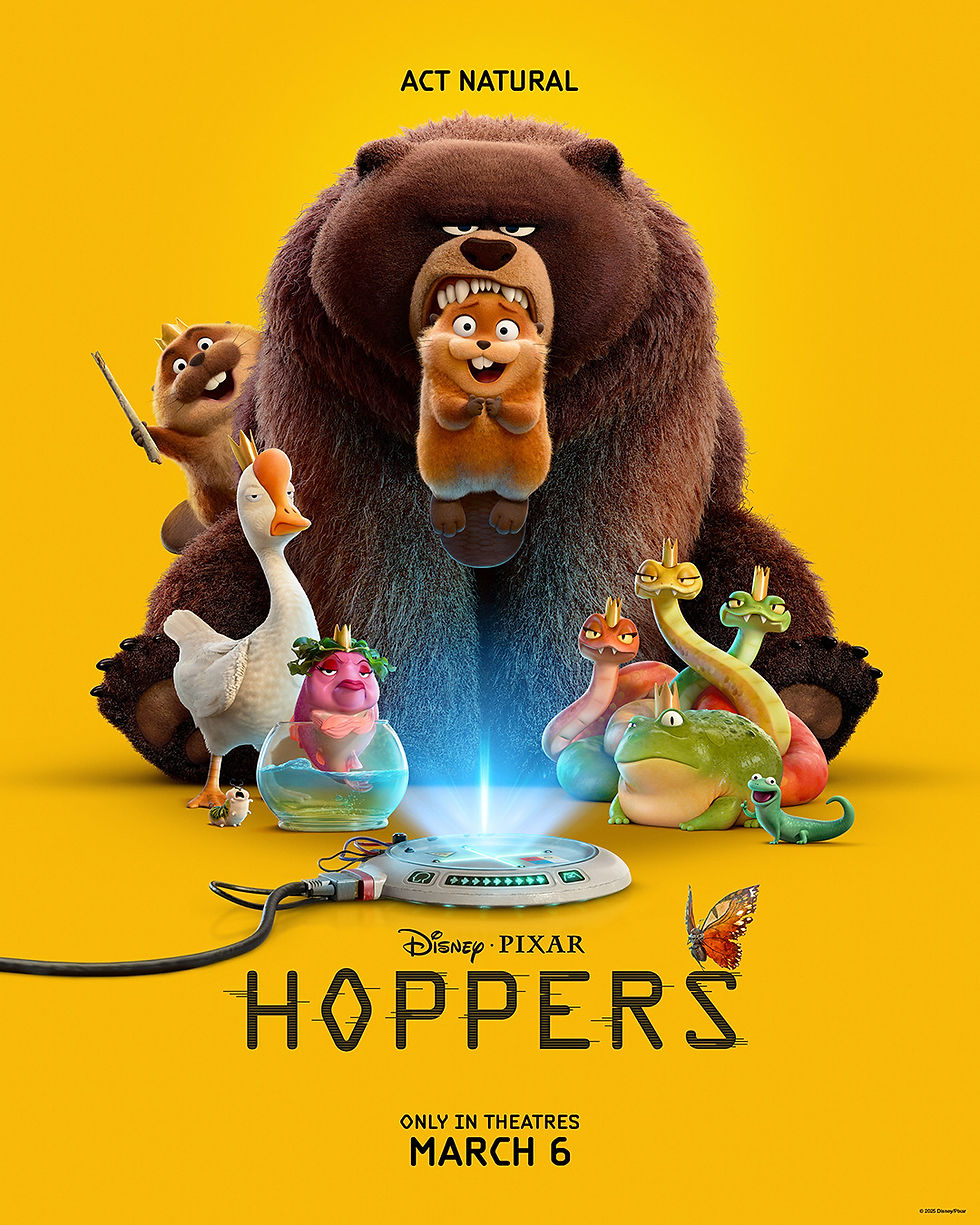
However, things took a turn for the worse when, after being promoted by George in gratitude for leading them back home, Mabel proposed a pushback to the other monarchs of the forest as they gathered together for a council meeting. And I don't mean just King George, since he's the Mammal King, but also the Insect Queen, the Fish Queen, the Bird King, the Frog King, and a trio of Snake Queens. Mabel described Jerry to them as a 'human king' who was willing to take whatever he wanted and suggested that they intimidate him, only to find out that their idea with Jerry, as proposed by the Insect Queen, was to 'squish' him. Yes, really. And it got even worse when Mabel, in a heated moment, did something unthinkable in front of the Insect Queen's son, Titus. After that, Titus decided to seize this opportunity and be the Insect King himself.
But it got even crazier. First, Mabel found Jerry to talk him out of doing the construction plans over the glade. Then, she found out mid-pursuit – and during the animals' plans to 'squish' him for sure – that Jerry's a more decent guy than she thought. But would you believe it if I told you that Titus decided to make a robot of a human, specifically a Jerry lookalike, and take power over not just the animal kingdom, but the 'human kingdom' too?
You know something? This movie is nothing like Avatar. Or The Wild Robot.

And that's one of the first things I ought to applaud the movie for. It took what I thought was going to be a straightforward plot about environmental welfare and harmony and turned it on its head, delving even deeper into the complex organizations of Mother Nature. As I've laid it out to you, there were many different ways in which certain animals in the animal kingdom functioned as their own group, whether it's the reptiles, the mammals, the fish, the birds, the amphibians, or any animal that lived together to form a general ecosystem. And not only was Mabel there to witness it all, as did Fairfax and her fellow hoppers via Mabel's robotic beaver lenses, but it also led to multiple revelations that would have left us looking at both the animal kingdom and even human civilization – specifically from Jerry's point of view – in a more complex light. In most other films about the environment, the focus would have been on portraying the natives of a certain ecosystem as inevitably friendly and the human intruders as savage and unreasonable.
Even the Avatar movies were guilty of this. As you may remember from my review of Fire and Ash, it did attempt to tread on the complexities apparent in both humans and the Na'vi, but it stumbled in its attempts. It's pretty bad when Hoppers succeeded where Fire and Ash failed.
But with Hoppers, it blew my expectations out of the water with different angles that would have shown different societies as more complicated than we would normally view them. It showed that there can be a dark side to Mother Nature and that there was some shred of decency to be found in humanity, especially in the most seemingly unlikely or unscrupulous of people. And with those aspects in mind, it would've made something like tribalism, whether among the humans or even the animals, less excusable. As Grandma Tanaka said about the wonders of nature,
It's hard to be mad when you feel like you're part of something big.
And that was demonstrated most splendidly with the council meeting and with Jerry's freakish turn of events, both of which occurred midway throughout the film.
With the animal council, they all voted to squish Jerry. In contrast, Mabel was completely against that, not just because she viewed the animals as outnumbered in terms of their collaborations and strength against who they called the human king, but also because she was not on board with the idea of killing someone, no matter how much she hated whatever harmful causes they would've concocted.
Even then, because Mabel painted Jerry as the human king, it could've hinted at a potential battle for supremacy among Mother Nature, as the kings and queens debated amongst themselves what the best way forward was to maintain the balance of their home. But it could be just a matter of them reacting as animals normally would, while also highlighting how little they knew of the human world.
And on Jerry's end, even though it did seem like he and his workers caused more trouble for the animals than it's worth, and the fake trees with the boom boxes clearly didn't help, it's become more apparent that there were reasons for them to go through with the construction of the bridge, like how it's a matter of making sure it was completed on schedule as well as helpful to the citizens of Beaverton.
So, the biggest enemy from the human side was likely shortsightedness, mostly from Jerry. And it did lead to one of the funniest scenes in the movie where Mabel, in beaver form, along with some of her friends, King George, Tom Lizard, and Loaf, another beaver, attempted to communicate to Jerry about what went on and what Jerry must do, all in the form of using Jerry's phone and having it say back to him what the animals tried to say to him, especially Mabel, in the form of emojis.
But I think the best part of the movie was what Mabel did to trigger Titus' rise as the Insect King. During the council meeting, and in a moment of panic, Mabel squished the Insect Queen by mistake. While Titus seemingly grieved her death, he suddenly revealed himself as ready to take advantage of this and be the Insect King. As we've seen, after he, as a caterpillar, went through his metamorphic state to become a butterfly, his ideas of becoming a king were nothing short of insane and tyrannical.
Not only was he willing to do anything it took to be the next Insect King, but it led to one of the most unexpected parts of the movie, where, after witnessing the humans use robots to get into the minds of animals, the Insect King dared to perform the opposite extreme: build robots to get into the minds of humans, or in this case, a robot made out of Jerry's likeness, who he still thought was the quote 'human king'. And watching the Insect King attempt to reign supreme over both the animal kingdom and even human society, particularly with the fake trees and the boomboxes with their volumes amped up to the max, seemed like a crazy way forward and like a most ingenious twisting of expectations.
It was this kind of witty plotting that made Hoppers look deserving of a reputation as a modern Pixar classic, one that ought to be seen alongside the other Pixar greats.

Of course, this leads me to talk about the animation of this movie.
As you can tell from the posters and trailers, the animation style of this movie was generally wild and frantic, yet restrained and grounded enough to let the emotional impact sink in. The closest thing I can think of to a Pixar movie with this kind of animation is Turning Red. And while that movie went all out with its exaggerated animation, it still snuck in moments where the emotional weight seeped through when it called for it.
Hoppers did the same thing, except the animation's exaggeration and the emotions of the scenarios balanced each other out. It was such that you could chuckle and laugh at the right spots, and also listen and empathize at the right moments, in equal measure.
The animation of the humans, for example, expressed some of the traditional Pixar feels, with them being very quiet and letting their body language reflect what was going through their heads, not only about themselves but also about others. But at other times, when things got hectic, serious, or a little out of hand, the characters acted a little more exaggerated, thus contributing to the comedic canvas the movie offered.
And I can say the same about the animals, too, even in their own sense of exaggeration. However, I have to give the movie credit for diversifying the animals' designs depending on how they were viewed. When the animals were viewed through human eyes, they were depicted mostly with dotted eyes to emphasize their simplistic nature. Or should I say the humans' simplistic ideas of them as animals? But when it was explored through animal eyes – or rather, through technically animal eyes in the form of Mabel's robotic form – that's when the animal characters had regular eyes and became more expressive. With that in mind, I have to give props to the animators for expressing such restraint, fluidity, and different styles in one movie.
Come to think of it, I also have to give props to the animators for the complexity of the robotic beaver's design. We all remember the robotic beaver form Mabel portrayed, right? Well, later in the movie – and I hate to give that part away – it was also inhabited by Jerry, of all people, who was the next to explore what it felt like to be in the body of a beaver, nay, an animal. Not only would it have given him more of an in-depth look into how animals would have lived out their lives, but it also made the robotic beaver, in which he was transfused, suddenly undergo a slight transformation that would have made it match his likeness, just like how the robotic beaver matched Mabel's likeness when she took it over. I found that detail hilarious and cleverly played with.

The part of the animation that felt truly Pixar-worthy was the layout and design of the surrounding forest. Whether we are witnessing it through the highly constructed beaver dam or through the wondrous details of the glade, it allowed you to feel as immersed in the ecosystem as Mabel was in her beaver form. This, and not just Mabel's grandmother, made me understand why the glade was so precious to Mabel. And looking at Beaverton and what that city was like, in conjunction with the forest, highlighted the functionalities that were apparent on both sides of the coin, especially to Mabel once she got the hang of hopping.
And how about the voice actors? What were they like?
Starting with Piper Curda as Mabel, she conveyed her with enough eccentricity to set her apart from others who might have seen things differently, whether for human society or Mother Nature. But she still had enough of an inner drive to show how Mabel would've stuck to her gut and tried to do the right thing, whether she knew she was doing it the right way or not. And when Mabel was in her robotic form, she still maintained enough of that to convey Mabel's likeness in her beaver form and make the beaver form look as animated and expressive as in her human form.
I also admired the actor who played King George, Bobby Moynihan. Whenever I listened to him talk, I would have mistaken him for another easygoing beaver who had a relaxed outlook on life with his fellow forest animals and would have done his best to try to find common ground as well as peaceful matters in which to settle whatever ongoing issues would have abounded among them. It was also apparent just what insecurities Moynihan gave to George when he spoke with Mabel about the issues they knew were going on or did not know were going on, especially when he was out talking to the animal council. It's obvious he had no idea what to make of the scenarios and was unsure how to present his case to the other animals on the council. So, I can tell that there was a lot of uncertainty on his part as to how worthy he was of being a Mammal King.
Speaking of which, though, I found King George's proposition to Mabel funny, mostly because of Mabel's reactions to it. She thought of it as just being asked to marry an adult when she was only a teenager, or it could be just a matter of her being grossed out by potential bestiality. I can't tell. But either way, even though King George meant to promote her as his head regent, or the 'Paw of the King', it was still funny to watch Mabel's reactions to the idea of possibly being betrothed to someone like King George.
And I will admit that I like the actresses who played Sam Fairfax and her assistant, Nisha. While there may not have been much to them in terms of their characteristics, what they did express gave me enough of an idea of how they came up with the idea of transplanting human likenesses into the bodies of robotic animals, while also being aware of just how risky this whole operation was going to be.
But while Aparna Nancherla, who played Nisha, Sam's assistant, played her with more of a scientist angle to her, Kathy Najimy, who played Sam Fairfax, conveyed her with enough authority and rationale to demonstrate just what a reliable figure she was to someone like Mabel, whether she was her college professor or not. Being the mastermind behind the whole operation would have told me that she knew all the ins and outs of this kind of technology and how successful – or hazardous – it could be, depending on who was using it.
The actors who played the animal residents were pretty hilarious in their own way. Eduardo Franco conveyed Loaf, the lazy beaver, with such a supreme level of indifference that it made his character, who would otherwise have been this movie's version of Eeyore, suddenly feel as delightful as could be despite his alleged disinterest in whatever came about him. And Melissa Villaseñor, who played Ellen, the bear, also deserves a mention because when Ellen wasn't busy acting on her instincts, she played her as a seemingly wimpy and uncertain bear who tried to get by as one of the apex predators, only to run into situations where it prohibited her from achieving that, especially when it concerned who she had for friends that were lower in the food chain.

Before I talk about Titus, let's shift our attention to what made his mother, the Insect Queen, so memorable. Like George and the other royal animals who ruled over each section of the wildlife and gathered for the council, she weighed in her opinions on the matters at hand, assessing their effects on the entire animal kingdom, down to confidently proposing that they 'squish' the 'human king.' But what I found memorable about it, little did I know, was that the legendary Meryl Streep lent the voice performance. She was no stranger to animation - look at how well she played Felicity Fox in Fantastic Mr. Fox - but she expressed such a show of regality and utmost commitment in what the Insect Queen believed through her voice, that it made her role in the movie short but sweet as honey.
With that said, let's give props to the actor who played Titus, Dave Franco.
Starting with Eman Abdul-Razzak as Titus as a caterpillar, he sounded like an innocent child who had to watch the murder of her mother in front of her. But whether his grief was genuine or not, it belied a more sinister urge to make a name for himself by becoming the next in line as the Insect King.
And as for Dave Franco, his performance as Titus after he became a butterfly was where Titus truly became a scene-stealer. Whereas Jerry was a little egotistical in the first half of the movie, the Jerry I've seen as a robot, which Titus made to hijack, looked so wacky and fiendish, as did Titus' voice, that it helped highlight the crazy, frightening, and wild antics Titus would have concocted to make his way in both animal society and even human society. And when Titus boasted and went all out in his rampant persuasion for a higher position in power, that's when he let loose more of an unhinged factor in him to highlight how unstable he was. Whether that was premature handling in supremacy or not, Franco clearly had a blast capturing all the power-hungry antics inherent in Titus when he ascended to his family's idea of the throne his way.
But let's get to the biggest choice actor that made me think Hoppers was going to be more simplistic than it turned out to be: the actor who played Jerry, which was none other than Jon Hamm.

Admittedly, I'm not familiar with his work except for one major source: Fargo's fifth season. If you have seen that show, you may remember that Hamm also played a high-ranking politician, Roy Tillman, though he was clearly corrupt. Only in Hoppers' case, you don't see him engage in any wife-beating. What I admire about his performance in this movie is that, at first glance, just like how he played Roy in Fargo, he played Jerry with such a level of egotism that he made me feel that he was about as corrupt a mayor as you can come by, especially when he's along the same lines as Roy. However, the longer the movie dwelt on him, the more mellow his performance as Jerry became. And once it was all mellowed out, I suddenly began to look deeper into Jerry's personality and wonder, just like Mabel did, whether Jerry was really as bad a guy as we were made to believe he was. So, in a way, his performance did hone what the movie was trying to say about how there's more to certain societies and the world in which we roam than meets the eye.
As for the characters?
Hopping back to Jerry – no pun intended – he did seem about as shortsighted as you would have expected from a mayoral figure. But it was obvious that it was just that: shortsightedness. It's not like he knew anything about the glade that Mabel and her grandmother liked to dwell on in their free time. It was just that he was so preoccupied with getting the bridge project off and running that he failed to look at all the ins and outs that would have interfered with his construction of the bridge, even those that had nothing to do with Mabel.
Even in the quick montage we'd see, he also had a loving mother. That actually said more about him than all the neighborly greetings given to him as their mayor. That was another reason why there might have been more to him than we were led to believe. And by the time he got into Mabel's crosshairs more and began to see what was going on from her side, then that's when he realized what was going on in terms of how Mother Nature herself viewed this construction, and how he'd have to prioritize what he and his fellow people could arrange so it would have worked as well for the animals as it would have for themselves.
I also like King George for his personality in this movie. Even though he demonstrated a slight immaturity in terms of his regal position in natural society, he was a bit of a partier, had a more easygoing, relaxed attitude, and even tolerated some of the other opinions of some of his animal friends just so that he would have guaranteed a more unified whole as a society for the forest animals. Think of him as the more reasonable half to King Julien's wilder half. Whenever he wrapped his head around what went on among the animals and how to best respond to it, especially when he began to like Mabel or understand who Mabel really was, that's when I understood who King George was as a beaver and as another animal trying to get by, especially as a leader.

Mabel's grandmother, Tanaka, was clearly a contented old lady and, much like Mabel, probably had a slightly wild nature to her. But as her grandparent, she tried her best to appreciate who she had in her life, especially Mabel, and why they reminded her of just what she loved so much, especially when it came to lounging by her favorite glade. So, when I looked at her through Mabel's eyes, I understood why Mabel was so committed to keeping the glade safe, in one piece, and away from Jerry and his construction forces' clutches.
Like I said, there might not have been much to remember of Sam Fairfax or her assistant, Nisha. But Fairfax clearly had Mabel's best interests at heart and tried to do whatever it took to abide by her better conscience, especially when it came to Mabel being perpetually late for her college courses. But when it came to Mabel discovering her personal science project and what she meant to do with it, it strengthened her instincts to protect Mabel once she began to understand how the hopping machine worked. And when you look at her assistants, who kept close tabs on which animal's doing what through their robots' cameras, and even hopped into different animals themselves, that told me how committed they were to wanting to know Mother Nature from the inside out and what kind of society, or ecosystem, lay within the depths of the forest.
Getting back to Ellen, Loaf, and even Tom Lizard, what they did may not have amounted to much in terms of characterization, but their comedic banter together provided genuine laughs. And it was also pretty sweet to see them come together when it's easy to remember that they were just a bunch of prey and a predator gathering together in Mabel's support. You could say they're along the lines of Ling, Chien-Po, and Yao from Mulan in terms of their side support and their comedic banter.
Another character I should bring to attention is Diane, the shark. When the stakes intensified and the animals enacted their plans to 'squish' Jerry, they went the extra mile, so to speak, with the birds carrying a shark named Diane. But besides being brought over as their hit woman, there's just something about how politely and easygoing she sounded as she spoke and was about to complete her task. It underscored how hungry she was for human flesh, and the juxtaposition made her even funnier as a character.
As for Mabel herself? It's obvious how much of an oddball she was in terms of her dedication to animals, as well as how devoted she was to doing things in the name of environmental welfare. The movie even demonstrated how hardcore it was through her theft of class pets in the innocent hopes of setting them free again when she was younger. It would've also shown just how personally she took it, as evidenced by her constant bickering and protests against Jerry and his operations. It later became obvious that she was a bit of a screw-up, given her dedication to the forest and how shortsighted she turned out to be when it came to unraveling what she did not anticipate or understand. Part of it stemmed from her commitment to protecting one of the last remnants of home and family she ever had.
Sure, her parents moved all the way across the country, but Mabel told them that she decided to stay home to watch over her grandmother, which was a nice gesture in and of itself. Exactly how she was able to afford living there with her grandmother around high school and college, I don't know. But whether in human form, as a beaver, or even with Jerry, she would've become more memorable in how impulsive and inexperienced she admitted that she was after acting more by her heart rather than by her brain. Most of the time, it led to some good laughs, but other times it tested her character in terms of what she was up against and how or if she could have pulled it off.

And of course, I have to give special props to the comedy throughout the movie.
Similar to how Turning Red used an exaggerated style to heighten the humor throughout the movie, Hoppers took a more restrained approach, accentuating it in moments that felt a little chaotic or out of the ordinary. While it was all good and well in terms of the physical comedy, the dialogue in terms of comedy was also about as witty as they come. They were so snappy and filled with so many commonsensical quips and remarks that it lent Hoppers more side-splitting instincts than you would normally expect from a Pixar movie.
I believe we can attribute that to the movie's director, Daniel Chong.
For those of you who don't know, he worked for a while as an animator at Pixar Animation Studios and, as Cartoon Network fans would tell you, he also created the animated TV show We Bare Bears.
I had never seen that show during its run. After all, I'm more of a Regular Show guy. But it revolved around three brother bears, Panda Bear, Grizzly Bear, and Ice Bear, who had to live together and get by within the neighborhoods of San Francisco. From what I understood of its premise, it navigated all the possible pratfalls and triumphs the bears would have undergone in their attempts to settle into human society, and just what sort of connections can be found, if any. Hoppers explored the same kind of connection. I can tell, even from what Hoppers explored, that We Bare Bears explored the fundamentals of human-animal relations and the possibilities of animals intermingling with human society, and probably vice versa.
Much like how Princess Mononoke displayed the murky mentality in both humanity and the wilderness through their prejudices against each other and what warmongering instincts they'd have inflicted because of that, Hoppers demonstrated what complications they both had, especially towards each other, and what the chances would be of them possibly getting along. Furthermore, it made clear that the healthiest possible way forward, if possible, would be through compromise.
Apparently, there was much to unpack from this movie, and all of them were terrific, explosive, and worthy of the Pixar name. The animation was stylish, the story was refreshingly unprecedented, the characters were all witty, the sense of humor provided a nice shake-up, and the moral landing offered some fascinating food for thought that we would never have anticipated from a movie like this. Hiring people like Daniel Chong, who was already famous for We Bare Bears, tells me that Pixar knows good artists and storytellers when they see them. And judging from what we've seen with Chong and his movie, it seems that Pixar might be on its way to reclaiming its former glory as another champion in the animation industry. Here's hoping that Pixar will maintain this stronghold for a little while longer and keep churning out animated masterpieces as I know they and Disney do best.
Hop on in and explore this movie in all its wonders.
My Rating
A low A
Additional Thoughts
MAJOR SPOILER ALERT
— At the end of the movie, when Sam broke the news to Mabel that she had voluntarily shut down the Hopper technology, she reassured her that she would redirect her technology to more productive tools, as she demonstrated on the chalkboard. And what was among the experiments shown there?
Collar translators.
Sound familiar?
— In the climax, after Titus was eaten most unceremoniously by the Frog King, the monarchs of the forest sprang into action to help Mabel put out a wildfire that was destroying the forest and inching its way closer to Beaverton. Meanwhile, the crown for sovereignty over all the insects was handed off to a female ant. Wouldn't it have made more sense for the crown to be passed off to a queen bee instead?


Comments