

Home Alone 2: Lost in New York - Epiphany Review

Updated: Jan 30
Home Alone. When writer John Hughes and director Chris Columbus unleashed this holiday classic in 1990, it propelled slapstick to artistically brilliant new heights while adding warmth, holiday magic, enjoyably flawed character dynamics, and the ultimate message that companionship and family are always paramount at Christmas.
It spoke to many people, as it became the all-time highest-grossing comedy and Christmas film at the time. So, with what John Hughes and Chris Columbus had achieved with Home Alone, what would that have done to help them both forward?
Well, for one thing, getting a sequel underway is one thing to get off the ground, and that’s precisely what they did with Home Alone 2: Lost in New York.
Now, I am ashamed to admit that, between the two, this movie was the one I was first introduced to when I was first familiar with the Home Alone movies. However, as soon as I caught on to the first one, I began to appreciate both films on their own. And while I strongly value the first film for what it pulled off, how do I feel about the second film now that I caught on to what a legacy the first film established?
There is a good chunk of this movie I still enjoyed as I did when I was younger, but in everything else, regrettably, I can understand where the critics are coming from, because this time I’m noticing more cracks in the movie.
Let’s start with what’s going on in the story.

Set around a year after the first film, the McCallister family got together and prepared to head out on another Christmas vacation, this time to Miami. And the occasion was that, once again, Frank planned to invite his family and his brother’s family over to where he and Aunt Leslie used to stay on their honeymoon.
However, Kevin McCallister ended up in yet another rut with his brother Buzz, this time during a Christmas pageant at their local school. Because Buzz pulled an inappropriate but ultimately harmless prank, and Kevin went too far by pushing Buzz, and thus, everyone else, down in the pageant, the McCallisters looked like they were on Buzz’s side. Outraged by this, Kevin had yet another falling-out with them and Kate, telling her that he would have been happy not if they wished their family out of existence, but rather if he went out on a vacation of his own, where he could’ve enjoyed himself to the fullest.
At first, Kevin tagged along with them on their trip to Miami. However, because of the families’ hustle-bustle as they ran through to the airport, Kevin, who was lagging, but mostly because he was trying to find batteries for a recording device that he held on to, ended up running towards the wrong crowd and the wrong plane. Since he ended up in the wrong plane, where did he end up?
Well, what Kevin did not know was that in his desperation to catch up with his parents, he ended up boarding a plane bound for New York City instead. And of course, none of them caught on to the turn of events that transpired. Kevin didn’t realize he’d ended up on the wrong plane bound for the wrong destination, nor did the McCallisters realize they’d boarded their plane without Kevin, until they each landed at their destinations.
At first, Kevin was pretty rattled by ending up on the wrong plane and in the wrong city, but after surprisingly little time to think it over, he decided to have at it and take New York City by storm.
Speaking of storms, the conditions in Miami were overcast and rainy – not what the McCallisters had hoped for – making for a less-than-pleasant Christmas experience there.
Kevin, on the other hand, ended up having the time of his life in New York City, partially because he ended up with his father’s baggage, and thus his cash and credit cards, which meant he would have taken advantage of those to hop over to whichever destination he pleased. But his most sought-after destination was the Plaza Hotel, which he saw on TV back home in Chicago. Kevin would have found himself ending up with more problems than he bargained for, however. One, when he got settled into the Plaza Hotel, the concierge, Mr. Hector, played by Tim Curry, caught on to something off with Kevin when it was just him, a 10-year-old boy, checking in to the Plaza Hotel with his father’s credit card.
Two, outside of New York City, it just so happened that the Wet Bandits, who were incarcerated by the end of the first film, broke out of prison and were on the run. Only this time, they had one particular destination in mind for the robbery. Their target was a lavish toy store named Duncan’s Toy Chest, filled to the brim with the kinds of toys that any toy store owner would have dreamed of offering. But they weren’t after its toys; they plotted to rob the store of its cash, and worst of all, Duncan’s Toy Chest’s donations to the nearest children’s hospital, St. Anne’s. And lo and behold, during one of Kevin’s outings throughout New York City in a limousine – with a complimentary cheese pizza, no less – Kevin would eventually have explored Duncan’s Toy Chest for himself.
How would Kevin have reacted to the idea of the Wet Bandits being on the loose all over again after outwitting them the first time? How would Kate, Peter, Uncle Frank, and the family have reacted to the idea of Kevin having been left behind, and later in New York City? And would Mr. Hector have caught Kevin red-handed for credit card fraud and turned him in? And would Kevin have attempted to outwit the Wet Bandits yet again?
If what I just laid out to you feels very familiar, that’s because it is. It introduces the movie’s biggest problem, which I can sum up in two words: déjà vu.

Let me break it down to you how this all played out.
The McCallisters hustling and bustling to get their things ready for their next Christmas flight? Check.
Kevin getting into a fight with his big brother Buzz, getting blamed for the mishaps, and being sent to the third floor of the McCallister house for it? Check.
The McCallisters rushing to reach their plane before almost missing out? Check.
The McCallisters discovering that they left Kevin behind? Check.
Kevin discovering that he was alone only to decide to take advantage of his alone time? Check.
Kate and the family doing whatever they can to reach out to Kevin? Check.
Kevin getting into some mischief? Check.
Kevin watching How the Grinch Stole Christmas and a violent gangster movie that he used to trick other people with? Check.
The McCallisters watching It’s a Wonderful Life in a foreign language? Check.
The Wet Bandits being up to no good? Check.
Kevin running into a feared individual and becoming friends with them? Check.
Kevin deciding to engage in hijinks against the Wet Bandits at every turn until Kevin called the cops on him, leaving him and Kate to reunite afterwards, and all’s right with the world?
Hoo, boy.
As I’m sure we all know by now, the surest way to a solid sequel is to continue the story rather than repeat it. And in Home Alone’s case, it decided to mostly repeat it, which is pretty sad considering that this is Home Alone we’re talking about.
Surprisingly, while the repetition still stuck out like a sore thumb, the movie did not repeat as much of the first film’s plot as I remembered. I believe that the first and last thirds of the movie felt the most like it copied what the first Home Alone did, while the middle section was where it ventured into new ground and arguably took the most advantage of the new setting. After all, because Kevin had a big fight with his family before he joined up with them for the flight, only to separate from them and bard a different plane by mistake, thus initiating his ascent into New York City, it hinted at a slightly freaky occurrence where Kevin caught on to being in New York for a mere few seconds before deciding to take full advantage of his time there and live up to his dream of having his own vacation.
And it only ended after he checked into the Plaza Hotel, made the suspicious staff gain on him, and was forced out of the hotel and into the streets of New York City. Talk about living up to the subtitle! But I liked this setup because it showed both the positive and negative aspects of New York City and how it is not as glamorous as it is often made out to be. But even those juxtapositions felt a little too extreme. The Muppets Take Manhattan, for instance, handled that very well by interweaving the city’s positive and negative attributes more smoothly and naturally.
I also have to give director Chris Columbus some credit. Given the premise of a child accidentally wandering into New York City and taking full advantage of his time there, his direction throughout the film helped make the scenario seem less implausible, like it could easily happen in real life.
But as is, it felt more like National Lampoon’s European Vacation than it did National Lampoon’s Christmas Vacation. It’s basically the same plot as the first movie, but with a few things changed here and there to set it apart.
Not only that, but there were a few elements in this movie that didn’t quite click in terms of serendipitous mechanisms, if you know what I mean.

For example, Kevin used ‘Angels with Even Filthier Souls’ - a sequel to ‘Angels with Filthy Souls’ from the first film, I might add, with Ralph Foody reprising his role as the gun-toting Johnny – to trick Mr. Hector and the staff into thinking they ran into someone who had a beef with them. They were all reacting to a guy on television at regular volume, without bothering to step into the room to see whether they were talking to a real person or a TV character. Do you remember how, in the first film, Kevin managed to fool a pizza boy and Marv by playing ‘Angels with Dirty Souls’ on TV with subwoofers and firecrackers to heighten the effect? Because nothing like that was utilized here, it just felt a tad awkward to me.
That doesn’t mean, however, that what was ‘communicated’ between Mr. Hector and Johnny did not crack me up. You’d have to see it to believe it.
As another example, you remember how an incoming storm knocked out the power at the McCallister house before everyone woke up and rushed out? In this film, Peter unplugged an outlet in the family room, meaning he unplugged the clock, too. But after he took a plug out, possibly to either recharge his camcorder or to prevent a power overload, and plugged the outlet back in, the clock reverted to an unset, blinking 12:00.
Oops.
In other words, they slept in because of one little mistake that they could have avoided. I don’t know, it was either too unrealistically oblivious on their part, or it goes to show you what to watch out for if you don’t want things to start blowing up in your face.
There were a few things like that carried over from the first movie, and sometimes they worked, but other times they looked awkwardly executed and lacked the proper movement or mechanisms to make me buy into them.
So what does this say about the last third, where Kevin, after running into the Wet Bandits, decided to settle the score with them with his classic arsenal of booby traps?
Well, in the first film, Kevin was still inexperienced and vulnerable when the Wet Bandits were about to hop over to rob his house. And because of that, it prompted him to rise to the occasion and arm his house with the booby traps so he would have protected his home and himself from the Wet Bandits. But here, Kevin decided to go out against the Wet Bandits, not just because he had dealt with them before, but because he knew they were trying to rob a toy store of the money meant to be donated to St. Anne’s Hospital for Children.
So how did Kevin deal with them this time? He hopped over to what was basically an abandoned house that used to be lived in by Kevin’s uncle Rob and aunt Georgette, who, the last time they were heard from, were away on vacation in Paris, just like the McCallisters in the first film. It almost looked abandoned, as if it had been left behind for quite some time, despite it being supposedly renovated some time before. Because Kevin decided to get even with the Wet Bandits, this is the house he set booby traps in.
And man, the booby traps Kevin unleashed onto them, besides being generally what we expected from the movie, were an inconsistent bag.

Whereas in the first film, Kevin unleashed his booby traps against the Wet Bandits out of self-defense, the booby traps he unleashed on them in this movie felt like candy-coated vengeance from beginning to end. And in terms of their overall intensity, that’s where their inconsistencies were most noticeable. Some of the traps were very generic and wouldn’t have inflicted much damage, like a splintering ladder and a tool chest falling down the stairs.
But what really shocked me was everything else. In the first film, the slapstick humor mostly outweighed the pain. In this film, the humor and pain were pretty neck and neck. The booby traps were still funny, but some of them looked so surprisingly painful that my girlfriend and I actually winced at how the Wet Bandits were able to endure them all. It amounted to what looked like a miracle on 95th Street, not 34th Street. I mean, get a lot of this.
Four bricks in a row being thrown onto Marv’s forehead, outside of it losing its painful value by the fourth throw? It’s a miracle Marv did not suffer a concussion from that.
Marv being shocked to the bone by a sink linked to electric clamps? I do NOT want to know what a 90-volt zap feels like.
Harry having his head torched by a flame and dousing it with gasoline when he thought it was water? I don’t know what you call it when you scalp by fire, but I’m surprised this didn’t do him in.
A 100-pound bag of concrete mix falling directly onto Marv’s head?

But I do have a favorite booby trap in the movie, and it concerns the paint buckets. Not because they were carried over from the first film, but because of the buildup and the characters’ sense of foresight. Here’s how it went down.
Kevin talked the Wet Bandits into going upstairs to track him down, but Harry remembered from experience just what Kevin was going to throw down to them. So, he and Marv fooled Kevin into thinking they were running upstairs and being battered by the paint cans that they knew Kevin would’ve flung down to them. Kevin, of course, knew they were going to fool him, so he kept throwing one paint bucket after the next at them until he used up his paint buckets. And just when the Wet Bandits thought that Kevin had used up his tricks on the stairs, Kevin caught them both with their pants down with a lead pipe that knocked them both down.
That coordinated attack felt very creative and felt more in line with what Home Alone was capable of. You knew that the longer Kevin fooled the Wet Bandits with these paint buckets, the harder and more efficiently the payoff would’ve hit.
I was also bewildered by the resolution between Kevin and his family at the Plaza Hotel in the end. Because of Kevin’s altruistic efforts to nab the Wet Bandits and save the money that was supposed to be donated to the Children’s Hospital from being stolen, Mr. Duncan repaid him with a truck full of gifts that were delivered to his and his family’s suite in the Plaza Hotel. However, read what Buzz said in his speech about what occurred.
If Kevin hadn’t screwed up in the first place – again – we wouldn’t be in this most perfect and huge hotel room with all this free stuff.
Wouldn’t this have been the most opportune moment for Kevin to tell his family why they ended up with all the gifts? And his experiences with the Wet Bandits, both this Christmas and the one before?
And yes, what I’ve laid out so far has had a pretty inconsistent effect on the characters.
Kevin McCallister was still your average, highly knowledgeable boy who, once again, had to grapple with the values of family, especially after being humiliated at the school pageant, and ended up having to learn his lesson all over again when he was not busy enjoying himself over in New York City or trying to outwit the Wet Bandits. Yet, when he waltzed through New York City in all its various forms, only then did he acknowledge how huge the world was and how totally unprepared for some of life’s nastier elements Kevin could have been. But when he knew what must be done, he would automatically have stuck to his guns and delivered it in swift hits, especially since he had experience from outwitting the Wet Bandits in the first film.

Before I speak about everyone else, let me comment on Macaulay Culkin’s performance. Unfortunately, the superstardom that benefited him greatly from the first film started to get to him. I can tell that Macaulay Culkin tried to hone the wisdom he may have acquired since his last venture with the Wet Bandits, kind of like how he portrayed Kevin in the first film. But the problem with his portrayal in this film is that he made his character seem generally smart-alecky, minus the brightness. Because of that, whenever he talked more about what he believed to be true, it instead made him sound more like a smarty-pants, like there’s a little bit of egotism apparent in him this time.
But that was only the most prominent difference in his performance from the first film. The balance between childlike instincts and sophisticated handling was still evident in Culkin, even if it was too often sidelined.
As for the other characters, they’ve basically been stuck repeating the same lessons all over again from the first film.
Peter McCallister was still your everyday father who meant to look out for Kevin’s and his family’s welfare, especially Kate’s, when she finally caught on to their son’s disappearance. But he might’ve been right to panic a little, since Kevin ended up with his wallet, which, by extension, included his cash and credit cards.
Kate obviously attempted to maintain her composure and sense of responsibility as the mother in the household, especially when it came to Kevin. And also, just like last time, Kate was sure to try to get back to her son when they left him behind again, even if she wouldn’t have known how to do so, since they left Kevin behind in the middle of the airport, so they would have had no idea where to find Kevin. Though it was pretty nice to see that by the time they did know where Kevin was, the entire family would have hopped over to find him. Kate may have talked them into it, but still, her resolve spoke for itself. It was nice to see her round them up so they would have tried to track Kevin down before anything bad happened to him.
We know that Buzz McCallister was a bit of a thorn in Kevin’s side, but other than that, he was just a pretty modest boy who was both bullyish and frustrated by his little brother’s shenanigans in the first film. But here, his mannerisms, mostly with Kevin, were just too obnoxious. Who thinks that pulling a prank on Kevin mid-performance was a good idea?
Same thing with Uncle Frank, although he was almost no better. By the time Buzz pulled his prank on Kevin, Uncle Frank looked more like he was enjoying himself and finding it ironically hilarious. That, and his opinions on the trip to Miami, painted him as a little too thoughtless.
Come to think of it, neither of them was involved very much throughout most of the movie, except for the beginning and the end. Most of the subtleties and nuances that Devin Ratray and Gerry Bamman infused their characters with in the first film were somewhat stripped away, so that didn’t do them any favors.
Of course, the whole idea of the trip to Miami being Uncle Frank’s idea, since he and Leslie spent their honeymoon there, didn’t seem too out of place, except for the part where he thought of it as a ‘free trip’. But when the McCallisters reached their destination, it was just a motel called Villa de Dolphiné, and it was raining. Combined with Uncle Frank’s excuse…
It didn’t look this bad on our honeymoon.
…it looked like one pitiful way to spend Christmastime with the family.
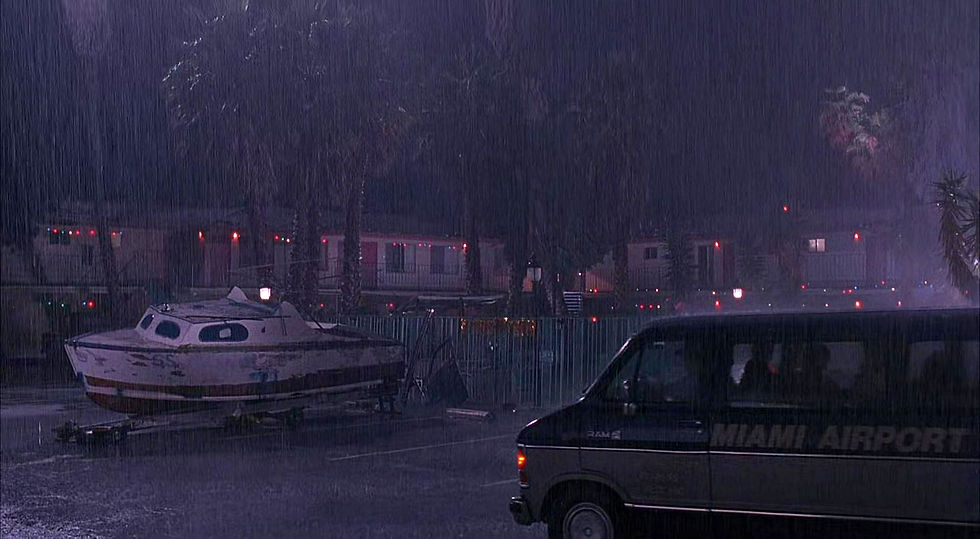
Yet, I can see this potentially working in the movie’s favor. Do you remember what Clark Griswold and his family discovered about Wally World when they made it there in National Lampoon’s Vacation? Or how about the shady hotels in which Neal and Del Griffith stayed in Planes, Trains, and Automobiles? There’s something in here that might’ve guaranteed the same amount of buildup and punchlines that made these two work so well, especially if Uncle Frank expected this vacation to be just right, just like the trip to his Parisian apartment last Christmas. But to see the weather much earlier on and Uncle Frank so unsurprised somehow ruined the effect.
Everybody else in the McCallister family basically did their usual thing as they prepared for their next Christmas flight.
But one detail about the headcount always confused me.
In the first film, the characters said that there were 15 people altogether, both from Peter’s and Uncle Frank’s sides of the family. But in this film, they said there were 14. So, that always left me wondering, what happened to the 15th member of the family?
The only McCallister I did not remember seeing in this movie was Heather, the eldest child. If she were out in college somewhere, started her own family, celebrated Christmas her own way, moved out, or anything like that, it would’ve made sense.
Now, with the Wet Bandits, their plot was no less intimidating than what they planned in the first film, only this time it was even dastardlier than simply robbing rich houses. So, it made me understand why these guys had to be stopped, besides the fact that they broke out of jail.
Whenever Kevin wandered into Central Park, he ran into a bird lady who was covered almost head to toe with pigeons and had a pretty dirty outlook on her. When he ran into her a second time, she helped Kevin get unstuck, leading him to warm up to her as they talked and got to know each other better. Kevin then discovered from her that she had no such luck in love or work until she finally lost her home.
At first, I was bothered by this subplot. With Old Man Marley in the first film, there was a lot of backstory and buildup for this character that ultimately paid off in a more rewarding finish. But with the homeless lady, it started very weakly. Kevin just saw her covered in pigeons, and he ran off, frightened of her. But for what reason? Just the fact that she was a lady covered in pigeons? What harm would that have done?

I usually didn’t think much of it, but to my surprise, the longer it went on, the sweeter it became. I ended up buying into what Kevin and the homeless lady shared in common and how much Kevin may have underestimated her for who she was. And by the time we reached the end of the movie, when Kevin met up with her again in Central Park, to me, that was where the movie reached the heartfelt quality the first film excelled at. And I found that a shame, given everything else that went on throughout the film and just how much this subplot got off to a bad start.
However, the most memorable new characters were the Plaza Staff.
First, you have the bellhop, Cedric. He was usually expected to be tipped by the people he served, but he was mostly just given gum. Poor guy. But the most memorable staff member was Mr. Hector, who was rightfully suspicious of Kevin when he checked in to the Plaza Hotel with what he suspected was a stolen credit card. The lengths to which he would have gone to get to the bottom of the case surrounding Kevin and whether he indeed stole a credit card to work his way in made him a surprisingly intimidating antagonist without being the villain.
So yes, while the new characters were intriguing for different reasons, everything about the returning characters ranged from having to relearn their lessons all over again in this movie to being aware enough of what they dealt with in the first film to try to remedy such situations again.
In the first film, it felt genuine and heartfelt. In this film, it felt contrived and somewhat superficial. And when you’re describing that about the main cast and story of a sequel to a movie like Home Alone, that is a red flag right there.
With all this in mind, you’re probably wondering,
How did John Hughes ever go from being a talented writer and director who crafted some genuine masterpieces to suddenly churning out one slapstick-filled dud after another?
Let me answer that question for you. When Home Alone first came out, it featured cross-promotional material with Pizza Hut and Pepsi, which explains Kevin’s love of cheese pizza (despite the pizza chain in the movie being called Little Nero’s) and even Fuller’s love of Pepsi, even though he would’ve drank Coca-Cola in this film instead. And the slapstick that Kevin unleashed onto the Wet Bandits obviously got a huge laugh out of the audience. As a result, Home Alone was not only the highest-grossing comedy film at the time, but also, consequently, the most successful movie in John Hughes’ and Chris Columbus’ careers at that point. It may have told John Hughes that audiences were hungry for slapstick, so he incorporated it more into his films throughout the 1990s.
Think about it. The baby outwitting the bad guys throughout New York City in Baby’s Day Out, Dennis the Menace trying to catch Mr. Wilson with his pants down, and even the animals trying to outwit Cruella De Vil in the 101 Dalmatians remake. Not to mention that Horace and Jasper looked too much like Marv and Harry if they went through a body swap, but that’s another review. On top of that, the Miracle on 34th Street remake even had the cross-promotional marketing, for which I’ll admit it was slightly guilty, combined with the warm, familial holiday feeling, in the hopes of recapturing what John Hughes achieved with the Home Alone movies.
This can’t possibly be a coincidence. With this string of films under Hughes’ hand, it all seemed to stem from what he believed made Home Alone so successful in the first place, when really, there was more to the first Home Alone that he unleashed that made it such a phenomenal film. Given how monumental a success the first Home Alone was, the turnout either really got into John Hughes’ head and made him drop the ball on what he’d captured like a pro before Home Alone, or it caused the movie execs to pressure John Hughes to whip out more slapstick-centered movies to stay afloat.
Now, about the focus on the pizzas in the first Home Alone and whether they had any ties to Pizza Hut’s promotions?

Well, the most obvious toy to be commercialized was the Talkboy. And it only came after the movie was released; it became a thing after moviegoers requested the device itself. It’s a handheld recording device that Kevin used to record whatever he heard and play it back, primarily for his own amusement. But other times, it came in handy, since it helped him be very careful in recording what he considered crucial conversations, like what he heard from Marv and Harry. Nowadays, recording whatever is being said is about as easy as just pushing a voice recorder on our iPhone.
But this device was really slick and handy. Because I was such a devoted Home Alone fan, it got to the point where I felt compelled to snag a Talkboy for myself. In case you’re wondering how this works, it requires only cassette tapes for you to use and record whatever you hear with. And you could have played with it however you wanted, either at regular speed or even in slow motion. It was a lot of fun to record whatever you want with this baby and then play it back at will.
I don’t know what became of it, but the enjoyment I had out of the Playboy toy was just something else. It became so popular that its developer, Tiger Electronics, developed the Talkgirl, with more feminine features for the recording device. I bet that, at the time of the film’s release, the toy became to children what the Red Ryder Carbine Action 200-Shot Range Model Air Rifle was to Ralphie Parker in A Christmas Story.
Now, while the characters and story were more misses than hits in terms of what was pulled off for the second film, three things helped save it.
The first is the performances.
Sure, they all had to repeat what they already went through in the first film plot-wise. However, for what the actors had pulled off with the characters, they still gave their utmost commitment, and their conveyances of the characters didn’t miss a beat from the first film. They remained as grounded and identifiable as possible even in the face of circumstances at their most recycled.
John Heard still conveyed his sense of rationale and reasoning as Peter McCallister, especially as things became more hectic for him and his family regarding Kevin’s whereabouts.
Sure, Buzz’s behavior in this movie seemed a little more extreme than in the first film. However, Devin Ratray still nailed it in portraying Buzz McCallister with his usual regular tendencies and his ‘big brother bully’ antics. Only this time, it’s a little hard to tell how much of what he said was genuine or if that was just him messing with Kevin.
Gerry Bamman still played Uncle Frank as his usual grouchy self again, even if, again, some of his mere responses to what went down were still inappropriate.
Even if they were in the background, you can still feel a lot of the actors’ and actresses’ background and commitment to making the McCallister family feel as believable as possible.
Brenda Fricker, who played the pigeon lady, played her with just a fair amount of distinctness to her, highlighting just what an unusual person she could’ve looked like. But once she let down her guard and trusted Kevin more, the care and thought her character expressed were enough to convince me that she was just a lost lady trying to find her place in life, especially after her loved ones turned their backs on her. If anything, she, too, showed a little bit of a motherly tendency toward her, just like Catherine O’Hara did with Kate. But yes, I believe that, as far as this character was concerned, her performance was probably the strongest part.

And the actors who played the Plaza staff were terrific in honing their roles, including Rob Schneider. He did a decent job of highlighting Cedric’s professionalism and hopeless insecurities, whether he was going about his business or hoping for tips in return for his services.
On top of that, Eddie Bracken as Mr. Duncan also excelled in conveying him as a generous, elderly figure, as well as his commitment to raising the money he would’ve needed to donate to St. Anne’s Hospital for Children. It was apparent from his performance that he genuinely cared about the children, especially those at the hospital, and was willing to do whatever it took to ensure they were well cared for on Christmas.
What’s more, there were some acting niches that John Hughes and Chris Columbus brought back from the first film that amounted to some amount of subtlety. And the most primary example of that can be traced in the McCallister actors’ body language.
When Buzz apologized to the family, and Frank said, ‘Immature or not, it was pretty golddarn hilarious,’ Peter and Kate just looked at him as if to say, ‘Watch it, Frank.’ And at the very end, when Buzz said, ‘If Kevin did not screw up again,’ Kate’s gesture to him felt like a silent way of saying, ‘Don’t scapegoat him again, Buzz.’
Fortunately, moments of subtlety like that were apparent in the actors who played the McCallisters, just not as prominently as in the first film, and it was those subtleties that made Home Alone stand out so much. It’s just almost AWOL in Home Alone 2, and that might explain why it felt a little stilted most of the time, not just in Macaulay Culkin’s performances, but also in the cartoony methods, the comedy, and the general storytelling of this picture.
However, some actors who came back in this movie did a remarkable job with what they were given.
For one thing, Joe Pesci and Daniel Stern, once again, went to town with their roles as Marv and Harry. They portrayed them with the same chemistry, butting of heads, and attempts to prove their heinous reputation as they did in the first film. However, their performances had the disadvantage of feeling too standard and of relying too much on the same antics from the first film, even though they did their roles pretty well.
I just thought that since they upgraded from robbing residential houses in Lincoln Boulevard to attempting a robbery of a prestigious toy store in New York City, you’d think that their personalities and performances would have reflected the Wet Bandits’ new goals, like maybe their time in prison after they broke out toughened them up a little. Sometimes, that was apparent, like when Harry blatantly mentioned his contemplations of killing Kevin, and at that age, no less. So, there was a little bit of a danger factor in the Wet Bandits this time, but there’s not enough to make them feel as threatening as they did in the first film.
On top of that, what Marv attempted to do outside of robbing Duncan’s Toy Chest was to steal whatever he could in terms of cash from anyone who passed by. And he did so with a hand covered all the way around with tape as he dipped his hand into some coin jars with the intention of having the coins stick to his hand, hence his proposed nickname, the ‘Sticky Bandits’. And, evidently, not only did Harry think that was a stupid idea, but that name did not stick. Only the ‘Wet Bandits’ name stuck around more. So, even we think that Marv’s proposed name was pretty stupid.
What’s more, there were plenty of moments throughout the movie where Marv stealthily swiped from under their passersby’s noses any random materials that they happened to be carrying with them, such as gloves, scarves, hats, you name it, and mostly without his taped hand. Maybe that’s what prompted him to contemplate the name ‘Sticky Bandits’.
It leaves us with two scene-stealers in this film, one from each side of the participatory coin.

From the returning end, it’s Catherine O’Hara as Kate McCallister.
While her portrayal of Kate in this movie was mostly the same as in the first film, when she realized she and her family had left Kevin behind all over again, there was no desperation or misery apparent in her. This time, there was more determination in her posture and voice, like she remembered what she went through the first time around and was sure as hell never to make that mistake again as long as it meant finding Kevin.
But how this began was just priceless. At the Miami airport, she and the family handed off Kevin’s luggage person by person to give to Kevin, only to hand it back the same way when they realized Kevin was not with them, let alone back home in Chicago. Much like the paint bucket scene, this served as the proper buildup to strengthen the punchline it finished on. When Kate discovered that Kevin wasn’t with them, she reacted with a dazed fit of laughter before it suddenly dissolved into a state of pure, unadulterated panic as she screamed out his name at the top of her lungs and passed out. That was just pitch perfect.
It was funny because most of the time afterwards, she didn’t do anything, but that was mostly because she waited until she and the McCallisters heard back from the Florida Police and, eventually, the Chicago Police about Kevin’s whereabouts. And as soon as she knew exactly where Kevin ended up, that’s when her Mama Bear tendencies kicked into overdrive. Come to think of it, that’s another element that cemented O’Hara’s performance as one of the movie’s strongest: she arguably conveyed the most growth to her character.
And from the newcomer’s end, the second scene-stealer was easily Tim Curry as Mr. Hector.
I was impressed by how animated he made this character, which made his motivations seem conniving but not malicious; instead, they were understandable as suspicion. As Mr. Hector, you could read why he concocted every scheme necessary to get to the truth behind Kevin’s manageability in checking into a prestigious hotel like the Plaza Hotel. The moment Kevin walked into the hotel and checked in, his distrustful look was all you needed to know that he knew something wasn’t right about it.
On paper, Mr. Hector was just your everyday concierge who was up to no good, albeit for good reasons. But whenever Tim Curry took on his role, despite my dreading how close he was to exposing Kevin for the fraud he found him to be, I always enjoyed his performance because of how intimidating yet flavorful he made this character. He was just too good to resist.

In addition, while Jim Carrey was not bad at capturing the Grinch’s smug grin, the scene of that grin from the animated special transitioning into Tim Curry’s as he finally deduced the nature of Kevin’s credit card was the icing on the cake. It was so seamless that you’d swear that Curry captured what Chuck Jones mastered of the Grinch’s unnerving self-satisfaction with panache.
And this leaves us with the second aspect that saved this movie: the music, with John Williams once again at the helm.
Don’t give me wrong, I know that, just like the plot, half of the music was literally carried over from the first film. Surely, it carried over the classic leitmotifs from the first film, including the opening theme, the rush-hour themes, and the instrumental versions of ‘Somewhere in My Memory’. But I’m talking about how the instrumental score from the first film was literally carried over, note for note, into this movie.
But what makes this one of the movie’s saving graces is the other half of the instrumental score, the original ones that John Williams composed for this movie.
Some of his pieces carried the childlike, mischievous elements that made Home Alone such a hit. But it also toyed around with other elements that evoked a sense of grandeur, which was fitting, since we’re talking about a young boy making it out on his own in New York City. Just listen to the musical score when Kevin explored the Plaza Hotel and especially Duncan’s Toy Chest. There’s such an element of wonderment and enrapturement in these musical pieces that I’m convinced it foreshadowed John Williams’ later contributions to the music heard in Jurassic Park and Harry Potter.
Speaking of which, the musical pieces of Kevin running from Duncan’s Toy Chest all the way back to the Plaza Hotel were terrific, too. There’s a level of whimsical panic in the music as Kevin ran from the Wet Bandits after being confronted by them. But when Kevin ran into Mr. Hector, who finally cracked the case on his ‘stolen credit card’, the chase only continued, because to Kevin, the jig was up, and as the music continued, there suddenly was more urgency to it.
Such musical pieces as those that John Williams composed exclusively for this film, and not the first one, helped distinguish this more, and it felt and sounded welcome.
But it got better. The music that made Home Alone 2 so memorable also carried over into its songs. The new songs composed for this movie either evoked a rich sense of melody and emotion or became classic Yuletide tunes in their own right.
For starters, ‘All Alone on Christmas’ was a hip and excellent song that reflected what went through Kevin’s mind as he went to town in New York City and enjoyed himself every which way. Of course, there were enough deviations in the lyrics and prose to suggest that it could have represented the thrills to be gained out of exploring New York City at Christmas time, while also honing in on the necessities of not being alone at this time of year, where everyone should be together. And Darlene Love’s vocals felt like they just blared throughout the tune, with the utmost energy and commitment poured into them. I felt like I was tapping my feet every time I listened to this song, either from the movie or even on the radio. That’s how popular the song became on its own, and it blows my mind to think that it got its start here in Home Alone 2.
The following two songs, I believe, were close to being on the same scale as ‘Somewhere in My Memory’, although they expressed more of an outgoing vibe compared to the heartfelt simplicity of ‘Somewhere in My Memory’. And even that’s not a bad thing.

Starting with ‘My Christmas Tree’, it was upbeat and emphasized the need for a home for Christmas time while soaking in the essence of the season. It evoked the spirit of Christmas traditions, as if sensing them meant you were closer to home than before. Outside of its rhythmic beat, of course, one reason this song stood out so well to me might blow you away.
While the songs in this movie were still composed by John Williams, the writer of this song turned out to have been none other than Alan Menken. No joke. And this was at a time when he was on a roll at Disney with the music he helped compose for The Little Mermaid, Beauty and the Beast, Aladdin, and even Newsies, and was just on the verge of working on Pocahontas and The Hunchback of Notre Dame back then, too. So, the idea of Alan Menken’s work trickling into a movie like Home Alone 2: Lost in New York just helped make the music in this movie feel more like a melting pot of some of the most talented musicians in Hollywood at the time.
‘Christmas Star’ oozed in the simplistic measures of needing a home for Christmas time and where to be when you feel lost at this time of year, just as Kevin was. Whereas ‘Somewhere in My Memory’ was a bit of a lovesick song, this song sounded more hopeful, for it was soaked in the mere desperation to have a home again at one of the most cherished times of the year. And the melody and vocals accompanying the song were so irresistible and soothing that I can never get enough of this song every time I listen to it. Of course, despite this song sharing many things in common with ‘My Christmas Tree’, what separates this song from that one is that ‘My Christmas Tree’ was more homey and vibrant, whereas ‘Christmas Star’ was more homesick and dreamy.
As for the last new song of the film, ‘Merry Christmas, Merry Christmas’, it indulged in the grandness of exuberance that is usually felt every Christmastime. And John Williams’ music helped it live up to its potential as a strong Christmas tune fit for listening in the most uplifting of situations. I dare you to listen to this song and not feel just an ounce of its festive rapture!
Frankly, it reminds me a bit of Space Jam, where it felt problematic in its story and performances, but left me shocked by how remarkable its songs were. Maybe there’s something about composers and songwriters giving it their all in movies where they’d have been fine without it that leaves me willing to tip my hat to them. These songs and John Williams’ new score added zest to Home Alone 2, and I respect the musicians for achieving that.
And I have to admit, whenever I hear the Captols’ song, Cool Jerk, it might be impossible for me not to think of Uncle Frank singing it with all his might in the shower or of Kevin fooling Mr. Hector into thinking he ran into someone in the shower with an inflatable clown.
And the third aspect that made this movie feel so worthy?
I am aware of all the extra sequels that came about after this movie, including Home Alone 3, which I am familiar with. However, of all of the sequels that came out under the ‘Home Alone’ name, despite it being familiar for the wrong reasons, Home Alone 2 still felt the most like the first Home Alone. The characters and actors were the same, and the plot was very familiar. Whereas the characterizations and slapstick antics from the other Home Alone movies felt fake and uninspired, Home Alone 2 at least tried to make something of value out of what it carried over from the first film, even if its intentions were misguided.
Simply put, I’d much rather take Home Alone 1 and 2 over Home Alone 3, 4, 5, and 6 any day.
Even with all the fancy gadgets, music, and embellishments, Home Alone 2: Lost in New York was a slightly adequate sequel that suffered from major missteps, knocking it down a peg and keeping it from even coming close to being on par with the first Home Alone. And considering how successful Home Alone was when it first came out in 1990, that is usually not what it would have deserved. The story revisited what had already been explored the first time, and the characters seemed slightly oblivious to what had gone down.
But thankfully, it was all saved by some eclectic tunes, some evident commitment from the actors, and an engaging detour when Kevin ventured into New York City. To me, this movie is a guilty pleasure for the holidays the same way that Jim Carrey’s Grinch is: it’s a flawed take on a Christmas classic, but its distinct charms help it remain a cult classic on its own terms. I suppose that after being acquainted with movies like A Christmas Story Christmas, it makes me now look at this as just one prime example of what not to do with a sequel to a popular film and that should a follow-up ever be made to a popular or cherished film, that next chapter should also be treated with the same love, care, dedication, and attention as was given to the first film. At the same time, while Home Alone 2 was far from the best sequel out there, it’s also far from the worst either.
See for yourself if this is a Christmas destination worth flying into.
My Rating
A high B-

Additional Thoughts
— Marv said to Harry about Kevin learning their plans,
He’s not gonna tell anybody. Except maybe a fish. Or the undertaker.
Was that supposed to be a ‘sleeping with the fishes’ joke?
— Two things about Kevin finding out he’s in in New York City caught my eye. One, the lady he spoke to about the location was Ally Sheedy, who you may recognize as Allison from The Breakfast Club, another of John Hughes’ films. And two, Kevin went from panicking about being in New York instead of Miami to ecstatic about being in New York without his family in a matter of seconds. For all that the movie repeated from the first film, even I feel like maybe having what was said to Kevin earlier being repeated back to him in internal echoes before Kevin made his decision would’ve helped.


Comments