

The Mandalorian and Grogu

Updated: Sep 28
Lasting over three seasons and becoming one of Disney+’s earliest mainstream hits, The Mandalorian took the streaming world by storm and became every Star Wars fan’s dream come true as a translation of the prestigious franchise into television. The earliest Star Wars ventured into television was Star Wars: The Clone Wars, and it was celebrated as a cornerstone of storytelling that bridged the gap between Episode II: Attack of the Clones and Episode III: Revenge of the Sith.
Of course, the kind of Star Wars TV show audiences had in mind was a live-action series, which broadcast networks deemed impossible, despite George Lucas's wish to produce one back in the late 2000s and early 2010s.
But with the benefit of streaming networks and exponentially high budgets to back up their content, came The Mandalorian. That show swept everyone off their feet with the adventures of the mysterious Mandalorian himself, bounty hunter Din Djarin, and his adorable sidekick, Grogu, formerly referred to as Baby Yoda. It became so popular, and the characters with it, that plenty more TV shows under the Star Wars name came along to continue its prowess, including Ahsoka, Skeleton Crew, and most of all, Andor.
What’s more, thanks to the popularity surrounding The Mandalorian, a movie was bound to be made of it, but it may not have been the intention.
Originally, The Mandalorian was going to be picked up for a fourth season, but because of various complications, including the writers’ strikes of 2023, Jon Favreau, the cast, and the crew decided to continue The Mandalorian with a feature-length movie. And not just any movie, but one that would make it into theaters. Because the first three seasons were already such a staple in Star Wars-themed storytelling, especially for television, I was intrigued to see what tricks The Mandalorian had up its sleeve in its movie, called The Mandalorian and Grogu.
As for what we ended up with? Well, to give you the short answer, this film had to find its footing before it found the rhythm with which to establish itself as a cinematic continuation of the TV show. But that doesn’t mean that it wasn’t a fun film.
Let’s start with the story.
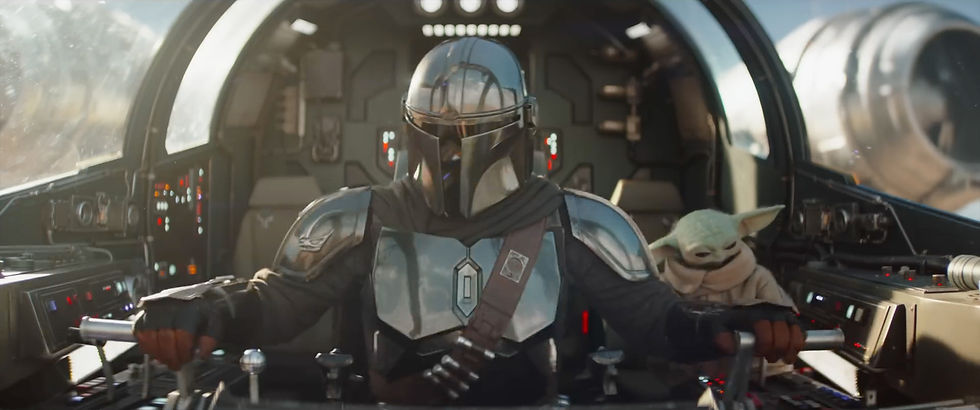
Taking place after season three, Din Djarin and Grogu did their everyday life as bounty hunters looking for rogue criminals to make some cold, hard credits while also hunting down rogue Stormtroopers for the then-budding New Republic. Then, after meeting up with the Ward, Din Djarin was given a mission to track down a rogue Hutt named Rotta, which Din Djarin agreed to do by first meeting up with the remaining Hutt family on their swampy home planet of Nal Hutta.
During their meeting, Djarin and Grogu learned that Rotta had left the family and was working as an up-and-coming gladiator on the planet Shakari. Rotta reluctantly admitted to Mando that he was ashamed of his family reputation and wanted to break free of it by any means necessary. What Rotta didn’t know, however, was that he was about to be executed on his alleged ‘final match’ by Lord Janu, whom Mando wanted to capture and bring in alive because he had leftover knowledge of the Empire that the New Republic could use against them.
But after a series of miscommunications and devious tactics by the Hutts to catch Din Djarin with his pants down, he and Grogu went through trials and tribulations that tested their relationship and pushed Djarin to uncover more about this conspiracy before he was done in. Djarin would also risk having his helmet removed, among other things, which would disgrace him even further.
Would Din Djarin and Grogu finally put Rotta back in his place? What further Star Wars characters would cameo in this movie? And what more can this movie offer of The Mandalorian that the TV show alone would not provide?
As you could tell, there was a lot of hype surrounding The Mandalorian and Grogu, since this was a theatrically released movie based on one of the biggest hit shows on Disney+. It would be almost no different from Downton Abbey and the movies it ended up with. Or, for that matter, think of it as the equivalent of Stranger Things, House of Cards, or any of the biggest streaming shows ever made since then.
The Mandalorian was honored to have a theatrically released movie made from it, and it had a big responsibility to uphold with this translation. But while what we ended up with kept a good chunk of what made The Mandalorian a breakthrough series, it also had plenty of missteps that kept it from reaching the same level as the TV show.

First, let’s start with the acting.
Much like the TV show, Pedro Pascal continued to hone Din Djarin’s mysterious nature and committed essence. With his no-nonsense attitude, his unwavering drive, and his determination to get the job done, whether it’s for pay or for personal reasons, Pedro Pascal lost none of the charm and essence that made him such a fascinating character after he was introduced in the TV show.
The only other actor I can think of who maintained a noticeable presence in the movie, besides Pedro Pascal, was Sigourney Weaver as Ward.
I don’t know how their characters met in the context of the TV show. Still, even though Weaver’s character didn't express enough to leave a lasting impression, her level-headed nature, commanding presence, and savvy tactics told me Ward had experience working for the Rebel Alliance against the Empire. Because of this, she helped Ward look like she knew what must be done, not only for Din Djarin as to what missions to complete, but also to keep a close eye on whatever leftover Imperial remnants could be out and about causing harm.
So, with many things going on for each actor, both individually and sometimes together, I appreciated what they brought to their characters, especially since they were mainly surrounded by other alien creatures.
Of course, listening to Ward’s conversations with Djarin about the still-ongoing fights by the New Republic made me curious whether it would highlight in any way, shape, or form any signs of either the New Republic as we’d recognize it from the sequel trilogy or whatever remnants of the Empire would grow into the First Order.
Even the prologue, which, I might add, was shown more as a text-on-screen reading as opposed to the famous scroll-up text that we’re used to from the other Star Wars films, talked about what went on in the movie as far as its overall place within the Star Wars timeline was concerned. It briefly talked about how the Empire was defeated and how rogue bands of Imperial troops were still out there, with the New Republic slowly picking itself up to police the galaxy and hunt down whatever traces of Imperial rule were left.
Surprisingly, I couldn’t think of many live actors who made themselves well known in The Mandalorian and Grogu besides either Pedro Pascal or Sigourney Weaver.
One of the most notable characters from the TV show who did not appear here was Greef Karga. Part of that may have been due to Carl Weathers’ tragic passing in 2024. And we obviously couldn’t see Gina Carino as Cara Dune, despite the fierce and unwavering portrayal she gave her character. In fact, one supporting character I’m surprised didn’t return in this movie was Katee Sackhoff as Bo-Katan Kryze. I found that shocking because I remember how big a role she played in reclaiming her and Din Djarin’s tribal heritage possessions.

As for nearly all the other actors, the live actors still played their roles adequately. The rest primarily did the characters’ voices, and they all excelled at bringing them to life with vocal fluctuations and flexibility. In doing so, they maintained much of what made Star Wars so exotic in its locales.
Let’s start with the actors who played the Hutts. Much like the voice actors who played Jabba the Hutt in the original Star Wars films, the actors who played the extended Hutt family managed to convey a foreign and, fittingly enough, slimy essence as directly and craftily as possible as they conversed with whomever they spoke with. What may seem like reasonable negotiations may instead be concealed plots to take designated enemies down, and they kept it foreign enough to sound distinct from the other aliens Din Djarin and Grogu continued to confront in the movie.
Speaking of foreign, I was taken aback by Jeremy Allen White’s voice performance as Rotta the Hutt. Rotta was a far different beast than I anticipated from this movie, let alone from Star Wars, because this Hutt spoke surprisingly good English…among other things, but I’ll save that for when I talk about his character. There were times when he spoke a different language, like the other Hutts, but most of the time, he spoke intelligibly whenever Din Djarin spoke with him. In his case, White conveyed his character with such inner pride and evident self-conflict that I understood why Rotta did what he did and why he believed what he believed, even when Din Djarin tried to tell him that what he believed to be true was a lie.
I also admire Stephen McKinley Henderson’s performance of Gatori, who lived in the hut. Even though he may look intimidating, I admire what Henderson conveyed about this creature by showing his more peaceful and low-key lifestyle. That is to say, he’s nothing more than a decent alien who’s willing to help those in need, like Grogu.
But let’s get to one voice actor who I didn’t expect to have a role in this movie: Martin Scorsese.
In this movie, he played a four-armed alien named Hugo Durant, who ran what looked like the alien equivalent of a hot dog stand in Shakari. Despite his seemingly innocent appearance, he knew details about the mob bosses who wanted Rotta the Hutt dead, and Din Djarin even pressured him to share what he knew about their negotiations so Djarin could inch closer to them.
However, this leads to one of the movie's biggest problems.
Most of the time, Star Wars was celebrated as an imaginative peek into a galaxy far, far away, with imaginary worlds, aliens, and alliances that tested who was who and whose side they were on, especially in their battle against the Empire.
But in this movie, it attempted to lunge into the dark noir aspects of the pulp adventures it paid homage to. But in doing so, it took Din Djarin and Grogu to a city on Shakari that carried many resemblances to New York City and what we are used to from many detective noir mysteries set there.
And I didn’t mean that as a compliment.

When you look at the city and the streets, it may have different-looking futuristic technology and aliens, but there wasn’t enough to set it apart from what it resembled. Jon Favreau said that this felt like the dark underbelly of Coruscant, but I’m not convinced. Even the undersections of the bridge where Djarin fought the aliens and retrieved Grogu reminded me too much of the undersection of the Brooklyn Bridge, which we may recognize from the Goodfellas poster.
And the fact that Martin Scorsese was the one voicing Hugo Durant may have been no coincidence. I also found that trippy because the last time I remember Martin Scorsese acting, let alone voice acting, he played Sykes the blowfish in Shark Tale. It’s pretty surreal to think about when it comes to roping in famous directors and actors to partake in franchises like Star Wars through The Mandalorian.
It felt like what I remember from season three when Djarin and Grogu visited Plazir-15, where they ran into characters played by Jack Black and Christopher Lloyd, and it looked like the Star Wars version of Disneyland. I remember that being a little too flashy and hokey, even for The Mandalorian, and it’s a shame to see that same thing happening with the first third of this movie, only with the exact opposite mood.
If you thought that some of the settings in the prequel trilogy were very unimaginative, like the diner scene, this felt like it was on the same level, if not more so. And that, I believe, was one of the weakest parts of the movie. It ventured into uncharted territory only for some of that ‘uncharted territory’ to not feel as foreign or alien as the rest of the locations and planets we’ve grown so well accustomed to throughout Star Wars.
How about the characters? What were they like?
Starting with Din Djarin, he continued to uphold his reputation as a wandering, Eastwood-esque bounty hunter as we’d known him throughout the show. This time, however, his duties served the blossoming New Republic, which may have earned him more leniency. Other than that, though, he continued going about his business as if he was loyal to no one and used his own wits and will to move his way closer to his target, but not to the point where he was untrusting. Djarin clearly knew what work was cut out for him, and he continued to demonstrate it in true Mandalorian fashion.
I also have to pay attention to one particular supporting character that I didn’t anticipate would have such a major role in the movie.
The idea was that Djarin was initially hired by the Hutt twins, Rotta’s cousins, to rescue him from execution. However, as Djarin and Grogu found him in the gladiator ring, they found out, as did we, that Rotta was a lot like the Hutts, except he was less sluggish and more, well, buff. He had a truly well-defined upper body build, and he’s won more than plenty of hard-won matches before. Rotta admitted that he wanted nothing to do with the rest of his family, least of all with Jabba, after hearing of his underhanded deeds before he was killed, and wanted to be his own Hutt, regardless of his awareness that he was being led into a trap. That, combined with all the other features about him that set him apart from the rest of the Hutts, made him one of the more unique characters in The Mandalorian.
I was also touched by the borderline friendship that began to develop between Grogu and Rotta the Hutt. After Mando, Grogu, and Rotta worked through their misunderstandings, they finally understood what Rotta went through that Din Djarin wasn’t clued in on. It highlighted what went on between them that made them feel so isolated, especially Rotta by the rest of his Hutt family, and why it would have challenged Din Djarin’s sense of judgment and obligations as a Mandalorian.
Initially, I didn’t know what to make of the Hutts who hired Djarin. Since they were Hutts, I knew they were up to something, the same way Jabba was, once we slowly but surely got the full scoop on his criminal organizations across the galaxy. But their real worth and purpose became clear midway through the movie.

Shortly after Djarin told Rotta to stay low, Djarin was knocked unconscious and taken to see the Hutts. They turned out to have played them like fiddles and tried to execute them, as well as Rotta, simply because Rotta was the son of Jabba the Hutt. At one point, they even removed his mask, knowing of the sacred Mandalorian traditions of never removing their helmet or revealing themselves to anyone else.
Beyond amping up their sense of pettiness, I found this interesting because it showed how much they disliked Jabba. The difference was, it may have been less because they thought he was out of line with his organization and more because they believed their way of running a tight ship would’ve worked better by comparison. For better or worse, this demonstrated the downsides of being entangled in a crime family. As Rotta acknowledged, once you get entangled in their business, there’s no going out.
Ward may not have had as much of a role in this movie, but for what she lent, she still left a subdued yet noteworthy mark. With her no-nonsense demeanor and astuteness in tracking down Imperial rogues, she established her New Republic experience by roping in whoever she could find to help her find whatever other traitors roamed about in search of new operations through which to bring the Empire back.
It may have been more due to the surroundings, but I also remembered Gatori, who befriended Grogu after seeing him hungry for his fish and even helped him when he tried to help Din Djarin. I will admit, though, he felt more like a plot device than an actual character, but as long as he provided the influx and supplies necessary to propel Grogu forth on his journey into helping Din Djarin, then that’s fine with me.
Speaking of which, it did lead to one section of the movie that may seem a little too alienating to some viewers. After Din Djarin was captured and taken in by the Hutts, he was dropped to combat a freaky tentacle-like creature called the dragon snake. He barely made it out alive before succumbing to the poisons that coursed through his veins from the fangs impaled upon him, and thus he gradually grew unconscious. The first time my girlfriend and I saw it, I was surprisingly concerned for him and thinking this could be the end of him, like he really was going to die in the movie.

Of course, as off-putting as this may be to other people, I was a little curious because, knowing this movie would continue after the supposedly last season of The Mandalorian, I couldn’t tell what next steps this movie would take for the franchise. Would it end with Din Djarin’s death? Would it throw in unanticipated turns that would have justified its cinematic place in the cinemas? Many things were on my mind as I went in to see the movie blind and watched the events unfurl in front of me.
But to elaborate on what I was about to lead into, the movie was called ‘The Mandalorian and Grogu’ for a reason. While this movie was all about showing the Mandalorian himself in action, it did a good job of giving Grogu his moment in the spotlight too. It felt like a pleasant surprise considering how sidelined he felt in parts of season three.
Din Djarin’s supposed ‘death’ led to an entire sequence devoted to Grogu as he tried to live by himself, find shelter for Din Djarin, and keep him hidden from enemy forces. This whole section of the movie was all about him trying to help Din Djarin in any way he could, most of it thanks to what elements of the Force he was able to master.
And you remember the tiny Anzellans in season three? They made a comeback here, and after seeing them in action, they began to feel like they were to The Mandalorian what the Ewoks were to Return of the Jedi.
I remember first seeing them in season three, when Din Djarin and Grogu were looking for someone to repair IG-11 to investigate his home planet, Mandalore. These critters did their business as they believed was manageable while Grogu intermingled in their business from time to time, down to piloting IG-11’s metal, skeletal remains and using them as a toy. And here they were, reuniting with Grogu as they attempted to help him help Mando, mostly with the help of their tiny spaceship.
Now, what may seem like child fodder or a sequence conceived entirely for the kids contained many clever moments scattered throughout that only made me more impressed with what Grogu had mastered of the Force and how far he had grown.
Throughout the entire show, I was used to seeing Grogu as just a baby, someone for Din Djarin to look after and keep from having too much fun with whatever or whomever they confronted together. But in this case, the fact that he was able to do a chunk of the protecting of Din Djarin on his own, while also running into unlikely and uncertain adversaries during that time, made the movie’s title suddenly feel more appropriate.
Speaking of which, once Djarin was fully revived after Grogu found medicine to give him, he remembered a quote from the Mandalorian Creed that he said back to Grogu.
The old protect the young, then the young protect the old. This is the way.
That served as a cute tie-in to the TV show and helped explain what made it so popular in the first place. But I also appreciated it for how much it tied into Djarin’s Mandalorian background while acknowledging Grogu’s blossoming place in his heart, whether as his apprentice or as his de facto son.
And that leads me to one of the movie’s other biggest strengths: the puppeteering of Grogu.

Much like in the series, the puppet masters continued to utilize pure practical effects – no CGI whatsoever – to operate Grogu throughout the movie; the effects, wrinkles, and expressions they mastered for Grogu were spot on. With just the right movements, expressions, and body language, they worked their magic in having Grogu express far more than what few words he could say would ever describe. You can read it through his facial expressions and body language. You can tell exactly how far Grogu has grown, or how much he loved Din Djarin whenever he roamed about and tried to do his thing, either to keep Din Djarin safe and alive or if it was just him exploring in his own baby-like manner.
Speaking of CGI, the visuals were still as splendid as we’d want from Star Wars. However, because ‘The Mandalorian and Grogu’ was bound to make it to theaters, I expected a much larger budget to back it up. As a TV series, the budget needed to bring the visuals to life spoke for itself, but while the visuals in the movie weren’t bad, they felt almost no different from the TV show. Some of the effects seemed a bit off, like with Rotta the Hutt, Hugo Durant, and the other aliens of Shakari. But others, like the Anzellans, the Dragon Snake, and Gatori, were conveyed as effectively as we’d want them to be. I personally like that the effects weren’t always as in-your-face as they were sometimes in the prequel trilogy.
Now, I will say that while the setting of the city on Shakari looked too unimaginative for me to appreciate it as another unexplored section of the galaxy, the rest of the settings that Din Djarin and Grogu ventured into felt more in line with what we expected from Star Wars: just imaginative, unseen worlds that were like what we are acquainted with from the rest of the Star Wars franchise, but still different enough for us to feel intrigued by what hospitality or horrors were in store for our heroes the moment they landed there in their ship.
Even the swamp, where Grogu hid Din Djarin in Nal Hutta, may look a little too much like the swamps we’re used to on our home planet, but it was still distinct enough for me to acknowledge it as another engaging alien forest. There’s enough familiarity for us to get the general feel of the location, but also enough differences to set it apart from what we’re used to and make it look alien, even more so than the city at the beginning.
Once the film reached its climax, it brought forth all of the gun-toting actions, dodging of the blasters, and all the impressive action that we’re so used to from the TV show, as well as the rest of Star Wars. After Djarin regained consciousness, the rest of the movie was just him and Grogu trying to get their spaceship up and running again after fighting off some foes to do so. They even kept up the momentum by battling their way through all the battle droids to inch their way closer to the Hutt twins and put them in their place for their treachery.
What also made this more exciting was the idea that the conspiracy that came about with the Hutt family in this movie came to a head and tested the Hutts’ and Rotta’s resistance, as we were to see who would come out on top, who would stab who in the back, and who would save the day. It was nowhere near the same level of epic scale as what we’re used to from the rest of the Star Wars franchise, but for what this movie could pull off, it was still well done.
I was also taken aback by the overall functionality and layout of the Hutts’ palace. It was located in the middle of a swamp, but judging from its structure, every time its walls or ceilings were shot down, it looked like it was part of a large, living biomagnetic organism that served as the Hutts’ palace. It makes me not want to know whether it was genetic, mutated, or anywhere in between, as a palace.
But it made for a terrific climax with which to wrap up The Mandalorian and Grogu, especially once Ward and her fellow members of the New Republic came to join the party.
In fact, it’s not just the ending.

Even before Djarin and Grogu hopped over to Shakari, the first few minutes of the movie, where Djarin and Grogu hunted down rogue Imperial leaders and their followers, provided some cool action scenes to get you settled into The Mandalorian and Grogu as a Star Wars movie. Djarin used his stealth to shoot his way closer to his target, while Grogu was both adorable and had the opportunity to destabilize and defeat his foes with what he could do in his own stealth, especially as far as the Force was concerned. For those who were either into The Mandalorian or have never seen the show before, these characters sure knew how to make a grand entrance.
Speaking of scale, though, one other problem this movie struggled with is that it was a feature-length version of a TV show whose narrative arcs stretched across entire seasons. Each season of The Mandalorian had an ongoing narrative that took eight episodes per season to cover. Because of this, the show could dive as deep as it wanted into the characters and what they went through. It even managed to dive deep into the supporting characters who tagged along with them and what they were going through, mainly in correspondence to the missions Din Djarin had to accomplish. Look at Boba Fett, for instance.
It even had enough time on its hands to explore some of the new worlds that Din Djarin and Grogu explored and encouraged enough intrigue out of them for us to naturally feel as curious about it as Djarin and Grogu did. Even if it’s something like the Disney World-like location from season three, it was still explored long and thoroughly enough for us to want to learn more about it.
Of course, that leads to another drawback with the movie. Because it had so little time to explore or go in-depth into what it did, it likely came in expecting us to be completely well-read on The Mandalorian before we went to see the movie. It’s sort of what I talked about with movies like The End of Evangelion and Mighty Morphin’ Power Rangers: The Movie. As extensions of the famous TV shows, they’d expect you to be fully knowledgeable of what transpired in the shows for you to understand what would go on in the movie.
For example, in The Mandalorian, it went to great lengths to explore Din Djarin’s lifestyle as a Mandalorian, as well as what kind of lifestyles he and his people left behind before their home planet was taken over. Even the Darksaber, one of the most sacred weapons they ever created, was one of the driving points behind the last half of the series.
None of that was ever touched upon in this film. All I remember is that Din Djarin’s Mandalorian tribe settled on Nevarro thanks to Bo-Katan’s successful reclamation of the Darksaber and Greef Karga’s charitable nature. So, the idea that this movie didn’t even reference any of Din Djarin’s background makes me feel like it could have done so much more with what it had from its characters and story. Either that, or perhaps the series spoiled me too much.
But I still know that there are movies like A Goofy Movie, Batman: Mask of the Phantasm, and even Twin Peaks: Fire Walk With Me, all of which did a good job of telling a cohesive story fit for the big screen while still being both tied to and separate from the TV shows off of which they’re based at the same time.
But it wasn’t just the TV show, now that I think bout it. I also wished it leaned a little closer to the Star Wars films, like it could have trickled into the long-term narrative of Star Wars and been involved in what would have been recognizable in either the original trilogy or the sequel trilogy. As is, it maintained what made The Mandalorian such a hit and kept to it even as it got comfortable in the cinematic environment. Since it was confirmed that Djarin’s ship, the Razor Crest, turned out not to have appeared in Episode IX: The Rise of Skywalker after all, that may have been part of the reason why I wasn’t certain where the future of the characters from The Mandalorian lay in the grand scheme of things.
On a side note, this wouldn’t have been a movie of The Mandalorian without the unique music by Ludwig Göransson. Maintaining the distinct flute music and its proper emphasis on the action occurring in front of us as the audience, Göransson, much like Pedro Pascal and Grogu, lost none of his signature styles that helped The Mandalorian stand on its own two feet as an extension of Star Wars.
Finally, let’s talk about the film’s most noticeable and neat cameo.

Throughout the first third of the movie, when Din Djarin and Grogu battled the rogue Stormtroopers, one of the most familiar characters from Star Wars, Zeb from Star Wars Rebels, came along to help them. After being given a surprise visit from him in season three and seeing him fight Imperial forces with Ezra, Sabine, Hera, and the others, it was nice to see him attempt to fight what was left of the Empire in any way necessary, especially if it was with the collaborative help of Djarin and Grogu. I also understand that Star Wars: Ahsoka would have followed up on that as well, and not just her time in Star Wars: The Clone Wars. So, I found it intriguing to see what threads of connectivity would have coursed throughout Star Wars, no matter which movie or TV show you could start with.
Never mind that the Hutts were separate from Jabba the Hutt in Return of the Jedi. I still found it most intriguing to see what the rest of the Hutt family was like, knowing that Jabba was a dastardly guy who expected to be paid his due by Han Solo when he still worked for him. As we remember Jabba in the original Star Wars films, he was the galactic equivalent of a crime boss. His extended family looked like they had the same motivations as you’d expect from any underhanded criminal family: just a family who tried to work things out according to plan, and most of it for their own selfish means.
Ultimately, while I have no regrets about seeing The Mandalorian and Grogu on the big screen, I still stand by that this movie could have accomplished so much more as a cinematic extension of a prestigious TV show. Yet, it did not lose a chunk of what made the series so popular in the first place, with the mysterious nature of Din Djarin, the cutesy nature of Grogu, the exciting revelations that would have drawn the audience in just as much as the characters were drawn in, as well as all the epic sci-fi battles that put Star Wars on the map.
It felt like it suffered from unimaginative settings, a slightly convoluted mystery, and a narrative with too much restraint to help it live up to its potential as a Mandalorian movie. As I said, it may be because I was so used to the show’s narratives stretching across what is equivalent to eight hours’ worth of film to tell it all that I wondered what the creators could do in a two-hour runtime.
It was very tricky, but for what they were able to pull off, I wouldn’t say that this was a huge letdown. I found the first third a little weak before the film readjusted and settled fully back into Mandalorian territory. As soon as it did, it picked up the pace and embraced what made Din Djarin and his traveling companions so popular on Disney+, while charting unexplored terrain in the form of the big screen.
This might not be the way, but it was a valiant attempt nonetheless.
My Rating
A high B


Comments